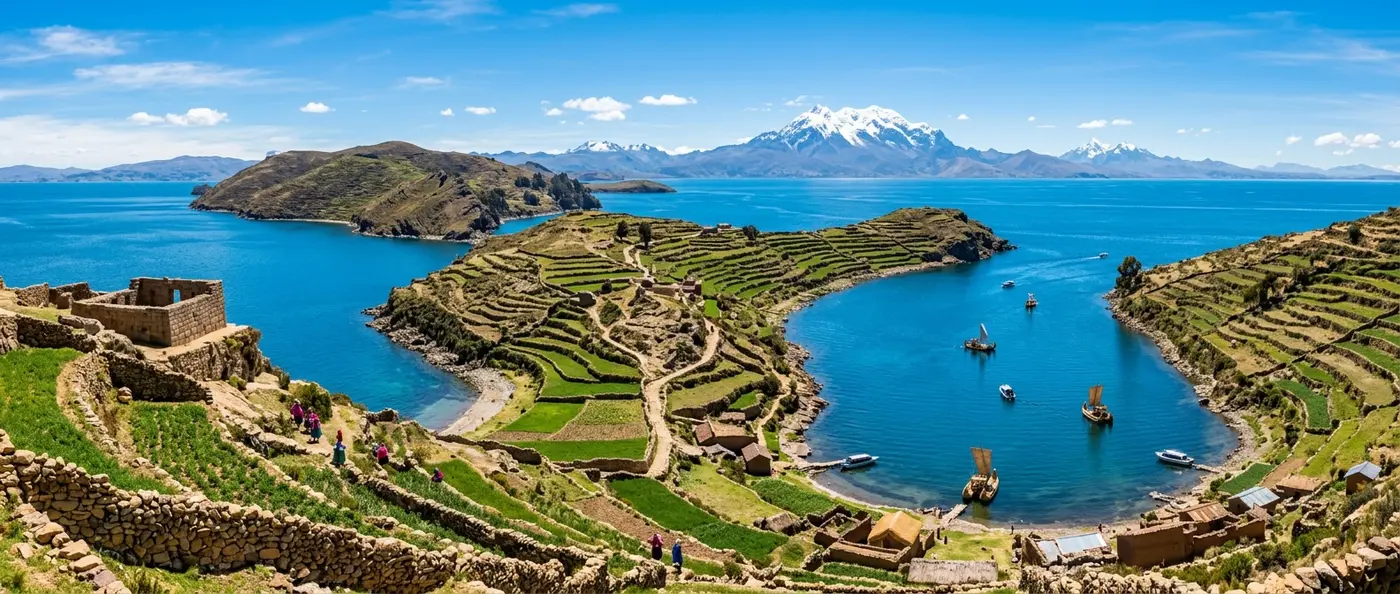
At 12,500 feet above sea level, where the air cuts your lungs and the sky bleeds into crystalline water, sits South America's largest lake. Lake Titicaca spans 3,200 square miles of impossible blue. But for the Inca, this wasn't just water. This was where their world began.
📖 Read more: Stonehenge: The Mysterious Stone Circle
🌊 The Lake of Gods at 12,500 Feet
Lake Titicaca straddles the Peru-Bolivia border at 12,507 feet elevation, making it the world's highest navigable lake. At 3,200 square miles, it dwarfs every other lake in South America. The deepest point plunges 922 feet down, while the average depth hovers around 351 feet.
Tectonic forces millions of years ago thrust the Andean plateau skyward, creating this massive basin. More than 25 rivers and glacial streams feed the lake, with the Ramis River contributing the largest flow. The water clarity reaches 50 feet visibility in some areas — a transparency that seems impossible at this altitude.
The climate around Titicaca is harsh and dry, with average annual temperatures around 46°F. Despite the extreme altitude and cold, the lake rarely freezes. Its massive size creates a thermal mass that moderates the brutal mountain weather.
🗿 Isla del Sol: The Mythical Birthplace
Titicaca's largest island, Isla del Sol (Island of the Sun), occupies the center of Inca creation mythology. According to their tradition, Manco Capac and Mama Ocllo — the first Incas sent by the sun god Inti — emerged from these waters to found their civilization.
Archaeological evidence shows human habitation dating to the 3rd millennium BC. The Inca transformed the island into a sacred pilgrimage site, constructing temples and ceremonial centers. The Pilkukayna temple, built in the 15th century, stands as one of their most impressive architectural achievements.
Today, about 800 indigenous Aymara and Quechua people inhabit the island, maintaining traditional practices unchanged for centuries. No cars exist here. No paved roads. Residents survive through farming, fishing, and tourism, cultivating potatoes, quinoa, and barley on terraces carved centuries ago.
📖 Read more: Toxic Red Mineral Found in Ukrainian Scythian Tombs
⛩️ Sacred Pathways and Ancient Temples
Stone pathways crisscross the island, connecting sacred sites in a network that predates the Inca. The main route, called "Willka Thaki" (Sacred Road), runs from the northern tip to the southern end, passing through the most significant archaeological zones.
At the northern section sits Chinkana, a labyrinthine complex believed to be a priest training center. The name means "place where one gets lost" in Quechua — visitors can easily disappear into its stone corridors.
The Sacred Rock (Roca Sagrada) near Chinkana marks the exact spot where the first Incas supposedly emerged. Pilgrims from across the empire brought offerings to place at this holy site, creating deposits of gold and silver that archaeologists still uncover today.
Pilkukayna Temple
Two-story 15th-century building with 14 rooms that housed high-ranking pilgrims during sacred ceremonies.
Sacred Springs
Three stone fountains believed to grant eternal youth, knowledge, and love to those who drink from them.
Sun Altar
Ceremonial platform where sacrifices and solar observations took place during solstices.
🏺 Daily Life on the Sacred Islands
During Inca rule, Titicaca's islands weren't just worship sites but centers of economic and social activity. Residents developed sophisticated terrace farming systems that exploited the microclimate at each elevation level.
Fishing provided crucial protein. Fishermen used boats made from totora reeds — a technique still practiced today. The lake's native trucha (trout) became a dietary staple that continues to define local cuisine.
The Inca established a courier system (chasquis) connecting the islands to the mainland. Messages and goods could reach from Cusco to Titicaca in under three days, despite the 250-mile distance across brutal mountain terrain.
📖 Read more: Viking Chieftain's Tomb Reveals 1,000-Year-Old Secrets
💡 The Mystery of Underwater Temples
In 2000, international diving teams discovered submerged structures 100 feet underwater near Isla del Sol. Stone walls, staircases, and platforms suggest an ancient temple complex that sank centuries ago, possibly due to seismic activity.
🌅 Rituals and Pilgrimages
Pilgrimage to Isla del Sol ranked among the most sacred journeys in the Inca Empire. Pilgrims underwent purification rituals and fasting before being allowed to step on holy ground.
During the winter solstice (Inti Raymi), thousands gathered on the island to witness the sun's rebirth ceremonies. Priests performed llama sacrifices and offered gold and silver objects to the lake.
A unique ritual involved selecting "virgins of the sun" (acllas). Young girls from across the empire were chosen to serve in the island's temples, weaving sacred textiles and preparing ceremonial drinks.
🗺️ Other Sacred Islands of Titicaca
Beyond Isla del Sol, the lake hosts more than 30 islands, many with religious significance. Isla de la Luna (Island of the Moon), also called Koati, sits 5 miles from Isla del Sol and was dedicated to the goddess Mama Killa.
This island housed the "Iñak Uyu" (Temple of the Virgins), where selected women trained in sacred arts. The temple ruins survive today, showing characteristic trapezoidal walls and niches for idol placement.
The floating islands of the Uros people, though artificial, represent a unique phenomenon. Built entirely from totora reeds, these islands were originally created as refuges from the Inca and other invaders. Today, about 1,200 Uros live on 60 floating islands, maintaining a lifestyle dating to pre-Inca times.
📖 Read more: Viking Gold Coin Reveals Great Heathen Army Warrior
⚖️ Major Sacred Islands
🔬 Modern Archaeological Discoveries
Research at Lake Titicaca continues revealing new insights about ancient civilizations. In 2013, Belgian and Bolivian archaeologists discovered over 2,000 artifacts on the lake floor, including gold and silver ceremonial objects.
Among the finds were gold masks, ceramic puma and llama figures, and animal bones from sacrifices. The objects date from 500 to 1500 AD, showing the lake was sacred long before the Inca rise to power.
Modern technology like underwater robots and side-scan sonar has revealed entire submerged structures. Some researchers believe these constructions belong to the Tiwanaku civilization, which flourished in the region from 300 to 1000 AD.
🌿 The Legacy Lives On
Five centuries after Spanish conquistadors destroyed the Inca Empire, Titicaca's sacred islands still draw pilgrims. Each year, thousands of indigenous Aymara and Quechua people make pilgrimages, blending pre-Columbian traditions with Christian elements.
The Copacabana Virgin festival in August draws pilgrims from Peru and Bolivia. Many cross the lake in traditional reed boats, following the same routes their ancestors used.
Local communities have taken active roles in preserving and protecting archaeological sites. Sustainable tourism programs allow visitors to experience the cultural heritage without destroying it, ensuring the sacred islands will continue inspiring awe for future generations.