📖 Read more: Minoan Civilization: Crete Before the Greeks
🌋 The Bronze Age's Most Catastrophic Eruption
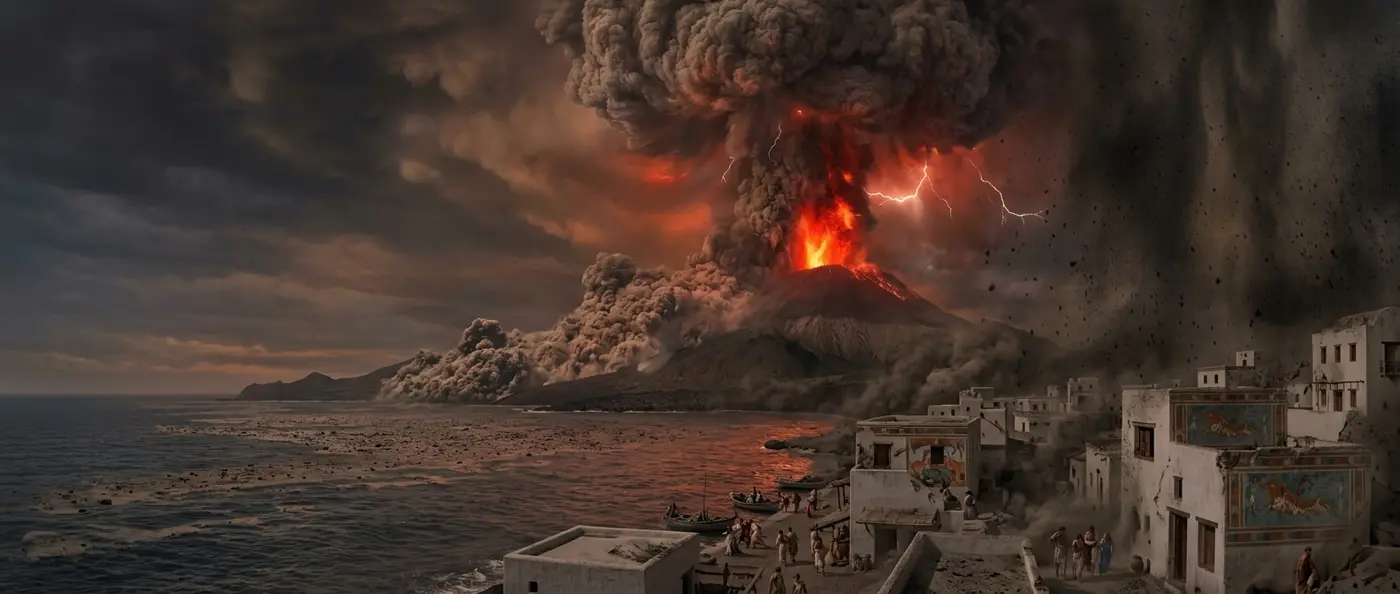
The Thera eruption, as the island was known in antiquity, ranks among the most destructive volcanic explosions in recorded human history. According to Britannica, the volcano that had remained dormant for an extended period awakened violently approximately 70 miles north of Crete.
The eruption's dating remains a subject of scientific debate. While traditionally placed around 1500 BCE, newer research from Greenland ice cores and dendrochronological analyses suggests it may have occurred earlier, possibly during the 1620s BCE.
The blast shattered civilization across the region. Earthquakes, likely concurrent with the eruption, destroyed Knossos and caused severe damage to other settlements in northern Crete. Ash and pumice from the explosion have been found in locations as distant as Egypt and Israel.
🏛️ The Connection to Minoan Civilization
The Thera eruption played a decisive role in the decline of Minoan civilization, one of the Bronze Age's most sophisticated cultures. The Minoans, centered on Crete, had developed an extensive maritime and trading network that spanned the entire Eastern Mediterranean.
The destruction wasn't merely immediate. Beyond the earthquakes that devastated major palatial centers, the eruption triggered tsunamis that swept the northern coasts of Crete. Harbors were destroyed, fleets were lost, and the economy based on maritime trade collapsed.
Even more significant was the long-term impact. Ash that covered vast areas of arable land destroyed crops for years. Climate change caused by volcanic gases led to cooler temperatures and reduced rainfall, worsening the food crisis.
📖 Read more: Linear A: Crete's 4,000-Year-Old Script Defies Decoding
🗿 Myths and Legends Born from Catastrophe
The catastrophic Thera eruption has been linked to two of humanity's most famous myths. The first is the legend of Atlantis, the mythical island civilization described by Plato that was lost to the sea in a single day and night.
The parallels run deep. An advanced island society with a powerful navy and extensive trading network is suddenly destroyed by a natural disaster and partially submerged beneath the sea. Today's form of Santorini, with its caldera filled with seawater, strongly resembles Plato's description.
The second myth connects to biblical references in the Book of Exodus. According to some researchers, the ten plagues of Egypt could be interpreted as effects of the volcanic eruption. Ash that reached Egypt could have caused darkness, while tsunamis and climate changes would explain other plagues.
💡 Did You Know?
The Thera eruption was so powerful it changed the island's morphology. What was once a single island transformed into today's island complex surrounding a massive caldera filled with seawater.
⚔️ The 726 CE Eruption: An Unexpected Discovery
For thousands of years, scientists believed that after the great Minoan eruption, Santorini's volcano had entered a period of relative calm. Recent research, however, revealed a startling discovery.
In the summer of 726 CE, according to historical sources cited by Live Science, the sea within Santorini's caldera began to boil. Dense smoke rose from the waters, followed by pyroclastic explosions. Massive volumes of pumice were ejected in such quantities that they covered the sea across a vast area.
Remarkably, pieces of pumice reached the shores of Macedonia and Asia Minor, over 400 kilometers away. Recent drilling revealed that the eruption ejected 3.1 cubic kilometers of material—roughly equivalent to one million Olympic swimming pools.
📖 Read more: Dog Teeth Baby Carriers: 5,000-Year-Old German Burials
Pyroclastic Flows
Hot gases and ash moving at speeds exceeding 60 mph destroyed everything in their path.
Boiling Sea
The sea in the caldera literally boiled from the heat of magma rising from the depths.
Pumice Everywhere
Tons of pumice covered the sea and reached shores 400+ kilometers away.
🔬 Modern Concerns and Monitoring
Santorini's volcano remains active and under close scientific monitoring. Between 2011 and 2012, satellite data recorded magma movements beneath the volcano, causing concern in the scientific community.
More recently, in January 2025, a swarm of small earthquakes in the northern part of the caldera led to an emergency meeting at the Ministry of Climate Crisis and Civil Protection. Aristotle University of Thessaloniki recorded at least 39 small earthquakes, most below 3.5 on the Richter scale.
Nevertheless, scientists remain reassuring. Seismologist Efthymios Lekkas emphasized that Santorini's volcano produces very large eruptions every 20,000 years. With 3,000 years having passed since the last major eruption, there's still plenty of time before we face a similar catastrophe.
📖 Read more: Knossos: Did the Minotaur's Labyrinth Really Exist?
🏺 The Legacy of Destruction
The Thera eruption left an indelible mark on Aegean history. Beyond immediate destruction, it forever changed the region's cultural landscape. The Minoans, weakened by the catastrophe, never fully recovered.
This opened the way for the rise of the Mycenaeans, who eventually dominated the Aegean. This change marked a new era in Greek prehistory that would ultimately lead to classical Greek civilization.
Today, Santorini is one of the world's most popular tourist destinations. Millions of visitors come annually to admire the caldera, perhaps without realizing they stand on the rim of one of human history's most destructive volcanoes. The white houses hanging on the cliffs are built upon the ruins of a world lost forever.
🌋 Santorini Eruption Comparison
📜 Lessons from the Past
Thera's story teaches us much about humanity's relationship with nature. An entire civilization at the height of its power can vanish within hours from a natural disaster. The Minoans had no way to predict or prevent the destruction.
Today, with modern technology, we can monitor volcanic activity and warn of impending eruptions. Yet nature's power remains unconquerable. The discovery of the 726 CE eruption reminds us that volcanoes can surprise us even when we believe they're in dormant periods.
As Santorini continues to attract millions of tourists annually, the volcano beneath the caldera remains active. Scientists monitor its every movement, knowing that someday in the future it will awaken again. The question isn't if, but when.