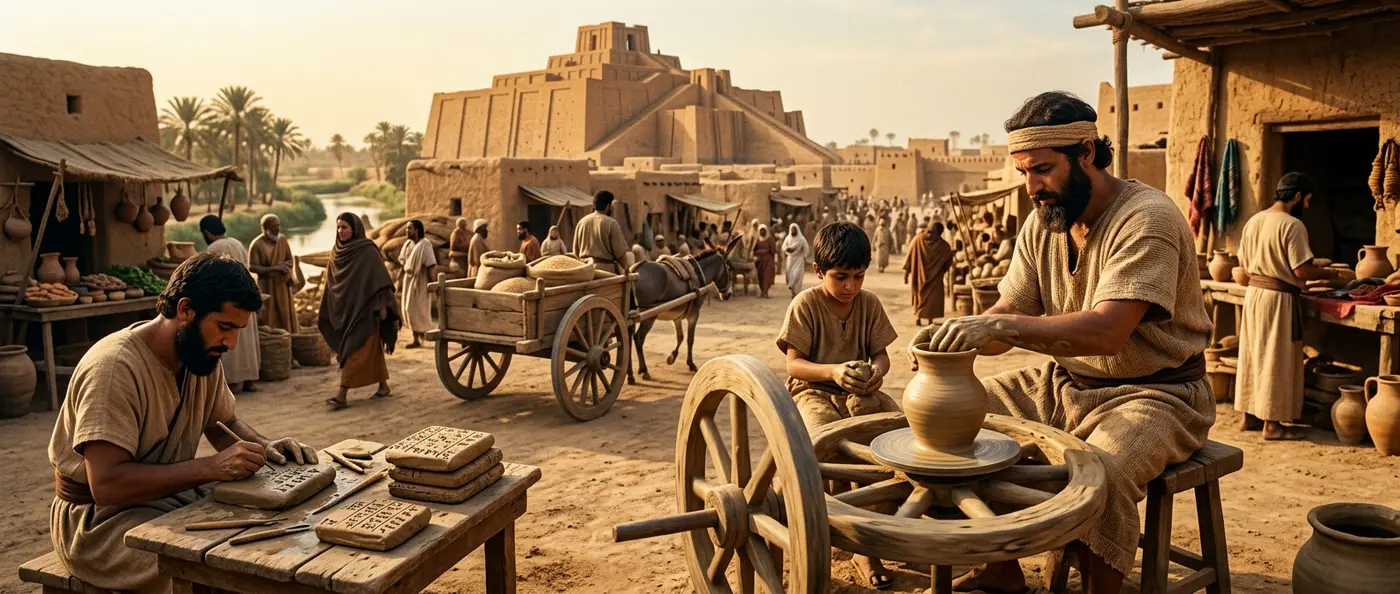
In the muddy banks of the Tigris and Euphrates, 6,000 years ago, the Sumerians invented writing, the wheel, and the first laws. The Sumerians didn't just invent the wheel — they built the foundation of our modern world, from writing and laws to mathematics and astronomy.
📖 Read more: Naram-Sin's Curse: How Hubris Destroyed the First Empire
🏛️ Birth of the First Civilization
Mesopotamia — the land between rivers — became the cradle of history's first organized civilization. Archaeological evidence shows the transition from nomadic life to permanent settlement began around 10,000 BC, with the Sumerians emerging as a distinct culture around 4,000 BC.
This wasn't an overnight transformation. Thousands of years passed as humans moved from seasonal migration to permanent settlement, from plant experimentation to systematic cultivation of grains and legumes. The Sumerians inherited these practices and perfected them, creating the first true city-states.
Early settlements at the edges of Mesopotamia include Zawi Chemi Shanidar and Shanidar, northwest of Rawāndūz. Dating from the transition between the 10th and 9th millennia BC, these pre-ceramic sites yielded primitive grain mills, remains of huts about 4 meters in diameter, and cemeteries with grave goods.
⚙️ The Revolutionary Invention of the Wheel
Sumerians first rolled heavy objects on tree trunk cylinders. Around 3500 BC, someone cut discs from these trunks and connected them with an axle.
Early wheels were solid, made from three pieces of wood joined together. Heavy and clunky, but they revolutionized transport. Soon, Sumerians improved the design, creating spoked wheels that were lighter and more durable.
The wheel's application went beyond transport. Sumerians used it in pottery wheels, enabling mass production of uniform vessels. Pottery production soared, transforming ceramic art and trade.
📜 The Writing That Changed the World
Sumerian cuneiform, developed around 3200 BC, was history's first writing system. It began as simple pictographs for recording goods and transactions, but evolved into a complex system capable of expressing abstract concepts and emotions.
Scribes used reed styluses to carve symbols into clay tablets. The stylus tip's shape created the characteristic wedge marks that gave cuneiform its name. Thousands of these tablets have been discovered, revealing details about every aspect of Sumerian life.
Commercial Records
Contracts, receipts, and ledgers show they had banks and credit systems.
Literary Works
The Epic of Gilgamesh, the first known literary narrative, was written in cuneiform script.
Legal Texts
Laws and court decisions that laid foundations for the later Code of Hammurabi.
🏰 The City-States of Sumer
Sumerians organized into independent city-states, each with its own king, patron god, and army. The most important were Uruk, Ur, Lagash, Eridu, and Kish. Each city was surrounded by walls and centered around a magnificent temple-ziggurat.
Uruk, the era's largest city, covered 6 square kilometers and housed over 50,000 people. It was the center of goddess Inanna's worship and featured two monumental sacred complexes. Here archaeologists found the oldest clay tablets with cuneiform writing.
Ur became famous for its royal tombs, dating around 2600-2400 BC. Excavations revealed gold jewelry, musical instruments, and elaborate artworks. The most striking discovery was tombs with human sacrifices — dozens of servants who followed their masters into death.
💡 The Mystery of the Ziggurats
The Sumerians' pyramid-shaped temples, ziggurats, weren't just religious centers. They functioned as astronomical observatories, administrative centers, and storage facilities. Ur's ziggurat, 21 meters tall, had three levels and 100 steps leading to the top, where the god was believed to meet with priests.
🔬 Sumerian Science and Technology
Sumerians laid foundations for many sciences. They developed a mathematical system based on the number 60, which we still use today for measuring time and angles. An hour has 60 minutes and a circle has 360 degrees thanks to the Sumerians.
In astronomy, they recorded planetary movements and created the first lunar calendar. They distinguished planets from stars and named them after gods. They tracked planetary movements precisely enough to predict eclipses.
Clay tablets describe surgical procedures, drug recipes, and diagnostic methods. They knew the properties of hundreds of plants and minerals, and had specialized doctors for various conditions.
⚖️ Laws and Social Organization
Sumerians created history's first written laws. The Code of Ur-Nammu, dating around 2100 BC, predates the famous Code of Hammurabi by three centuries. It contained laws for trade, property, marriage, and crime.
Society was strictly hierarchical. At the top were the king and priests, followed by nobles and merchants, then craftsmen and farmers, with slaves at the bottom. However, social mobility existed — a successful merchant could rise in status.
Women in Sumerian society had more rights than in later civilizations. They could own property, conduct business, sign contracts, and request divorce. There were female priests, scribes, and even one female ruler, Kubaba of Kish.
⚔️ Sumerians vs Later Civilizations
🌾 Agriculture and Economy
Sumerian success was built on conquering water. They developed a complex system of canals, dams, and reservoirs that transformed dry plains into fertile fields. Irrigation enabled food surplus production, which in turn allowed occupational specialization.
They cultivated barley, wheat, lentils, onions, garlic, leeks, and dates. Barley beer was the staple drink — so important that workers were partly paid in beer. They raised sheep, goats, cattle, and pigs. Fishing in rivers and marshes provided additional protein.
Trade was vital. Mesopotamia lacked stone, timber, or metals. Sumerians sent caravans and ships to distant regions: cedar from Lebanon, copper from Cyprus, gold from Egypt, lapis lazuli from Afghanistan. They developed standardized weights and measures to facilitate trade.
🎭 Art and Culture
Sumerian art was deeply religious yet realistic. Statues depicted gods, kings, and worshippers with large, expressive eyes. Murals and reliefs told stories of wars, religious ceremonies, and daily life with stunning detail.
Music held a central place. Archaeologists have discovered lyres, harps, drums, and flutes. The Lyre of Ur, decorated with gold and lapis lazuli, is one of ancient art's masterpieces. Musical scores on clay tablets show they had developed a system of musical notation.
Their literature included epic poems, hymns, proverbs, and myths. The Epic of Gilgamesh, the story of a king seeking immortality, remains one of history's greatest literary works. It influenced later narratives, including biblical stories like Noah's flood.
🌅 Decline and Legacy
Around 2000 BC, Sumerian dominance ended. Continuous wars between city-states weakened them. The Akkadians under Sargon conquered Sumer, followed by Babylonians and Assyrians. But these conquerors adopted and preserved Sumerian civilization.
The Sumerian language continued as a sacred and scientific language for another 2000 years, like Latin in medieval Europe. Their achievements in writing, mathematics, astronomy, and law became foundations for all subsequent Mesopotamian civilizations and beyond.
Today, as archaeologists continue discovering and deciphering clay tablets, we learn more about this remarkable civilization. Each new discovery confirms that Sumerians weren't just first — they were true pioneers who laid the groundwork for the world we live in today.