📖 Read more: Egyptian Astronomy: Gods Hidden Among the Stars
🏺 The Kingdom of Kush: From Nubia to Supremacy
The Kingdom of Kush emerged from ancient Nubia, a region stretching from Egypt's Aswan to modern-day Khartoum. Around 1500 BCE, as Egypt's Middle Kingdom declined, the Nubians had already developed a powerful civilization with distinct material culture and traditions.
Napata became the capital of a kingdom that thrived on trade and natural resources. The Nubians controlled gold and ivory routes, accumulating wealth that allowed them to develop a sophisticated civilization. In 730 BCE, King Piye successfully invaded Egypt, inaugurating the era of the Black Pharaohs.
The 25th Dynasty lasted nearly a century (770-656 BCE), with Nubian pharaohs adopting Egyptian customs while maintaining their own identity. Piye was the first pharaoh buried in a pyramid after 500 years, starting a tradition that would leave its mark on Sudan's desert.
🗿 Meroe: The City of 200 Pyramids
After defeat by the Assyrians and loss of power in Egypt, the Nubians retreated south. When Pharaoh Psamtik II sacked Napata in the early 6th century BCE, the Kushites moved their capital to Meroe. The choice wasn't random.
Meroe sat at the crossroads of African interior trade routes and Red Sea caravans. The land was fertile and rich in natural resources — particularly gold and iron. These resources fueled the development of a thriving metals industry.
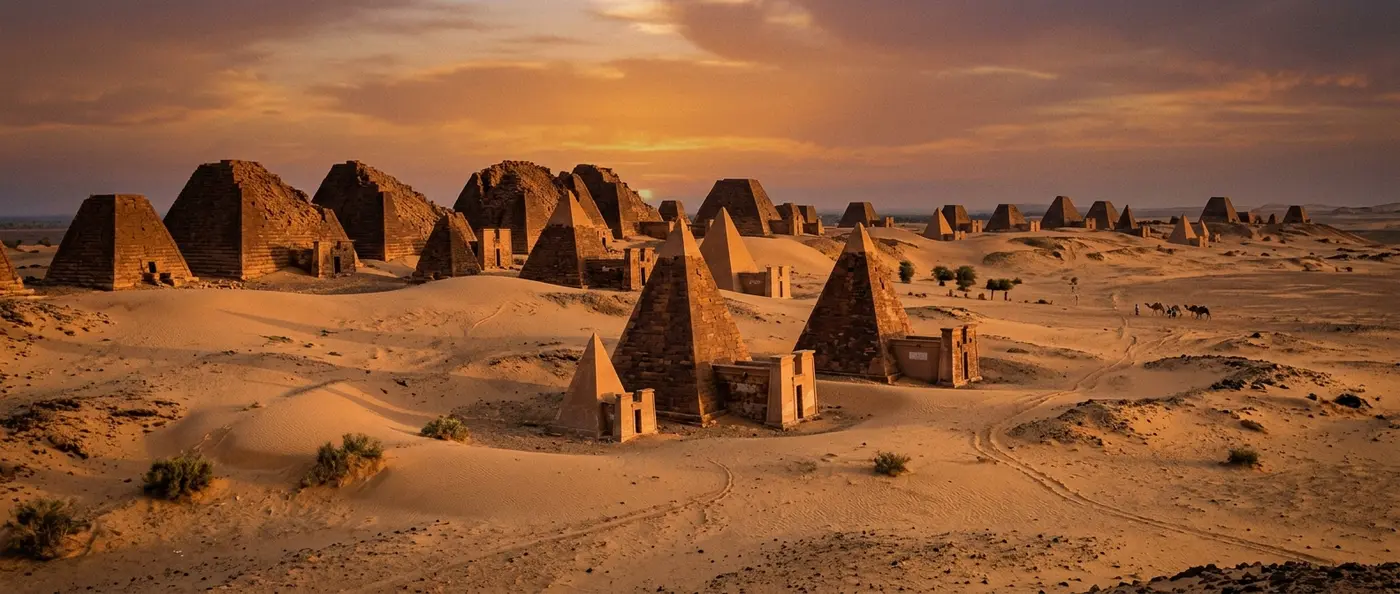
Around 250 BCE, Meroe became the preferred burial ground for Kushite kings. Two main burial areas developed: the southern cemetery, the older one, and the northern necropolis containing the best-preserved pyramids. The northern necropolis holds 41 tombs, with 38 belonging to monarchs who ruled between 250 BCE and 320 CE.
⚔️ The Mighty Queens of Meroe
Meroitic culture stood out for its powerful queens. Greek historian Strabo wrote about a queen called "Candace" who signed a peace treaty with Emperor Augustus. "Candace" actually means "sister" and was the title given to Kushite queens.
Amanirenas, the "Candace" Strabo referenced, led the resistance against Rome. Her successor, Amanishakheto, became famous for her treasures that were looted in 1834. Recently, archaeologists have been studying the tomb of another queen, Khennuwa, excavated by George Reisner in 1922.
Royal Women
Meroe's queens ruled with absolute power, commanded armies, and negotiated with emperors. The title "Candace" became synonymous with strength.
Warriors
Amanirenas lost one eye in battle against the Romans but continued leading. The Romans called her "the one-eyed queen" with awe.
Treasures
Royal tombs contained stunning jewelry of gold, silver, and precious stones, proving the wealth and craftsmanship of the Kushites.
🏛️ The Architecture of Nubian Pyramids
Meroe's pyramids differ significantly from Egyptian ones. They're smaller, ranging from 6 to 30 meters tall, with steeper sides angled at about 70 degrees. Unlike Egyptian pyramids, burial chambers lie beneath the structures, not inside them.
The earliest Meroitic pyramids were stepped. Scholars theorize that cylinders or spheres may have once crowned their peaks, made from materials that have since deteriorated. Later constructions from the 3rd century CE are simpler with smooth, steep sides.
Each pyramid had a small chapel attached to its eastern side. The entrance was formed by twin pylons that narrowed upward. Inside sat a stela, an offering table, and a distinctive element of Meroitic culture: a statue of the "ba" — the aspect of the human soul they believed gave the deceased their individuality — depicted as a bird's body with a human head.
🏺 Pyramid Comparison: Egypt vs Nubia
💎 The Treasures and Art of Kush
Royal tomb finds reveal the Meroites as skilled goldsmiths. Gold rings with Egyptian influences depict the Eye of Horus flanked by cobras. Intricate jewelry, weapons with golden details, and ceremonial objects testify to high craftsmanship.
Underground burial chamber walls were decorated with murals in ochre and yellow. A striking scene in King Tanwetamani's tomb (died around 653 BCE) shows his heart being weighed against a feather from the goddess Maat, goddess of truth — a test that determined if the king's soul could pass into paradise.
Kushite burial culture was a synthesis of Egyptian and African religious practices. Wooden coffins depicting the deceased's face were placed in burial chambers. Nearby lay sacrificed animals and, in some cases, human servants.
🔱 Decline and Legacy
The Kingdom of Kush prospered for centuries, but Cleopatra's death in 30 BCE brought changes. Egypt became a Roman province, straining the fragile truce the Kushites had negotiated with Rome. Tax revolts in Upper Egypt led to Roman invasions of Kushite territory.
Despite pressures, Meroe continued to flourish until the 4th century CE. Final collapse came around 400 CE, likely due to a combination of factors: climate change, overexploitation of natural resources, and raids from neighboring peoples.
🗺️ Meroe Today
In 2011, Meroe's archaeological sites were declared a UNESCO World Heritage Monument. Despite their significance, they remain relatively unknown to the general public. Sudan's civil wars and political instability have prevented tourist development, leaving these treasures almost untouched by mass tourism.
📜 The Mystery of Meroitic Writing
One of the greatest mysteries of Meroitic civilization remains their writing system. The Meroites developed their own alphabet around the 2nd century BCE, consisting of 23 symbols. Although scholars can read the characters, the language remains largely untranslated.
Thousands of inscriptions have been found on stelae, temple walls, and tombs, but without a Rosetta Stone for Meroitic, their content remains unknown. Without translation, much of Kushite history, religion, and daily life stays hidden.
Modern archaeological research continues to reveal new evidence. Swiss archaeologist Charles Bonnet spent decades excavating in the region. His work revealed a civilization that grew rich from trade, with fertile fields and livestock — a kingdom separate from Egypt with its own traditions.