📖 Read more: Oracle Bones: Ancient China's Divine Messages Decoded
🗿 The Construction Enigma
Stonehenge didn't appear overnight. What tourists see today is the culmination of over 1,000 years of continuous construction, starting around 3100 BCE with a simple circular earthwork and ditch surrounded by burial mounds. The monument we recognize began taking shape much later.
Professor Mike Parker Pearson from University College London has traced the monument's evolution through multiple phases. Around 2600 BCE, builders replaced a complex wooden post system with 80 blue dolerite stones from Wales. These weren't randomly placed — they were rearranged at least three times before the builders got it right.
The most dramatic transformation came centuries later with the arrival of the colossal sarsen stones. Each of these sandstone giants weighs roughly 25 tons and traveled 30 kilometers from the Marlborough Downs to create the outer circle and the heel stone beyond it. Moving them required engineering solutions that still impress today.
🏔️ The Welsh Quarry Mystery
In 2015, the mystery deepened. British archaeologists pinpointed the exact quarries in the Preseli Hills of northern Pembrokeshire, Wales, where Stonehenge's famous bluestones originated. These quarries sit 290 kilometers from Stonehenge — a staggering distance for prehistoric transport.
The excavations revealed extensive prehistoric industrial sites: loading platforms, access ramps, staging areas. Wedge marks still scar the rock faces where Neolithic quarrymen split the stone. Their technique was ingenious — they inserted wooden wedges into natural cracks between stone pillars and let Welsh rain swell the wood, gradually prying the stones free from the bedrock.
The most startling discovery was the timing. Radiocarbon dating of charred hazelnuts and charcoal from ancient hearths shows quarrying activity between 5,400 and 5,200 years ago. The stones were extracted roughly 500 years before they were erected at Stonehenge. Where were they for five centuries?
📖 Read more: Silk Road: How Ancient Trade Connected China to Rome
⚔️ The Epic Transport
Moving two-ton stones across nearly 300 kilometers defied every assumption about prehistoric capabilities. The narrow exit path from the quarries — just 1.8 meters wide — rules out wooden rollers. Archaeologists believe the builders used a combination of ropes, levers, and wooden sledges.
Evidence from India shows stones of this size can be transported on wooden lattice frames by teams of just 60 people. At Stonehenge, the operation required two crews — one at the top holding the weight with ropes, another below receiving the stones. The precision required suggests generations of accumulated expertise.
💎 The Altar Stone Revelation
Recent chemical analysis revealed that the largest non-sarsen stone, the Altar Stone, originated in Scotland — 750 kilometers away! The find forces archaeologists to imagine trade routes stretching the length of Britain — a network more sophisticated than anyone suspected.
🌅 Celestial Alignment
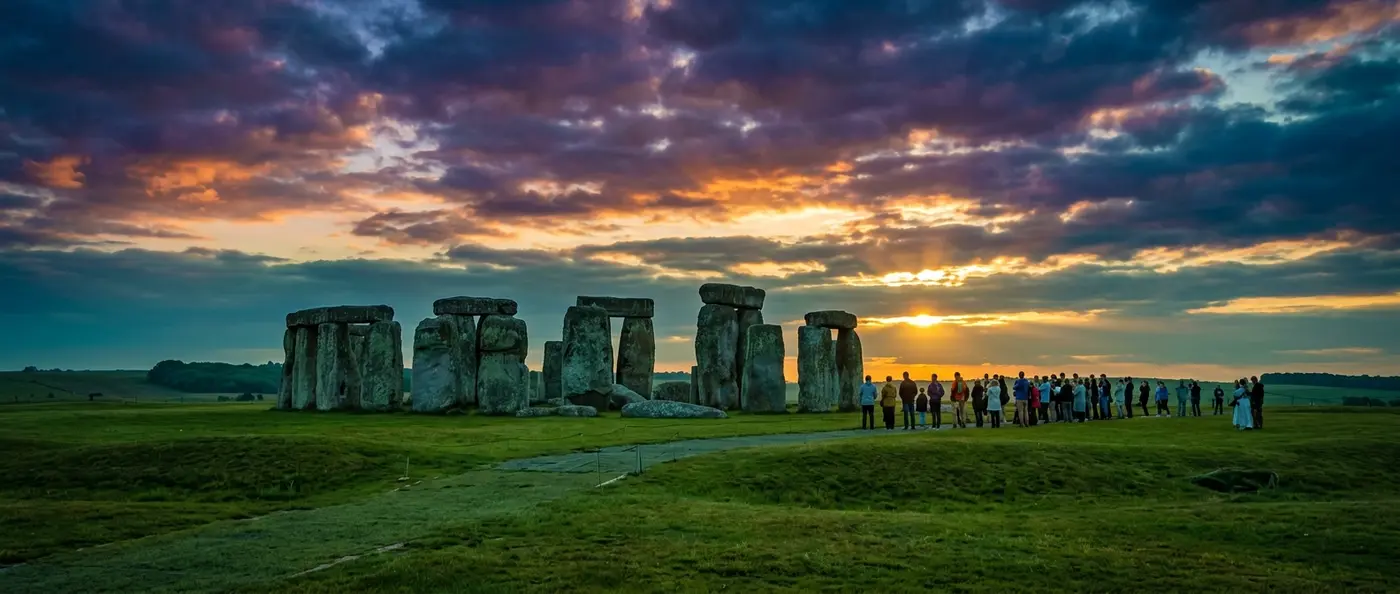
Between 2470 and 2280 BCE, Stonehenge's builders created a ceremonial avenue nearly 3 kilometers long connecting the monument to the River Avon. The first 500 meters of this avenue align perfectly with the summer solstice sunrise and winter solstice sunset.
Excavations in 2008 revealed something extraordinary. The avenue was built over pre-existing natural chalk ridges that coincidentally shared the same alignment with the solstices. This discovery suggests the site may have been chosen precisely because of this natural property — the landscape itself dictated Stonehenge's orientation.
Summer Solstice
The sunrise on June 21st aligns perfectly with the avenue and heel stone, creating a dramatic spectacle that draws over 30,000 visitors annually to witness this 4,600-year-old astronomical theater.
Winter Solstice
The sunset on December 21st passes precisely through the center of the trilithons, suggesting the monument functioned as a seasonal calendar for agricultural communities.
📖 Read more: Stolen Roman Mosaic Returns Home After Decades
🔱 Theories of Purpose
Modern archaeology splits into two main camps. One sees Stonehenge as a sacred worship site. The other views it as an astronomical observatory. Both theories rest on the monument's celestial alignments, but they interpret the evidence differently.
Tim Darvill from Bournemouth University proposes a more radical theory. He argues Stonehenge functioned as "prehistoric Lourdes" — a healing center. His theory hinges on the bluestones, which must have been considered magical to justify their transport from such distances. Excavations in 2008 strengthened this hypothesis when archaeologists found Bronze Age skeletons showing signs of bone deformities.
Mike Parker Pearson offers a different interpretation. He sees Stonehenge as an ancestor worship center, connected to a corresponding wooden circle at nearby Durrington Walls. The two circles, with their temporary and permanent constructions, represented the worlds of the living and the dead respectively.
🏺 New Discoveries in Cornwall
Recent discoveries at Tregunnel Hill in Cornwall shed new light on Neolithic Britain. Charred hazelnut shells found in prehistoric pits date between 3985 and 3793 BCE, pushing back the start of the Neolithic period in the region by at least a century.
The excavations revealed a rich archaeological landscape with evidence of human activity spanning 10,000 years. One particularly large pit contained an organized sequence of deposits: ash rich in charcoal, broken Carinated Bowl pottery, flint tools, animal bones, and beach pebbles — suggesting ritual deposition rather than casual refuse.
📊 Timeline Comparison
📖 Read more: Titicaca's Sacred Islands: Where the Inca Empire Began
🗺️ The Broader Ritual Landscape
Stonehenge wasn't an isolated monument. It formed part of an extensive sacred landscape including dozens of other structures. Geophysical surveys in 2009 and 2010 revealed two additional circles of pits — one at Airman's Corner and another northwest of the main monument.
At Durrington Walls, just 3 kilometers away, a massive settlement housed the thousands of workers who built Stonehenge. Archaeologists found remains of hundreds of houses and evidence of large feasts featuring pork consumption on an industrial scale.
The connection between Stonehenge and Durrington Walls via the River Avon created a symbolic landscape. Durrington, with its wooden structures, represented life and the temporary. Stonehenge, with its stone constructions, symbolized death and the eternal. Pilgrims likely traveled between the two sites as part of elaborate ceremonies.
🔬 Modern Research and Protection
Today Stonehenge is a UNESCO World Heritage Site attracting over one million visitors annually. In 2013, a new visitor center opened 2.5 kilometers from the stones, designed by Australian firm Denton Corker Marshall to minimize visual impact on the ancient landscape.
Research continues with cutting-edge methods. The Stonehenge Riverside Project, funded partly by the National Geographic Society, has delivered revolutionary discoveries. Geophysical surveys and DNA analysis keep turning up surprises in the chalk downs around Salisbury Plain.
Every year at the summer solstice, thousands gather to watch the sunrise through the ancient stones. Despite centuries of research, Stonehenge maintains its mysterious allure, reminding us that our prehistoric ancestors achieved extraordinary feats we still struggle to fully comprehend. The monument stands not just as stone and earth, but as testament to human ambition reaching across millennia — a 4,600-year-old question mark carved into the English countryside.