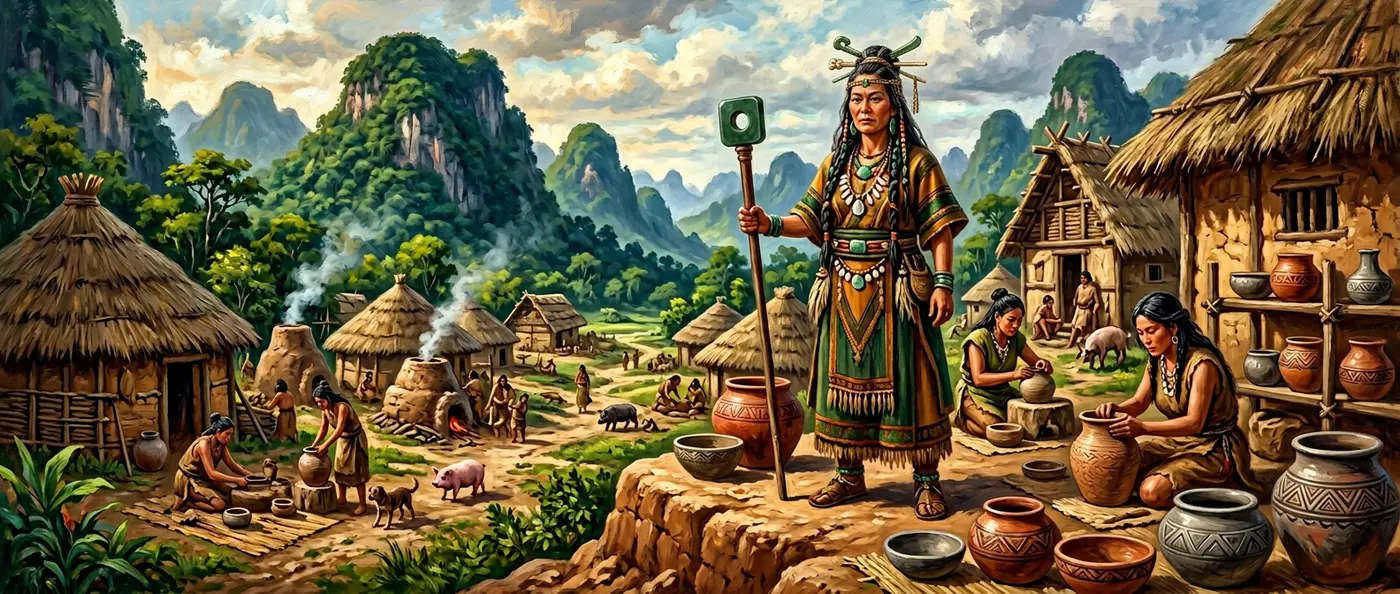
🧬 DNA Breaks the Silence of Millennia
The study published in Nature in June 2024 upended everything archaeologists thought they knew about prehistoric societies. At the Fujia archaeological site, researchers discovered two cemeteries containing over 500 burials dated between 2750 and 2500 BCE. But the DNA told a story that burial goods and bones alone never could.
Every single person in the northern cemetery — all 14 individuals tested — shared identical mitochondrial DNA (mtDNA), genetic material passed exclusively from mother to child. The southern cemetery revealed a different maternal lineage: 44 of 46 people carried the same mtDNA type, distinct from their northern neighbors. Two separate clans. Two maternal bloodlines. One revolutionary discovery.
The Y chromosome analysis from male skeletons revealed massive diversity, indicating fathers came from many different lineages. This pattern points to matriarchy — descent and inheritance flowing through the female line while men married into the community from elsewhere. For 10 generations, these women held the reins of power in ways that would make modern corporate boards look positively medieval.
🏺 Rarer Than Platinum
Finding matriarchal societies in the archaeological record is like spotting a unicorn. Only three other studies have used DNA analysis to identify prehistoric matriarchal communities: at Chaco Canyon in New Mexico, among Celtic elites in southern Germany, and among the Iron Age Durotriges in Britain. The Fujia discovery marks the first documented case of matriarchy in Neolithic East Asia.
The researchers discovered that teenage boys and adult men were buried exclusively with their maternal clans. This aligns with common matriarchal rules where men remain with their mother's family even after marriage. Women called the shots. Men followed the bloodline.
High rates of inbreeding persisted across 10 generations. While most people likely married second or third cousins, four individuals showed signs of mating with first cousins or closer relatives. This happens inevitably in small, closed societies — not the preferred marriage pattern, but an unavoidable consequence of isolation.
🗿 Queens of the Stone Age
Evidence for powerful women in the Stone Age stretches far beyond China. Across Europe and western Asia, archaeologists have unearthed over 200 female figurines from the Paleolithic period — the famous "Venus figurines." These tiny sculptures, dating from 35,000 to 14,000 years ago, point to the central role of women in prehistoric societies.
The oldest known figurine, the Venus of Hohle Fels from southern Germany, is roughly 35,000 years old. Standing just 7 centimeters tall, it predates the earliest cave paintings created by modern humans in Europe by 3,000 years. These figurines scatter from the Pyrenees to Siberia, their exaggerated feminine features carved by hands that clearly valued female power.
Three main regions produced these ancient artworks: western Europe (Pyrenees and southwestern France), central Europe (Rhine and Danube basins), and eastern Europe/Asia (southern Russia to Siberia). All figurines measure between 5-25 centimeters — perfectly portable for nomadic peoples who needed to carry their sacred objects across vast distances.
Geographic Spread
Female figurines span three major regions: western Europe (Pyrenees to southwestern France), central Europe (Rhine and Danube basins), and eastern Europe/Asia (southern Russia to Siberia).
Size and Portability
All figurines measure 5-25 centimeters in height, making them easily transportable for nomadic populations of the era.
Artistic Features
Most figurines depict nude female forms emphasizing breasts, hips, and belly. Faces often lack detail, suggesting generic representations rather than portraits.
⚔️ Gender Roles Were Fluid
Recent discoveries from Hungary add another dimension to our understanding of Stone Age gender roles. A study of 125 skeletons from two Neolithic cemeteries used between 5300 and 4650 BCE revealed that gender roles were more flexible than previously believed.
In one cemetery, most female skeletons lay on their left side and were buried with shell belts, while most male skeletons were found on their right side with polished stone tools. But two male and five female skeletons broke the pattern — buried in ways that didn't align with expectations.
One elderly woman stood out. She was the only person buried with polished stone tools typically associated with men. Bone analysis revealed activity patterns similar to the cemetery's male skeletons. According to researchers, this burial suggests women could assume roles traditionally linked with men.
💡 Why This Discovery Matters
The Fujia discovery marks the first proven matriarchal society in Neolithic East Asia, showing that women held leadership positions in social structures that defy our assumptions about Stone Age life.
🔬 New Tech, Ancient Secrets
Advanced DNA analysis techniques have revolutionized archaeology. In the Fujia case, scientists extracted and analyzed both mitochondrial DNA and Y chromosomes from 4,500-year-old skeletons. This allowed reconstruction of family relationships and social structures with unprecedented detail.
The technology also confirmed that Mesolithic Europeans had dark skin and light-colored eyes, overturning stereotypes about prehistoric European appearance. These genetic insights, combined with archaeological findings, create a more complete picture of Stone Age life.
Ancient DNA analysis has become archaeology's secret weapon. Where traditional methods see bones and pottery shards, genetic analysis reveals family trees, migration patterns, and social organization. The dead can finally tell their stories in their own words — or rather, their own genes.
🌍 Global Connections and Implications
The matriarchal society at Fujia demolishes the idea that patriarchy is humanity's default setting. Social structures we call "natural" are simply cultural choices that change across time and place.
Similar practices exist in contemporary matriarchal societies of Southeast Asia, suggesting these social structures may have deep historical roots in the region. The connection between ancient and modern matriarchal systems opens new research avenues for understanding human social evolution.
The Fujia women weren't anomalies. They were part of a broader human experiment with different ways of organizing society. Their success across 10 generations proves that alternative social structures can thrive for centuries.
📊 Matriarchal Discoveries Compared
🏺 The Legacy of Stone Age Women
The discoveries at Fujia and elsewhere remind us that women's history in power extends much deeper than often recognized. From tiny Paleolithic figurines to organized Neolithic matriarchal societies, women played central roles in prehistoric communities.
These discoveries prove that human societies have always experimented with different forms of organization. New genetic technologies will likely reveal even more examples of social structures that would surprise us today.
The story of women who ruled Stone Age China isn't just an archaeological curiosity. It's a reminder that human societies have experimented with many different forms of organization throughout history. Understanding this diversity can help us view our own social structures with fresh eyes and appreciate the full spectrum of human experience.
Four and a half millennia ago, while other societies were figuring out basic agriculture, the women of Fujia had created something remarkable: a stable, multi-generational power structure that lasted longer than most modern democracies. They didn't just break glass ceilings — they never built them in the first place.