📖 Read more: Battle of Thermopylae: The Real Story Behind the 300
⚔️ Birth of a Warrior: From Cradle to Boot Camp
A Spartan warrior's life began literally from the moment of birth. Newborns were examined by tribal elders who decided whether the child was healthy and strong enough to survive. This harsh practice reflected Sparta's deep belief that only the strong deserved to live and serve the state.
Until age seven, boys grew up at home, but their upbringing differed radically from other Greek cities. Their mothers trained them in hardship from early on, bathing them in cold water and letting them cry without rushing to comfort them. This was preparation for what would follow.
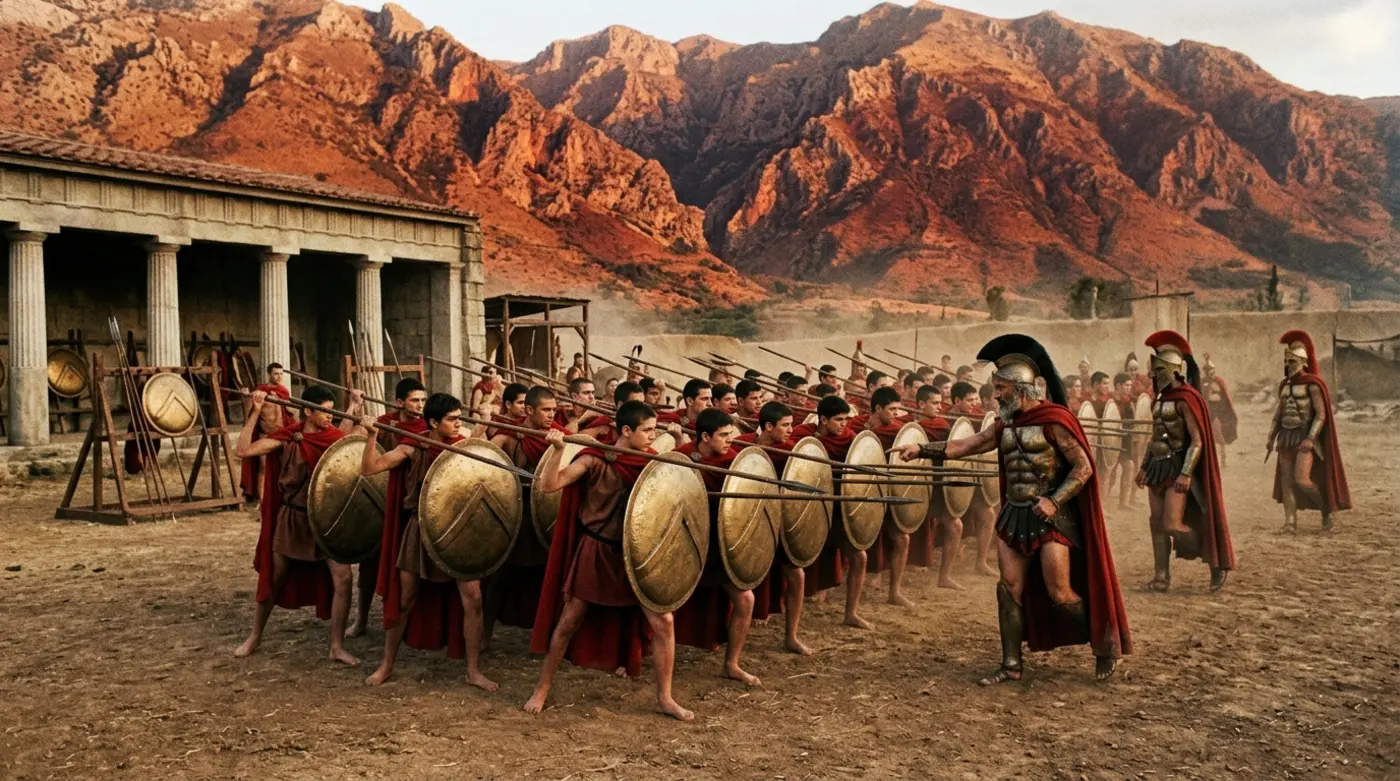
The real trial began at seven. The boy left home and joined the agela, a group of peers who would live, train, and fight together. From that moment, the state assumed responsibility for his education.
🏛️ The Agoge System: Structure and Organization
The Spartan education system, known as the "agoge," was a complex structure divided into various age groups. Each group had specific duties and objectives. Younger students learned from older ones, creating a chain of knowledge and experience passed from generation to generation.
The system was based on absolute discipline and collective identity. No child was special. All ate the same food, wore identical clothing, and slept under the same conditions. Individuality was suppressed for the collective good.
Paides (Ages 7-11)
Basic physical training, music, dance. Learning to endure hunger, cold, and pain. First contact with weapons and military formations.
Melleirenes (Ages 12-17)
Intensive military training. Participation in crypteia. Combat between groups. Wilderness survival skills and stealth operations.
Eirenes (Ages 18-19)
Preparation for army integration. Leadership of younger groups. Final endurance trials and combat readiness assessments.
Education wasn't limited to physical training. Despite popular belief, Spartans learned reading and writing, though at a basic level. Emphasis was placed on laconic expression - the ability to convey much with few words. This is where the term "laconic" originates.
📖 Read more: 10 Hidden Secrets of the Athenian Acropolis You Never Knew
💀 The Crypteia: Sparta's Dark Secret
The crypteia stands as perhaps the darkest aspect of Spartan education. Selected young men were sent into the countryside with minimal equipment, where they had to survive hidden during the day. At night, they were permitted to kill any helots they encountered.
The practice had two functions. It trained young men in the arts of ambush and survival while maintaining terror among the helots, the slaves who comprised the overwhelming majority of Sparta's population.
But the crypteia went beyond simple brutality - it marked the final transformation from boy to warrior. Those who returned successfully were considered ready for the next phase of their lives.
🗡️ Did You Know?
The word "crypteia" comes from the verb "krypto" meaning to hide. The young men who participated were called "kryptoi" and were considered sacred persons during their mission.
🍷 The Syssitia: When Meals Become Lessons
From age 20, every Spartan had to become a member of a syssitia, a group of about 15 men who ate together every evening. Membership wasn't automatic. It required unanimous acceptance from all members. A single negative vote was enough to exclude someone.
The food was deliberately simple and monotonous. The famous black broth, a type of soup made from pork blood, vinegar, and salt, was the staple dish. Foreign visitors found it repulsive, but for Spartans it symbolized their austerity and endurance.
The syssitia weren't just meals. They were schools of politics and strategy, where younger men heard the experiences of their elders. Here the bonds were forged that would keep the phalanx united on the battlefield.
⚔️ Sparta vs Athens: Educational Systems
📖 Read more: Ancient Thebes: Athens' Forgotten Rival That Ruled Greece
👩🎓 Spartan Women: Mothers of Warriors
Unlike other Greek cities, Sparta provided organized education for girls too. Female education focused on physical exercise, aimed at creating healthy mothers who would bear strong warriors.
Girls exercised naked, like boys, something that shocked other Greeks. They ran, wrestled, threw discus and javelin. Their physical condition was considered as important as that of men.
Spartan women enjoyed freedoms unthinkable for women in other cities. They could own property, move freely, and express their opinions. The famous phrase "either with your shield or on it" that they told their sons departing for war symbolized their iron will and values.
🛡️ The Phalanx: The Final Product of Education
All Spartan education culminated in one goal: creating the perfect hoplite for the phalanx. The Spartan phalanx was the most fearsome military formation of its time, a living death machine that moved and fought as one organism.
Each warrior protected not only himself but also his neighbor with his shield. This interdependence was key to success. A coward endangered not just his own life but the entire line.
Phalanx training began in childhood with group dances and coordination exercises. By age 20, the young Spartan was ready to join the ranks of hoplites. For the next 40 years, until age 60, he would remain an active soldier.
Aspis
Weight 15-20 pounds, diameter 3 feet. The lambda symbol (Λ for Lacedaemon) at center. Losing it was considered supreme shame.
Panoply
Bronze helmet, breastplate, greaves. Total weight up to 65 pounds. Designed for maximum protection in phalanx formation.
Dory
Length 8-10 feet. Iron spearhead, bronze butt-spike. The hoplite's primary weapon, designed for thrusting attacks.
📖 Read more: Battle of Salamis: How 370 Greek Ships Saved the West
📚 Beyond War: Music, Dance, and Poetry
Despite the emphasis on military training, Spartan education included artistic elements. Music was considered essential for developing the rhythm and coordination needed in battle.
Young men learned to sing paeans and marching songs. Dance, particularly the pyrrhic, was essentially military exercise with music. The movements mimicked attacks and defenses, preparing body and mind for combat.
Even poetry had its place. The verses of Tyrtaeus, which praised death for the fatherland, were memorized and sung. Every element of education served the same purpose: creating the perfect citizen-soldier.
🏆 The Legacy: Influence and Criticism
Spartan education left an indelible mark on history. For centuries, admirers and critics have debated its advantages and disadvantages. It forged warriors who terrified the ancient world, but crushed everything else that made them human.
Modern observers either worship Sparta's discipline or condemn its brutality. Sparta created a system perfectly adapted to its needs, but incapable of evolving when the world changed.
Ultimately, Spartan education collapsed from its own contradictions. The excessive emphasis on military virtue and contempt for every other activity led to demographic crisis. The Spartans became so few they could no longer maintain their system.
Today, Spartan education teaches us about the limits of human endurance and the power of collective effort. It also reminds us that every educational system reflects the values and priorities of the society that created it. In Sparta's case, these values were war, honor, and absolute submission to the state.
💭 Modern Reflection
Elements of Spartan training survive in modern military education programs. The emphasis on teamwork, endurance, and discipline remains fundamental in elite military units worldwide.