🦴 The Bone That Rewrites History
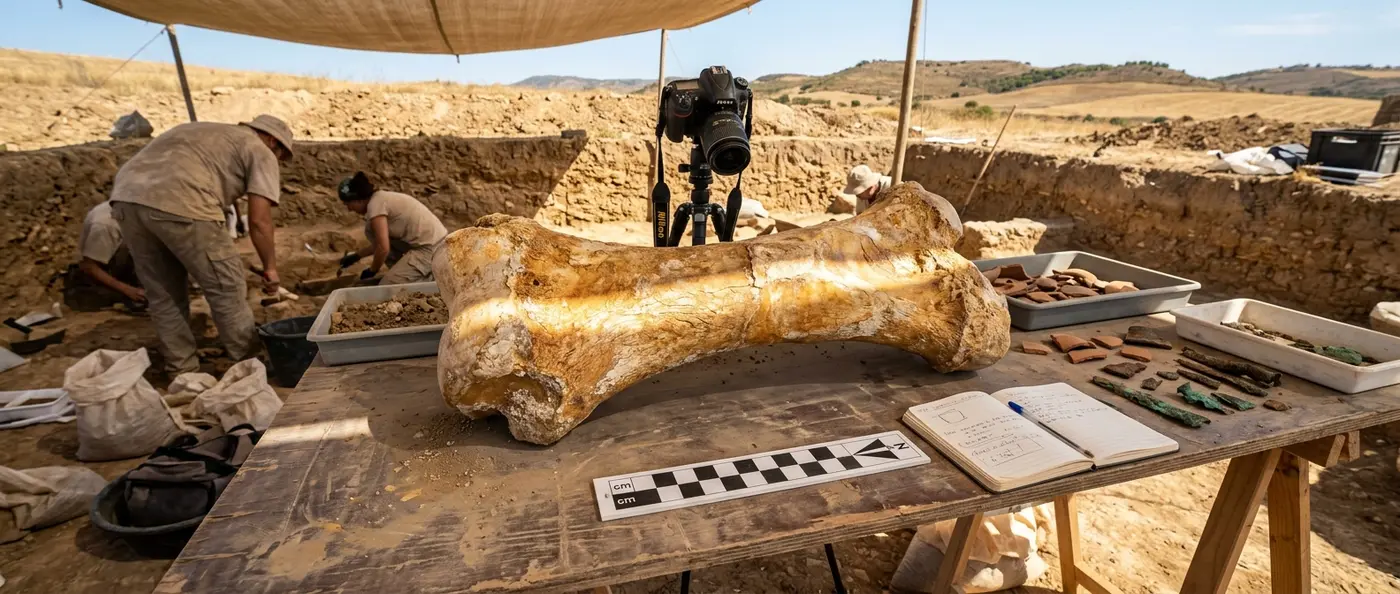
The bone surfaced in 2019 during excavations at a fortified Iberian village, buried in radiocarbon-dated layers from 2,250 years ago. It stumped researchers for years. No local animal matched its structure. Only later did scientists recognize it as the right carpal bone of an elephant — the "wrist" of the right front foot, equivalent to a human wrist.
Rafael Martínez Sánchez, archaeologist at the University of Córdoba and lead author of the study published in Journal of Archaeological Science: Reports, calls the bone "a landmark discovery." Until now, no direct archaeological evidence existed for these war beasts in ancient Iberian conflicts.
The bone lay protected beneath a collapsed wall. Researchers believe the elephant died in battle — they found 12 spherical stones at the same site, likely ammunition for Carthaginian catapults. The rest of the skeleton had rotted away over millennia, but this single bone survived, perhaps because someone kept it as a trophy.
⚔️ The Second Punic War
The Second Punic War (218-201 BC) changed the ancient world. Carthage — an ancient city-state on the coast of modern Tunisia that began as a Phoenician colony — commanded a fearsome naval fleet that terrorized the Mediterranean. But its armies packed equal punch, deploying war elephants in the first two Punic Wars against the Roman Republic.
Hannibal Barca, the Carthaginian general and nobleman, launched his legendary assault on Rome around 218 BC. Instead of attacking by sea, he chose the long route through Western Europe. He led his armies through Iberia, crossed the Pyrenees into southern Gaul, traversed the Alps, and invaded Italy to strike at Rome's heart.
He transported 37 war elephants across the Alps — probably the first elephants Europe had ever seen. Though most died crossing the mountains, Hannibal's armies won victory after victory against the Romans in Italy for years.
🏛️ The Celtic Fortress of Córdoba
The bone emerged from what Romans called an "oppidum" — fortified settlements typically used by ancient Celts. While most oppida perched on hilltops for defense, this one occupied a defensive river bend.
Excavations revealed signs of military conflict at the site. Beyond the elephant bone and catapult stones, archaeologists uncovered extensive destruction evidence suggesting a Carthaginian army camped nearby during the Second Punic War had engaged in battle at the ancient fortified village.
Most of the elephant's skeleton had decomposed over time, but the carpal bone survived under the collapsed wall's protection. Researchers don't rule out the possibility that someone preserved the bone as a memento — it's small enough to carry.
Fortified Village
The oppidum sat in a strategic river bend position, offering natural defense from three sides.
Military Conflict
Archaeological evidence shows signs of intense battle with catapults and other siege weapons.
Bone Preservation
The carpal bone survived thanks to protection from a collapsed wall that covered it for millennia.
🐘 Asian or African Elephants?
One major question the discovery raises is the elephant species. Martínez Sánchez explained that currently it's impossible to determine whether the animal was an Asian elephant (Elephas maximus indicus) — the species used by Greek king Pyrrhus of Epirus against the Romans about 10 years before the First Punic War — or a now-extinct African elephant species that Carthaginians preferred for their war beasts.
Historical sources report that Carthaginians mainly used elephants from North Africa, a smaller species extinct for centuries. These elephants were easier to train than the larger African savanna elephants and ideal for military use.
💡 The "Tanks of Antiquity"
War elephants earned the nickname "tanks of antiquity" for their devastating battlefield power. They could break enemy lines, trample infantry, and cause panic among horses unaccustomed to their smell and appearance.
🗺️ Hannibal's Route Through Spain
Greek historian Polybius, who lived roughly from 200 to 118 BC, recorded that Hannibal fought many battles during his passage from the Pyrenees. The destructive fire discovered at a Pyrenean farm confirms this wasn't "a peaceful passage," notes Professor Oriol Olesti Vila from the Autonomous University of Barcelona.
At Tossal de Baltarga, an Iron Age settlement in the Pyrenees about 115 kilometers north of Barcelona, archaeologists discovered evidence of a massive fire that completely destroyed a two-story farmhouse. The blaze killed four sheep, a goat, and a horse trapped on the ground floor — indicating residents expected attack and had brought their animals inside for protection.
Coins from southern Gaul found at the site date the destructive fire to the last quarter of the 3rd century BC — the time of the Second Punic War. A gold earring deliberately hidden in a small container on the house's second floor suggests residents suspected trouble was coming.
📊 Hannibal's March
🔬 The Discovery's Significance
Researchers emphasized that the elephant that died near Córdoba couldn't be one of the "legendary specimens" that crossed the Alps with Hannibal, since the site sits at the beginning of his route. However, the bone represents a relic from the ancient Carthaginian Wars for Mediterranean control and represents the "passage of the gigantic 'tanks of antiquity' through the Iberian Peninsula."
Until now, the strongest archaeological evidence for Hannibal's elephant march was indirect — like churned soil and other traces the giant beasts left passing through an Alpine pass on the modern French-Italian border. The Córdoba bone offers the first direct physical proof of war elephants' presence in the Iberian Peninsula during Hannibal's era.
The study published in Journal of Archaeological Science: Reports in February reports that this baseball-sized bone might be the only direct evidence of the Carthaginian general's war elephants. While we can't know with certainty if this specific elephant belonged to Hannibal's army or another Carthaginian commander of the era, the dating and historical context make the connection highly probable.
🏺 The End of the Punic Wars
Hannibal was recalled to Carthage in 203 BC to defend against Roman attacks there. Roman general Publius Scipio had invaded Carthaginian Africa, forcing Carthage to recall Hannibal and his armies from Italy. But the Carthaginians ultimately lost their second war with Rome, just as they had lost the First Punic War more than 20 years earlier.
Scipio became known as Scipio Africanus — "the African" — and Carthage became subordinate to Rome. About 50 years later, Rome provoked a Third Punic War for political reasons, which the weakened Carthage also lost. This led to the city's complete destruction in 146 BC.
The bone near Córdoba shows that the Punic Wars devastated local populations caught in the armies' path. Fortified villages burned, people were displaced, and even exotic war animals like elephants met death far from their homeland.