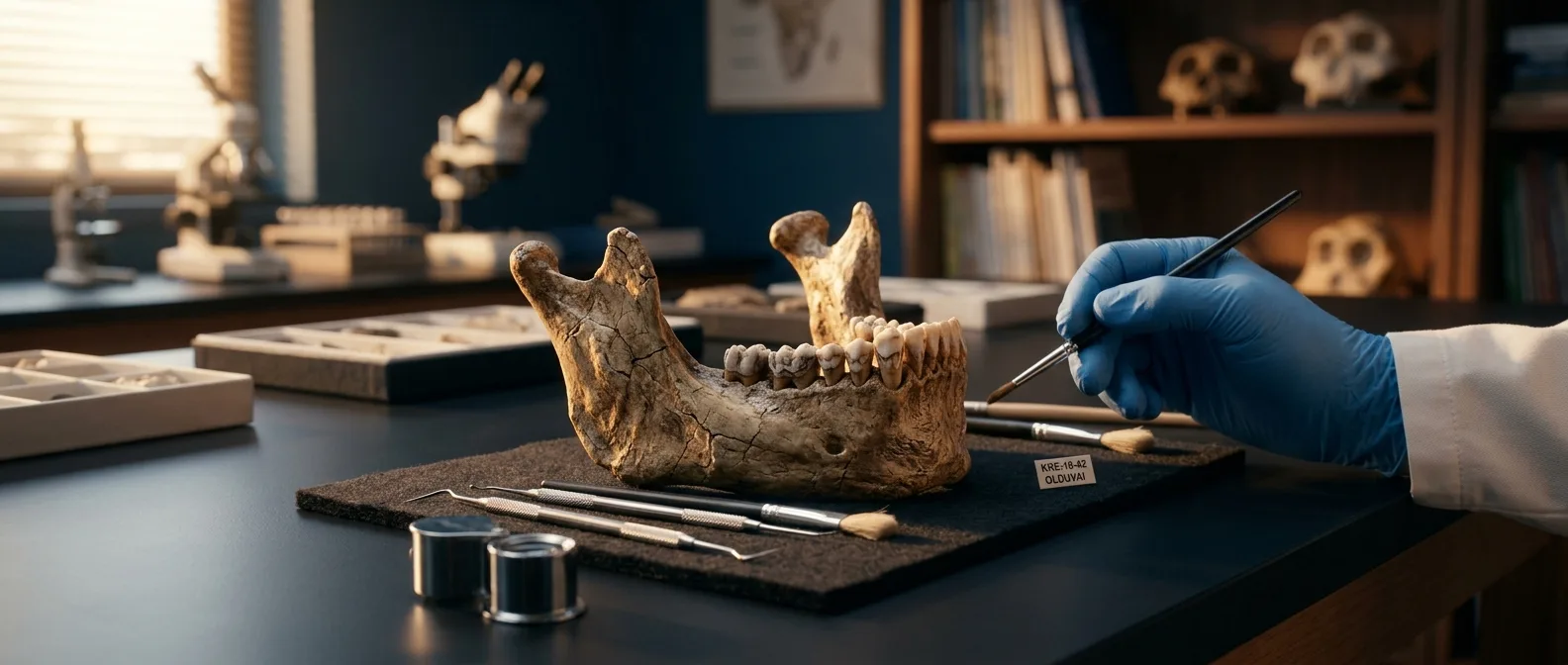
Three jawbones. That's what changed everything. Hidden in a former hyena den on the terraced slopes of Casablanca, these 773,000-year-old remains — from two adults and one child — may have just solved one of evolution's biggest puzzles. They could be our last common ancestor with Neanderthals and Denisovans.
📖 Read more: 430,000-Year-Old Wooden Tools Discovered in Greece
🔬 The Cave That Rewrote Prehistory
The Thomas Quarry I site in Casablanca isn't your typical fossil dig. Moroccan and French researchers have excavated this site for three decades as part of the "Prehistory of Casablanca" program. But what makes these Casablanca skulls so extraordinary? The secret lies in Morocco's Atlantic coast geology. This coastline holds some of Africa's richest Pleistocene fossils. Repeated sea-level fluctuations, wind-blown sediment phases, and rapid cementation of coastal sands created perfect preservation conditions — a natural time capsule that kept these ancient bones intact for nearly three-quarters of a million years.The unique dating method: Researchers analyzed 180 sediment samples to pinpoint the magnetostratigraphic sequence that includes Earth's magnetic field reversal 773,000 years ago — a geological "signature" that provides exceptional dating accuracy.
The Grotte à Hominidés (Cave of Hominids) was carved by marine tides into older coastal formations, then filled with sediments. The result? A secure, undisturbed stratigraphic environment that preserved hominin fossils for hundreds of thousands of years. The cave tells a darker story. The cave wasn't a peaceful dwelling. Bite marks and consumption traces on the femur bone tell a darker story — this individual became dinner for predators, likely hyenas. The cave served as a carnivore den, evidenced by predator traces throughout the area.📊 A Dangerous Neighborhood 773,000 Years Ago
The Thomas Quarry findings paint a grim picture of ancient Morocco. Beyond the violence, these bones reveal something far more significant. Detailed micro-CT analyses, geometric morphometry, and comparative anatomical studies uncovered a mosaic of archaic and evolved characteristics.773,000 years old
3 partial lower jaws
180 magnetostratigraphy samples
European Connections
Particularly intriguing: the fossils share characteristics with hominids from Gran Dolina at Atapuerca, Spain — the so-called Homo antecessor — of comparable age. This suggests possible ancient population contacts between northwest Africa and southern Europe. However, by the time of the magnetic field reversal 773,000 years ago, these populations appear to have already separated clearly, implying such exchanges must have occurred earlier.📖 Read more: 480,000-Year-Old Bone Tool Made from European Elephant
⚡ Humanity's Family Tree Gets Redrawn
The Moroccan fossils do more than fill a regional gap. They fill a massive gap in Africa's hominin fossil record between 1 million and 600,000 years ago — a period crucial for understanding human evolution. As Jean-Jacques Hublin from the Max Planck Institute for Evolutionary Anthropology explains: "There are many hominin fossils in Africa up to about one million years ago, but then there's a jump to 500,000 years ago, and in that gap we have almost nothing."Genetic studies had suggested that during this timeframe, the last common ancestor of modern humans, Neanderthals, and Denisovans lived in Africa. The Thomas Quarry fossils are the best candidates for this "root" of the ancestral tree."The fossils from Grotte à Hominidés may be the best candidates we have at present for African populations that are close to the root of this common ancestry."
Jean-Jacques Hublin, Max Planck Institute
The Mystery of "Ancestor X"
The last common ancestor of the three human groups — sometimes called "ancestor x" — is an "elusive figure," as Antonio Rosas from Madrid's National Museum of Natural Sciences describes it. Genetic evidence suggests this ancestor lived roughly 550,000 to 765,000 years ago, before splitting into three distinct "sibling" species. The paleontological evidence from Grotte à Hominidés aligns more with the older part of this range — a finding that reinforces Africa's role as humanity's birthplace.📖 Read more: Did Preeclampsia Kill Off the Neanderthals?
🧬 The Sahara Wasn't Always a Barrier
This discovery underscores that northwest Africa played a crucial role in early Homo evolutionary history, during an era when climate fluctuations periodically opened ecological corridors across what is now the Sahara Desert.Geographic Significance
Morocco proves key to understanding human evolution, with the oldest known Homo sapiens remains at Jebel Irhoud (300,000 years) and now this potential common ancestor.
Evolutionary Evidence
The combination of archaic African features with traits approaching later Eurasian and African morphologies provides critical evidence for human ancestry.
Comparison with Other Candidates
Researchers didn't rush to assign the Moroccan fossils an official scientific name, but comparisons with other candidates prove revealing. The remains resemble other species like Homo erectus, but also appear to be close ancestors of modern humans. As Ryan McRae from the Smithsonian explains: "The question then becomes whether Homo erectus populations directly gave rise to everything, including humans, Neanderthals and Denisovans, or whether there's a traceable lineage with observable changes along the way."🎯 What This Means for Future Research
This discovery isn't just another fossil record addition. It redefines our understanding of where and how humanity evolved. Until now, most human origin studies relied primarily on eastern and southern Africa. Now, northwest Africa emerges as equally significant. Hublin emphasizes that more work is needed on north Africa's exceptionally rich fossil record, especially since the clearest early H. sapiens evidence comes from Morocco's 300,000-year-old Jebel Irhoud site.Future research: Planned paleoproteomics analyses could help clarify relationships between European and North African fossils.
Focusing on this geographic region may also reveal new evidence about the split between our species and our Neanderthal and Denisovan relatives. But there's another question: what should we call these fossils? John Hawks from the University of Wisconsin-Madison proposes a provocative idea: "In my way of thinking, these may be the oldest fossils that we should really call Homo sapiens." This proposal could overturn how we understand early human taxonomy. Instead of waiting for "classic" modern human characteristics, perhaps we need to expand our definition to include these ancient ancestors. However we view it, the bones from Casablanca remind us of something fundamental: human history is complex, full of migrations, contacts, and separations that occurred long before anyone could imagine writing about them on a computer in 2026.Sources: