📖 Read more: Aksum Empire: Africa's Forgotten Superpower That Ruled Three Continents
🗺️ The Geography of History's Greatest Trade Network
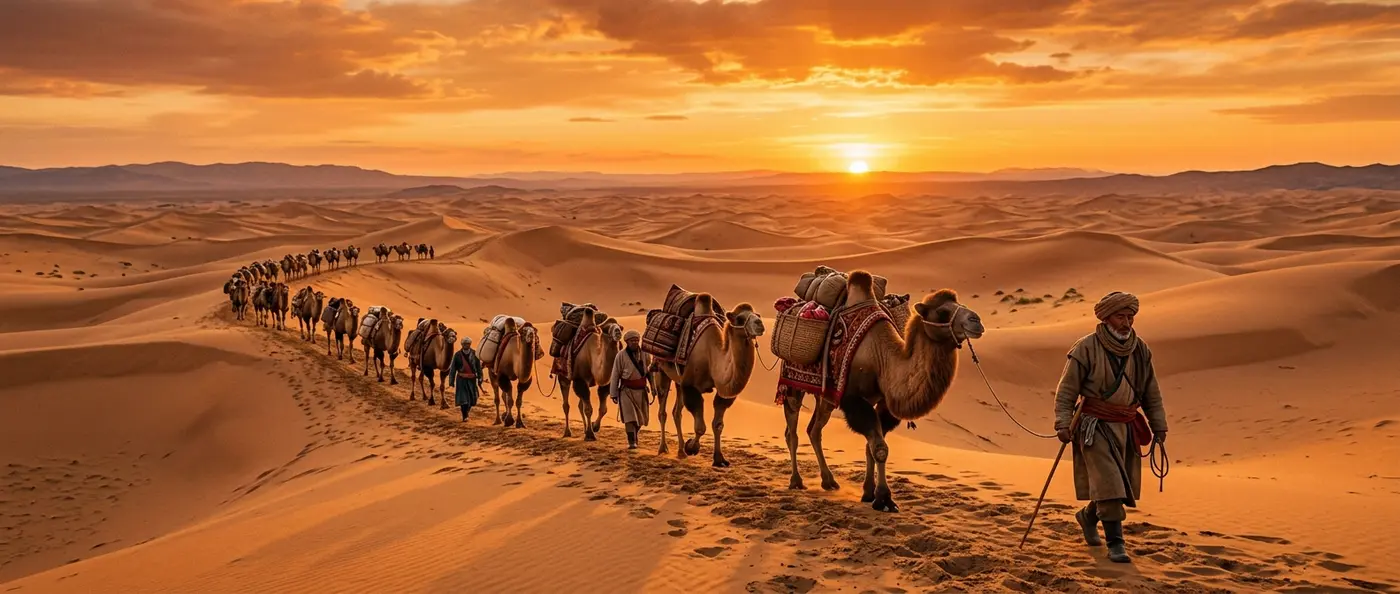
The Silk Road began in Chang'an (modern Xi'an) in central China and stretched roughly 6,400 kilometers westward. The network followed the Great Wall northwest, skirted the vast Taklamakan Desert, climbed the Pamir Mountains, crossed Afghanistan, and ended in the Middle East and Mediterranean.
Nobody traveled the entire route. Merchants operated like links in a chain — picking up goods at one station and carrying them to the next. This relay system protected traders from the dangers of an impossibly long journey while preserving each region's monopoly on trade.
The route split into multiple branches. Northern and southern branches curved around the Taklamakan Desert, maritime routes connected Chinese ports with Southeast Asia, and overland offshoots reached India. Each branch had its own supply stations — oasis cities like Samarkand and Bukhara that grew wealthy from caravan traffic.
🏺 The Goods That Changed the World
Silk was the most coveted product traveling from China westward. Romans valued it so highly that Seneca complained Roman women were emptying the empire's treasury to buy Chinese silk. But trade wasn't one-way.
From Rome and later from Christian European kingdoms, high-quality wool fabrics, gold, and silver traveled toward China. The Chinese particularly prized horses from Central Asia — the famous "heavenly horses" of Ferghana that were considered superior to local breeds.
East to West
Silk, porcelain, paper, gunpowder, spices (cinnamon, ginger), tea, jade
West to East
Gold, silver, wool, glassware, wine, olive oil, horses, furs
Regional Specialties
Precious stones from India, carpets from Persia, incense from Arabia, ivory from Africa
⛩️ China's Tribute System
China didn't approach trade like Western powers. From the Han Dynasty (206 BCE - 220 CE) through the Qing Dynasty (1644-1912), Chinese emperors used the tribute system. Any foreign power wanting to trade with China had to recognize the emperor as ruler of "all under heaven."
📖 Read more: Ancient Greek Coins: How Money Was Born
Envoys had to perform the kowtow — a ritual bow involving full prostration and striking the head on the ground. They offered gifts to the emperor and received precious objects that often exceeded the value of their own offerings. This system combined diplomacy, trade, and confirmation of Chinese supremacy.
🔱 Religions and Ideas in Motion
Along with material goods, the Silk Road carried something even more powerful — ideas and beliefs. Buddhism traveled from India to China through merchants and monks. Early Assyrian Christians brought their faith to Central Asia and China long before Marco Polo arrived.
Islam spread along trade routes, reaching China where Muslim communities established themselves and exist today. Zoroastrianism, Manichaeism, and other religions found followers in remote areas thanks to merchants who carried not just goods but their beliefs.
💡 Did You Know?
Papermaking technology, invented in China around 100 CE, reached the Islamic world via the Silk Road after the Battle of Talas in 751 CE. From there it spread to Europe, revolutionizing the spread of knowledge.
⚔️ The Rise and Fall of the Mongols
After the fall of the Roman Empire and the rise of Arab power in the Middle East, the Silk Road became increasingly dangerous. Bandits, wars, and political instability made journeys extremely risky. But in the 13th and 14th centuries, the Mongols brought an unexpected renaissance.
Under Genghis Khan and his successors, the Mongol Empire stretched from Eastern Europe to the Pacific. For the first time in history, a single political control covered nearly the entire Silk Road. The Mongols imposed the Pax Mongolica — a period of relative peace that allowed trade to flourish again.
During this period, Venetian merchant Marco Polo traveled to China, spending 17 years at Kublai Khan's court. His descriptions of China's wealth and technology seemed so incredible to Europeans that many considered him a liar.
📖 Read more: Etruscans: The Mysterious People Before Rome
💀 The Dark Side: Disease and Pandemics
Not everything about the Silk Road was positive. Along with goods and ideas, diseases traveled too. Many historians believe the bubonic plague that caused the Black Death in 14th-century Europe was transmitted from Asia via the Silk Road.
Fleas carrying the plague bacterium traveled on rats hiding in merchandise. As caravans moved from city to city, the disease spread with catastrophic consequences. The Black Death killed approximately one-third of Europe's population, forever changing the course of history.
📊 Silk Road Eras Compared
🚢 From Land to Sea
The decline of the overland Silk Road accelerated with European arrival in Asia. In 1513, the Portuguese reached Guangzhou and soon established themselves in Macao. Maritime routes proved faster, safer, and more economical than overland caravans.
In 1684, Emperor Kangxi of the Qing Dynasty announced that all of China's coastal ports would be open to private maritime trade. This decision effectively marked the end of the traditional tribute system and the beginning of a new era in international commerce.
🌏 A Legacy That Endures
Though the historic Silk Road ceased functioning as a major trade artery, its influence remains alive. Sections survive as modern highways connecting Pakistan with China's Xinjiang Autonomous Region. The United Nations has proposed creating a trans-Asian highway and railway following the historic route.
Modern China has drawn inspiration from this historic legacy to create the "One Belt, One Road" initiative — an ambitious infrastructure plan aimed at connecting Asia with Europe and Africa through land and sea routes. The new "Silk Road" promises to bring together civilizations once connected by camel caravans.
Beyond its economic significance, the Silk Road left an indelible mark on culture. Art, music, cuisine, even languages along the route were influenced by centuries of cultural exchange. From the Buddhist monasteries of Dunhuang to the mosques of Samarkand, monuments along the Silk Road testify to a world far more interconnected than we often imagine.