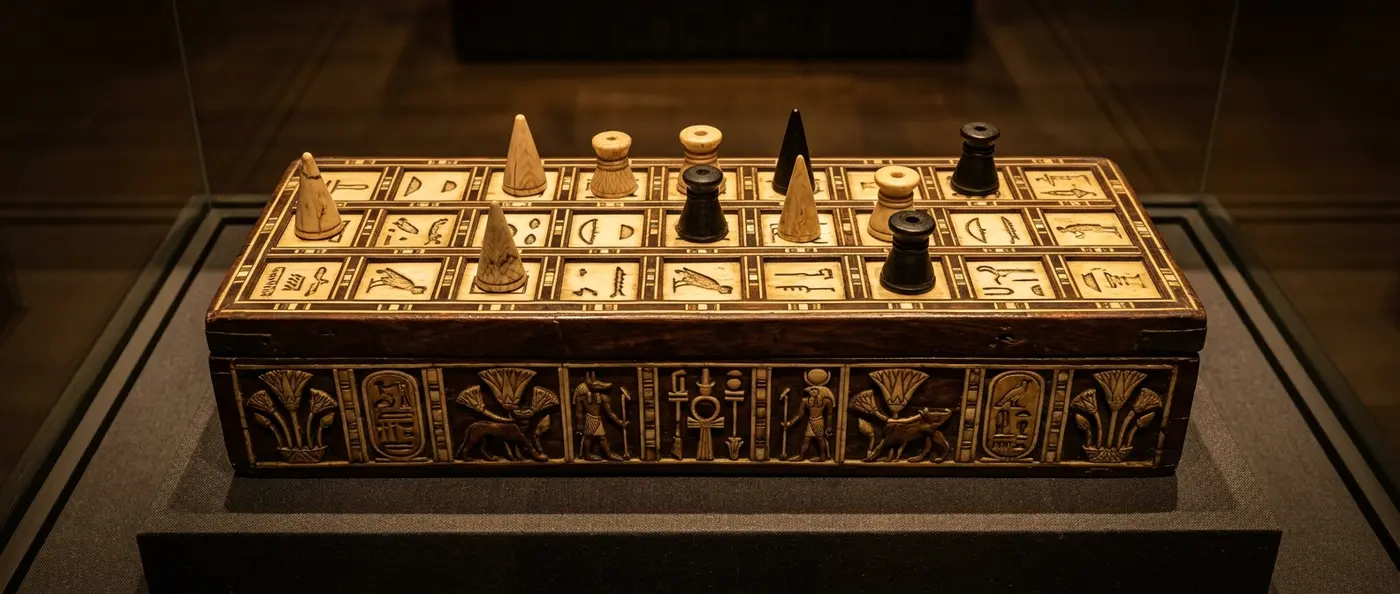
Inside Tutankhamun's tomb, buried beneath golden treasures and priceless artifacts, archaeologists found four wooden boxes with strange patterns carved into their surfaces. They weren't jewelry. They weren't weapons. They were board games — and the most famous was called Senet, a game ancient Egyptians had been playing for thousands of years before the boy king was even born.
📖 Read more: Egyptian Mummification Secrets: Ancient Preservation
🎲 What Made Senet Different
Senet wasn't just entertainment. For ancient Egyptians, every game represented the soul's journey through the afterlife. The word "senet" in ancient Egyptian means "passing" or "crossing" — hinting at the game's deeper purpose beyond moving pieces around a board.
📖 Read more: Tutankhamun's Sandals: Trampling Enemies with Every Step
The board consisted of 30 squares arranged in three rows of ten. Each player controlled five to seven pieces that had to traverse the board while avoiding traps and obstacles. Instead of dice, players threw sticks or knucklebones to determine their moves. Simple mechanics. Profound meaning.
What makes Senet unique is its dual nature. On one hand, it was a straightforward strategy game played in homes and taverns across Egypt. On the other, it was a sacred object that accompanied the dead into their tombs, helping them navigate the trials of the Duat — the Egyptian underworld.
🏺 From Game Night to Sacred Ritual
Senet's transformation from parlor game to religious symbol tells a fascinating story. During the early dynasties around 3100 BCE, Senet was pure entertainment. Archaeologists have found tomb paintings showing people playing casually, laughing and drinking beer while moving their pieces.
But something shifted during the Middle Kingdom (2055-1650 BCE). The game began acquiring religious dimensions. Board squares became associated with specific gods and afterlife trials. Square 15 became known as the "House of Rebirth." Square 27 turned into the "House of Water" — a dangerous spot where players could "drown" and lose the game.
By the New Kingdom (1550-1077 BCE), Senet had fully transformed into a metaphor for the soul's journey. Chapter 17 of the Book of the Dead describes the deceased playing Senet against invisible opponents. Win, and the soul passes safely to the afterlife. Lose... nobody wanted to find out what happened then.
The presence of Senet in pharaohs' tombs proves its importance. Tutankhamun's tomb contained four different Senet sets, each more elaborate than the last. The most impressive was crafted from ebony with ivory inlays and gold details — a gaming set fit for eternity.
But Tutankhamun wasn't alone. Queen Nefertari, wife of Ramesses II, is depicted in her tomb playing Senet by herself — symbolizing her soul's struggle against the forces of chaos. Even Amenhotep III had an entire room in his palace dedicated to Senet, with massive boards carved into the floor.
📖 Read more: Nefertiti's Tomb: 2026 Discovery Within Reach?
Life Symbolism
The first 14 squares represented earthly life. Each move symbolized the daily challenges and victories of the player's existence.
Passage Through Death
Squares 15-26 corresponded to the journey through the Duat, filled with traps and trials that had to be overcome.
Rebirth
The final squares (27-30) symbolized union with the god Ra and eternal life in the heavens.
🎯 How the Game Actually Worked
We don't have any ancient "instruction manual," but Egyptologists have reconstructed Senet's likely rules by studying depictions and texts. The game began with pieces placed alternately on the first 14 squares.
Players threw four sticks with one flat side and one round side. The number of flat sides showing determined the move: one flat = 1 step plus another throw, two = 2 steps, three = 3 steps, four = 4 steps plus another throw, no flats = 5 steps plus another throw.
Certain squares had special properties. Square 15, the "House of Rebirth," was a safe haven. Square 27, the "House of Water," was a trap — land there without an exact throw and you went back to square 15. Squares 26, 28, 29, and 30 required specific throws to exit the board.
🔮 Magic Squares
Five Senet squares bore hieroglyphic symbols: the ankh (life), nefer (beauty), men (stability), heka (magic), and su (water). Each symbol granted special powers in the game.
📖 Read more: Nefertiti's Lost Tomb: Hidden Behind Tutankhamun's Walls?
🌍 Senet's Global Influence
Senet didn't stay confined to Egypt. Game variants appeared throughout the Mediterranean. In Cyprus, archaeologists have found Senet boards dating to the 16th century BCE. In Nubia, the game became so popular that locals created their own version with 40 squares instead of 30.
Even more intriguing is how Senet influenced other board games. Many researchers believe the Roman Ludus Duodecim Scriptorum and Byzantine Backgammon trace their roots to the ancient Egyptian game. The idea of pieces moving along a predetermined path based on dice throws became the foundation for countless games that followed.
Archaeologists continue uncovering new evidence about Senet. In 2018, a team from Cairo University found an intact Senet board in a 13th Dynasty tomb near Saqqara. The pieces were still in their positions, as if the game had been interrupted 3,700 years ago.
Technology is also helping us understand the game better. Using 3D scanning and analysis, researchers can now study details on worn boards that were invisible to the naked eye. This has revealed hidden symbols and inscriptions that clarify previously disputed rules and religious meanings.
🎲 Senet vs Modern Board Games
💭 Why Senet Endures
Senet stopped being widely played around the 4th century CE when Christianity spread through Egypt. But its legacy survives. Today, you can buy reproductions in museum shops worldwide. Developers have created digital versions for smartphones and computers.
But why does a 5,000-year-old game still captivate us? Maybe because Senet touches something deeper than simple entertainment. It's a game about life, death, and hope for something beyond. Every throw of the sticks reminds us that luck plays a role in our lives, but strategy and choices determine the outcome.
In an age of video games and virtual reality, Senet reminds us of the power of simplicity. A wooden board, some pieces, and four sticks were enough to entertain kings and peasants, connect the living with the dead, and create a tradition that lasted millennia. Perhaps that's Senet's real secret — the best games aren't those with the most complex rules, but those that make us think about our place in the world.