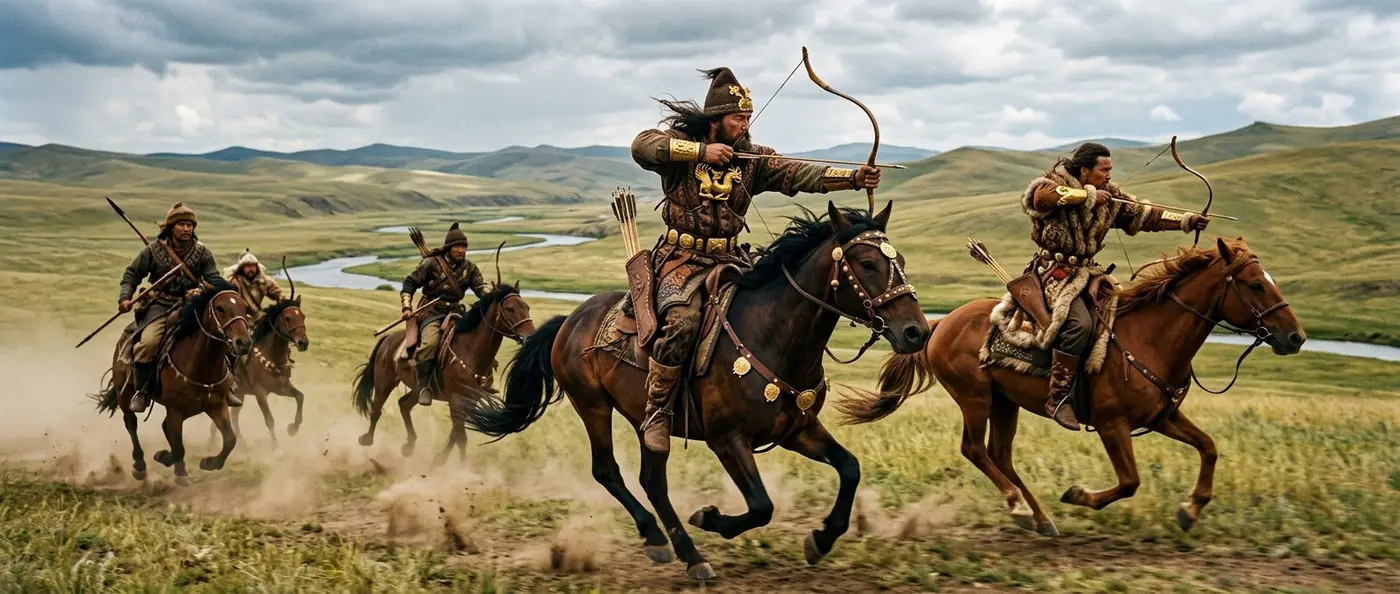
🏇 The Cavalry Revolution That Changed Everything
Around 900-700 BCE, something clicked on the Eurasian steppes. Nomads figured out how to fight effectively on horseback, ditching the clunky, expensive chariots that had dominated battlefields for nearly five centuries. This wasn't just an upgrade. This was game over for traditional armies.
The breakthrough was simple but devastating. Riders learned to drop the reins and guide their horses with voice commands and heel pressure, freeing both hands to draw their composite bows. A Scythian warrior could gallop at full speed, wheel around, and put an arrow through your eye before you even saw him coming. Then he'd vanish into the grasslands before your infantry could take a single step.
The Scythians spoke an Iranian language and swept into Ukraine after conquering the Cimmerians, the previous rulers of the region. Herodotus recorded that some Scythians claimed they'd migrated from the Altai Mountains at the eastern edge of the Western Steppe. Some modern scholars even suspect the barbarian invasions that toppled China's Western Zhou dynasty in 771 BCE might have been connected to Scythian raids from the Altai.
⚔️ The Scythian War Machine
The Scythians built a loose confederation spanning the entire Western Steppe. Their supreme king probably had limited control over distant territories. But when the situation demanded it, they could mobilize massive numbers of horsemen for long-distance raids that struck terror across continents.
In 612 BCE, one such raid helped collapse the Assyrian Empire. Scythian warriors sacked Nineveh and rode back to the Ukrainian steppe loaded with treasure, leaving the Medes, Babylonians, and Egyptians to squabble over the Assyrian inheritance. The message was clear: no empire was safe from the steppes.
The threat of renewed raids from the north became a permanent headache for Middle Eastern rulers. Lightning-fast raiding parties from the steppes were nearly impossible for settled peoples to counter. By the time you assembled your army, the horsemen were already hundreds of miles away, counting their loot.
🛡️ When Persians Met Their Match
The Persians, who took political control of the Middle East in 550 BCE, learned this lesson the hard way. Cyrus the Great, founder of the Persian Empire, died in 530 BCE while leading a punitive expedition against the Massagetae, who lived north and east of the Caspian Sea. The king who had conquered Babylon and Lydia was killed by nomads most of his subjects had never heard of.
Darius the Great had mixed success in 512 BCE when he tried to subdue the European Scythians by crossing the Danube. His massive army marched deep into Scythian territory, but the nomads simply melted away, burning the grasslands behind them. Darius found himself chasing ghosts across an endless steppe, his supply lines stretched to breaking point. He retreated with his tail between his legs.
The Persians eventually learned that diplomatic arrangements worked better than military campaigns. Pay the border tribes to guard against raids from the deep steppe, and everyone stays happy. As long as Persian tax collectors provided suitable goods to subsidize friendly frontiersmen, the system held.
Cyrus the Great
Killed in 530 BCE fighting the Massagetae, proving that even the mightiest empire-builders could fall to nomad warriors.
Darius the Great
Failed to subdue the Scythians in 512 BCE despite crossing the Danube with a massive army — the steppes swallowed him whole.
🏺 Masters of Gold and War
Despite leaving no written records of their own, the Scythians created a vibrant and sophisticated culture. They were master goldsmiths, crafting intricate artworks that often depicted animals and battle scenes. A characteristic example is a gold plaque from 400-350 BCE showing a bearded Scythian warrior on horseback, ready to strike down his enemy.
Unlike other cultural groups, the Scythians were famous for using elaborately decorated weapons. Daggers, knives, and arrowheads were often adorned with gold. Many of these objects have been discovered in burial sites, revealing the wealth and technical skill of these nomadic people. Every weapon was both functional and beautiful — form following deadly function.
A 2017 study revealed that Iron Age Scythian nomads managed to avoid inbreeding in their horses and selected for specific coat colors and strong front limbs. These magnificent animals appear frequently in gold artwork created by the group, including the warrior-on-horseback plaque. The Scythians understood that superior horses meant military superiority.
💀 Death Rides a Pale Horse
Herodotus described in detail the elaborate funeral rites of the Scythians for their "royal Scythians" in the 5th century BCE. According to the historian, the Scythians sacrificed dozens of horses and servants to honor the death of a Scythian king. Once killed, the horses would be disemboweled and stuffed, then both the sacrificed humans and horses would be propped up with wood to look like they were riding around the burial mound as a kind of "ghostly cavalry procession."
Recent excavations in Siberia uncovered a 2,800-year-old burial mound containing the remains of an elite member who was buried with at least one sacrificed human and dozens of sacrificed horses. The mound dates to the late 9th century BCE, making it one of the oldest known burials showing evidence of Scythian funeral practices.
The sacrificed victims likely served as guardians or servants of the elite member in the afterlife. Interestingly, most of the sacrificed horses were between nine and 15 years old, with three being over 20 years old, suggesting they weren't necessarily sacrificing the best horses from their herds. Quality mattered less than the symbolic gesture.
🗿 The Mystery of Sacrifice
In Scythian culture, sacrificed victims likely served as guardians or servants of the elite member in the afterlife. The fact that they didn't sacrifice their best horses suggests these rituals were about spiritual protection, not showing off wealth.
🌍 The Scythian Legacy
Scythian influence extended far beyond the steppe borders. Their military innovation — the art of mounted warfare — spread across Eurasia like wildfire. In China, border principalities were forced to convert to cavalry tactics to organize successful defenses, with the first state developing cavalry power only after 325 BCE. The Scythians had rewritten the rules of war.
The Scythians also left a permanent mark on the collective memory of ancient civilizations. For Greeks and Persians, they represented the ultimate "other" — the wild nomads from the north who could strike without warning and vanish before any resistance could be organized. They became the boogeyman that kept emperors awake at night.
Today, archaeologists continue to uncover new evidence about this enigmatic people. Each new excavation reveals more about their lives, culture, and beliefs. From their golden artworks to their imposing burial mounds, the Scythians remain one of the most fascinating ancient civilizations we study.
📊 Scythians vs Other Ancient Warriors
The Scythian story teaches us that military innovation can radically shift the balance of power. From simple steppe nomads, they became the terror of great empires, proving that mobility and adaptability can overcome even the most organized and wealthy opponents. Their legacy lives on today, not just in museums where their golden masterpieces are displayed, but in our understanding of how innovation shapes human history.
These ghost riders of the ancient world showed that sometimes the greatest empires fall not to other empires, but to those who refuse to play by the established rules. The Scythians wrote their history in gold and blood, leaving behind a legacy that reminds us: in the game of civilizations, it's not always the biggest player who wins. Sometimes it's the fastest.