📖 Read more: Sinai Rock Art: 10,000 Years of Human Expression
🗿 The Discovery of the Petroglyphs
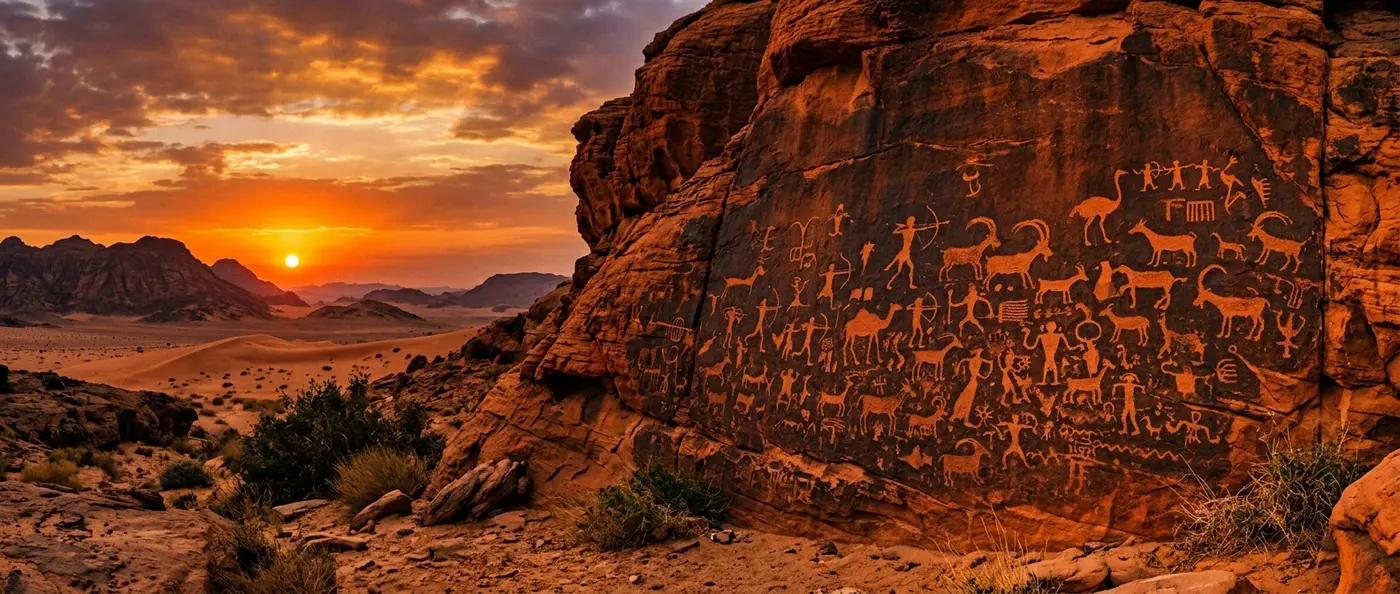
Saudi Arabia's rock art represents one of the Middle East's most spectacular archaeological finds. These petroglyphs span from the Neolithic period to the early Islamic era, covering more than 10,000 years of human history. That's longer than recorded civilization.
Researchers have identified thousands of sites across the kingdom. The most significant cluster around Hail, Najran, and the northwestern borders. Each location reveals different aspects of ancient life — from daily hunting routines to religious ceremonies that shaped entire communities.
The implications are staggering. For the first time, archaeologists can reconstruct how human societies evolved in a region traditionally considered barren and inhospitable. These weren't just passing nomads leaving random marks. These were sophisticated communities documenting their world with deliberate artistic intent.
🏺 Techniques and Themes
Ancient artists used sharp stone tools to carve directly into rock surfaces. The technique, called pecking, involved repeatedly striking the stone to create images. Some artists added natural pigments for color, though most relied on the contrast between the carved surface and the rock's patina.
The subject matter tells an extraordinary story of environmental change. The oldest petroglyphs show hunting scenes with animals that vanished from Arabia millennia ago: lions, elephants, ostriches, and even crocodiles. This proves the Arabian Peninsula once supported lush vegetation and abundant water sources.
As centuries passed, the imagery shifted dramatically. Later petroglyphs depict domesticated animals — camels, horses, goats — alongside scenes of nomadic life. Written inscriptions in ancient Arabic dialects appear, providing direct testimony from people who lived thousands of years ago. The rock art becomes a visual timeline of humanity's adaptation to a changing world.
⚔️ From Hunters to Nomads
The carvings document a dramatic shift in how people survived. The region's first inhabitants were hunter-gatherers who followed wild animal herds. Early carvings show groups of hunters with bows and spears pursuing large mammals across what was then savanna grassland.
Around 6000 BC, the petroglyphs begin showing the first signs of animal domestication. Dogs appear alongside humans, marking the beginning of a new relationship between people and animals. Gradually, hunting scenes give way to images of herds and herders.
The most dramatic change occurs around 3000 BC when camels make their debut in the rock art. Camel domestication allowed inhabitants to traverse vast deserts and develop extensive trade networks. Petroglyphs from this period show camel caravans, merchants, and scenes from desert nomad life that would define Arabian culture for millennia.
Hunter Era
8000-6000 BC: Large mammal hunting, stone weapons, group attacks on wild animals in grassland environments.
Early Domestication
6000-3000 BC: First domestic animals, dogs, goats, sheep, permanent settlements near water sources.
Nomadic Age
3000 BC-500 AD: Camels, trade caravans, nomadic lifestyle, development of writing and commerce.
🔬 Modern Analysis Techniques
Contemporary archaeologists deploy cutting-edge technology to study and preserve these petroglyphs. Digital photogrammetry creates three-dimensional models with stunning accuracy. These models reveal details invisible to the naked eye and help analyze the techniques ancient artists used.
Dating petroglyphs presents unique challenges. Researchers combine multiple methods, including analysis of the patina that forms over carved surfaces and comparison with other archaeological finds from the region. When organic materials are discovered near petroglyphs, radiocarbon dating becomes possible.
Artificial intelligence and machine learning now classify and analyze thousands of images. Pattern recognition algorithms identify recurring motifs and connect petroglyphs from different locations, revealing cultural connections and migration patterns across vast distances.
📖 Read more: Druids: The Secret Religion of the Ancient Celts
🗺️ Geographic Distribution and Significance
Saudi Arabia's petroglyphs aren't randomly scattered. They concentrate in areas that once had water or lay along ancient trade routes. The Hail region in the north hosts some of the most impressive collections, with sites like Jubbah and Shuwaymis containing thousands of images.
In the south, the Najran region reveals a different petroglyph tradition, emphasizing inscriptions and religious symbols. Here, ancient Arabic inscriptions coexist with images showing influence from neighboring Yemeni and Ethiopian cultures.
The geographic distribution provides valuable information about past migration patterns and trade routes. Similarities in style and subject matter between distant locations suggest cultural exchanges and shared traditions that spanned great distances.
💡 The Mystery of Vanished Animals
The petroglyphs depict animals that no longer exist in Saudi Arabia: elephants, hippos, and crocodiles. This proves the Arabian Peninsula once had a dramatically different climate with lakes, rivers, and dense vegetation. The climate change that transformed the region into desert occurred gradually over millennia.
🏛️ Cultural Heritage and Protection
Recognition of the petroglyphs' significance has led to intensive protection and preservation efforts. Many sites have been inscribed on UNESCO's World Heritage List, ensuring international recognition and protection. However, significant challenges remain.
Natural erosion, human activity, and urbanization threaten many locations. Authorities have established strict regulations to protect the petroglyphs and created specialized research and documentation centers. Educational programs aim to raise public awareness about this cultural heritage's importance.
Digital documentation has become a priority, with research teams creating detailed databases including high-resolution photographs, three-dimensional models, and comprehensive descriptions of each petroglyph. This digital archive not only preserves knowledge for future generations but enables international collaboration among researchers.
📜 Language and Inscriptions
One of the petroglyphs' most captivating aspects is the presence of ancient inscriptions. These inscriptions, written in various ancient Arabic dialects, provide direct testimony from people who lived thousands of years ago. Linguists have recognized at least five different writing systems, reflecting the region's cultural diversity.
The inscriptions include names, genealogies, prayers, and everyday messages. Some reference historical events like battles or agreements between tribes. Others describe commercial transactions or record caravan passages. These written testimonies complement the pictorial representations, creating a more complete picture of ancient life.
Study of these inscriptions has revealed the evolution of Arabic language and writing. The oldest inscriptions use simple symbols, while later ones show the development of more complex alphabetic systems. This evolution reflects increasing social complexity and the need for more sophisticated forms of communication.
📊 Petroglyph Evolution by Period
🌍 International Significance and Future Research
Saudi Arabia's petroglyphs have captured the international scientific community's attention. Research teams from universities worldwide collaborate with local archaeologists to study and document these treasures. The interdisciplinary approach, combining archaeology, anthropology, linguistics, and technology, continuously reveals new aspects of this ancient heritage.
New discoveries emerge each year as satellites spot previously unknown sites. New technologies like satellite imaging and drones enable the discovery of sites in remote and inaccessible areas. DNA analysis from ancient bones found near petroglyph sites may reveal information about ancient populations' origins and movements.
Connecting the petroglyphs with other archaeological finds across the broader Middle East and North Africa region reveals a complex network of cultural exchanges. Similarities in style and subject matter with petroglyphs from Jordan, Yemen, and Oman suggest shared cultural traditions that transcended modern borders.
As research continues, Saudi Arabia's petroglyphs promise to reveal even more secrets about the Arabian Peninsula's first inhabitants. Each new discovery adds a piece to the puzzle of human history, helping us understand how our ancestors adapted and thrived in one of the planet's most demanding environments.