A baby floats down the Euphrates River in a reed basket, abandoned by his mother. The child grows up to become a cupbearer to a king. Then he conquers the known world. This sounds like mythology, but 4,300 years ago, Sargon of Akkad lived this impossible story. He didn't just build an empire — he invented the concept. Before Sargon, rulers controlled cities. After him, they dreamed of controlling continents.
📖 Read more: Ancient Warrior Belts Found on Children in Italy
🏛️ The Birth of Empire
The Akkadian Empire, founded around 2334 BCE, was humanity's first experiment in large-scale political organization. Different peoples, languages, and cultures suddenly found themselves under one roof. Sargon wasn't just a conqueror — he was an architect of unity who understood that lasting power comes not from the sword alone, but from the ability to bind diverse civilizations together.
His rise unfolded through careful calculation and brutal opportunism. Starting as a cupbearer to the king of Kish, one of Mesopotamia's most powerful city-states, Sargon harbored ambitions far beyond serving wine. When he seized power, he didn't stop at controlling one city. His vision stretched across the entire fertile crescent, from the Persian Gulf to the Mediterranean Sea.
The military campaigns that followed redrew the map forever. He crushed Sumerian resistance in the south, pushed north into modern-day Syria, and reached west to the Mediterranean coast. Ancient inscriptions record that he "washed his weapons in the sea," symbolizing the completion of his conquests. For the first time in human history, a single ruler controlled the trade routes, river systems, and agricultural heartlands that would define Middle Eastern power for millennia.
⚔️ Military Genius and Innovation
Sargon didn't win through luck. He revolutionized warfare itself. His greatest innovation was creating the world's first standing professional army — 5,400 men who ate together, trained together, and lived for war. While his enemies relied on farmers who grabbed spears when trouble came, Sargon's soldiers were always ready to march.
His tactics transformed Bronze Age warfare. Light infantry armed with composite bows could strike from distance, while heavy infantry with spears and shields formed the backbone of his formations. His units moved fast and hit hard, allowing him to defeat larger armies through superior coordination and surprise attacks.
Sargon's most crucial decisions came after the battles ended. Instead of burning conquered cities to the ground, he absorbed them into his empire. Local customs and traditions survived under Akkadian oversight. He appointed governors to manage day-to-day affairs while maintaining central control. This policy let him rule a vast, diverse empire with remarkable stability for over half a century.
🗿 The Mystery of Origins
Sargon's origins are shrouded in legend and political necessity. The legends surrounding his birth read like a fairy tale. According to the "Legend of Sargon," a text discovered in Ashurbanipal's library, his mother was a priestess who bore him in secret and abandoned him in a reed basket on the Euphrates River.
The basket drifted downstream until a gardener named Akki found it and raised the child as his own. This story, strikingly similar to the biblical tale of Moses, might be mythological, but it reveals something crucial: Sargon didn't come from royal blood. He was a commoner who clawed his way to the top through sheer force of will.
His name itself tells a story. "Sargon" means "legitimate king" in Akkadian. The fact that he chose this name suggests his right to rule was questioned. He likely overthrew his predecessor and needed to assert his legitimacy. The name was a brilliant political move that sent a clear message: he was the rightful ruler, regardless of his humble origins.
💡 Did You Know?
Sargon was the first ruler in history to use propaganda systematically. His inscriptions, written in both Sumerian and Akkadian, spread throughout the empire, praising his achievements and presenting him as chosen by the gods.
📜 The Cultural Revolution
The Akkadian Empire wasn't just a military superpower. Under Sargon's leadership, it became a center of cultural development and innovation. The Akkadian language, a Semitic tongue different from Sumerian, became the lingua franca of Mesopotamia for the next two thousand years.
Sargon promoted a unique cultural fusion. The Akkadians adopted Sumerian cuneiform writing, adapting it to their own language. They preserved and developed Sumerian literature, art, and religion while adding their own innovations. This cultural synthesis created a dynamic new civilization that influenced the entire Middle East.
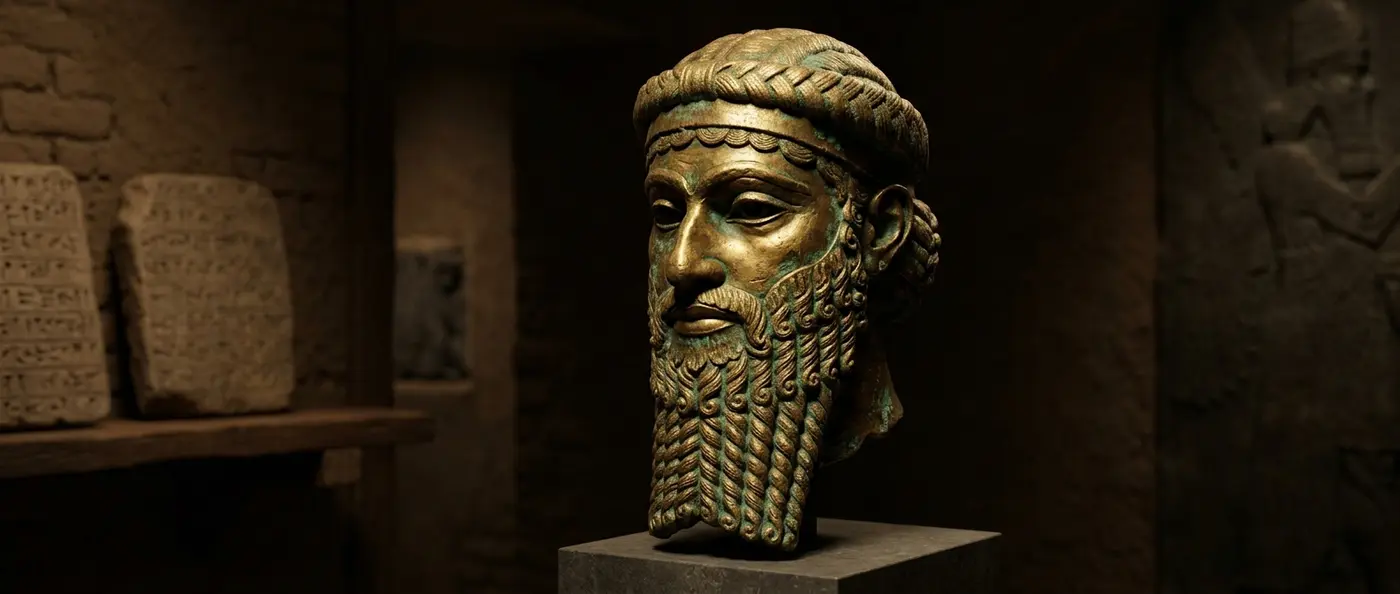
Art from Sargon's period shows new realism and dynamism. Sculptures and seals from the era depict battle scenes, religious ceremonies, and daily life with unprecedented detail. The famous bronze head believed to represent either Sargon himself or his grandson Naram-Sin stands as one of the masterpieces of ancient metallurgy.
Linguistic Revolution
Established Akkadian as the diplomatic language, creating the first bilingual state. Official documents were written in both languages.
Artistic Renaissance
Akkadian art combined Sumerian traditions with new techniques, creating works that depicted individual faces and dramatic action scenes.
Literary Legacy
Akkadians preserved and developed Sumerian literature, adding new epics and myths that influenced all of Mesopotamia.
📖 Read more: Sumerian Beer: The World's Oldest Alcoholic Drink
🔱 Religion and Divine Legitimacy
One of Sargon's shrewdest political weapons was his use of religion to legitimize his power. He presented himself as chosen by the gods, particularly the goddess Ishtar/Inanna. According to inscriptions, the goddess loved and protected him, granting him victory in battle.
His daughter, Enheduanna, became the first known poet in history and served as High Priestess of the moon god Nanna at Ur. Her appointment wasn't just religious — it was a political masterstroke that united the northern Akkadian dynasty with southern Sumerian traditions. The hymns she wrote survived for millennia and represent some of the first signed literary works in history.
Sargon also developed the concept of the "universal king" — the ruler who governs by divine mandate not just a city or region, but the entire known world. This ideology shaped every later Mesopotamian king's claims to power, from the Babylonians to the Persians.
🏰 Administrative Brilliance
Governing such a massive empire required innovative solutions. Sargon created history's first centralized administrative system. He appointed governors (called "ensi") to each major city, who reported directly to him. These governors were typically Akkadian officials, loyal to the king above all local interests.
His taxation system replaced arbitrary tribute demands with predictable levies. Instead of arbitrary tributes, he established regular taxes based on each region's productivity. Taxes were collected in goods — grain, barley, dates, livestock — and stored in central warehouses. This allowed the empire to maintain its large standing army and fund major public works.
Justice was another area where Sargon innovated. While we don't have a complete legal code from his era, references to "just judgments" and "protection of the weak" suggest he tried to create a unified legal system. Judges were appointed by the king and required to follow central guidelines, not just local customs.
⚖️ Administrative Systems Comparison
💎 Economic Boom and Trade
Unifying Mesopotamia under Sargon created history's first large unified market. Merchants could travel from the Persian Gulf to the Mediterranean without worrying about different laws, currencies, or customs. This led to unprecedented economic growth.
The Akkadians controlled the major trade routes connecting East and West. They imported lapis lazuli from Afghanistan, cedar from Lebanon, copper and silver from Anatolia. The city of Akkad, whose exact location remains unknown today, became the era's greatest commercial center.
Sargon introduced standardized weights and measures throughout the empire. The base-60 system (which we still use for time) became the foundation for all measurements. He also established the first form of "international" currency — standardized silver bars used for large transactions.
Agricultural production increased dramatically thanks to peace and stability. New irrigation projects were built, expanding cultivable land. The introduction of new crops from conquered regions enriched the diet. For the first time, Mesopotamia could feed a population exceeding two million people.
🗺️ The First Emperor's Legacy
After 56 years of rule, Sargon died around 2279 BCE. The circumstances of his death remain unclear — some sources suggest natural causes, others speak of a military revolt. Whatever happened, the empire he left behind was strong enough to survive another 150 years under his descendants.
Sargon's impact on world history is incalculable. He created the template for every subsequent empire. The Assyrians, Babylonians, Persians, even Alexander the Great — all followed the model he pioneered: military conquest combined with cultural unification and effective administration.
For centuries after his death, Sargon remained the ideal of the perfect king. Later Mesopotamian rulers tried to emulate his achievements. Sargon II of Assyria (8th century BCE) took his name to claim the great predecessor's glory. Legends and epics about Sargon continued to be written and copied for two millennia after his death.
Today, as we study the world's first emperor, we can see how one person with vision and determination can change history's course. Sargon wasn't just a conqueror — he was the architect of a new way of organizing human society that influences our world to this day.