📖 Read more: Pharaoh Hatshepsut: The Woman Who Became King
🗿 The Discovery That Started Everything
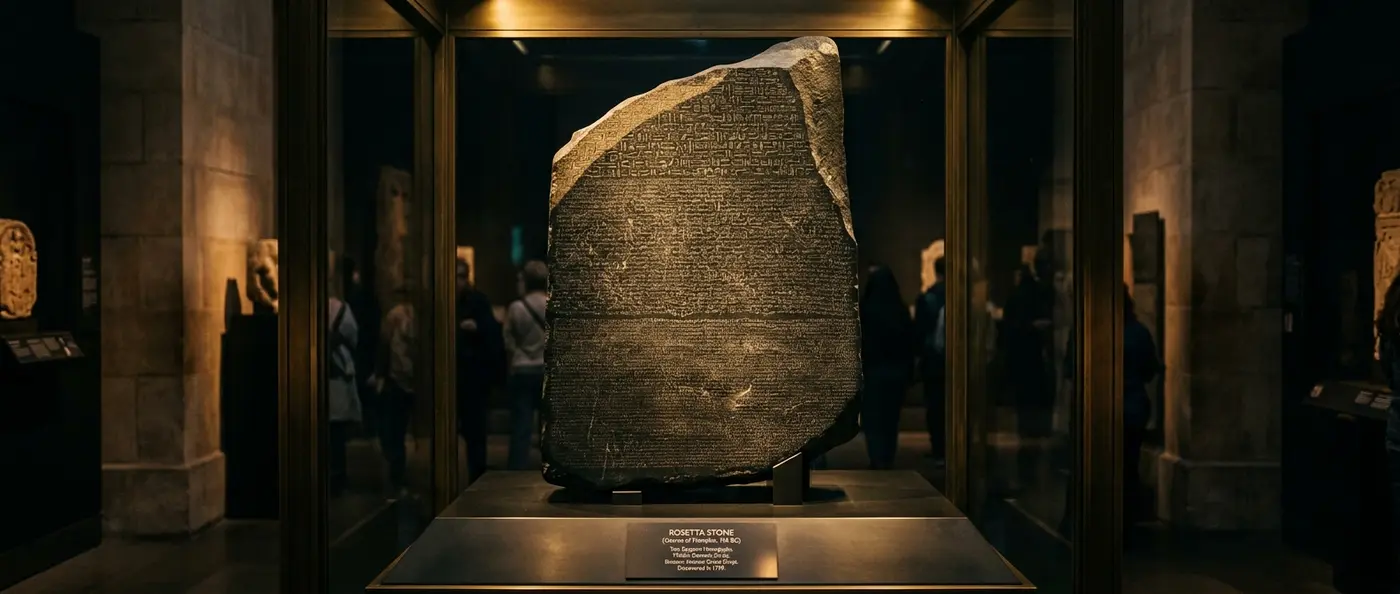
Summer 1799. Napoleon's soldiers were building fortifications in Rashid, the ancient town of Rosetta, when officer Pierre François Bouchard spotted something unusual embedded in an old wall. A slab of granodiorite, 112 centimeters tall and weighing 760 kilograms, covered in strange inscriptions.
What made this rock extraordinary wasn't its size. Three different scripts told the same story: ancient Greek, hieroglyphics, and demotic script — a simplified form of Egyptian writing. Bouchard immediately grasped what he'd found. Here was the key to scripts that had remained unreadable for centuries.
When the French lost to Ottoman and British forces in 1801, the Rosetta Stone traveled to the British Museum as part of the Treaty of Alexandria. It sits there today, despite Egypt's repeated calls for its return.
📜 A Royal Decree in Stone
The Greek text revealed the stone's purpose: a royal decree from 196 BCE honoring young King Ptolemy V Epiphanes on his first coronation anniversary. This wasn't just ceremonial fluff. The Macedonian Greek pharaoh needed to cement his authority after native Egyptian revolts and invasions by the neighboring Seleucid Empire had shaken his kingdom.
The inscription proclaims Ptolemy as "the god who manifests himself" and details his promises: funding temples and animal cults, increasing priestly incomes, reducing taxes, and pardoning prisoners. In return, his statues would grace every temple, with priests tending them three times daily.
Political spin, carved in stone. But this propaganda piece would become the skeleton key to an entire civilization.
⚔️ The Battle for Decipherment
By 1802, a Swedish diplomat had made some progress deciphering demotic words, using its similarity to Coptic — an Egyptian language that, like Latin, was no longer spoken but still understood.
Real breakthrough came in 1819. British scholar Thomas Young published an Encyclopedia Britannica article defining 218 demotic words and connecting them to roughly 200 corresponding hieroglyphs. He cracked the phonetic hieroglyphs for "Ptolemy." But Young suspected only names and foreign words were phonetic — everything else remained symbolic.
Enter Champollion. He disagreed with Young completely. The hieroglyphs formed a complete alphabet that could be decoded. Systematically matching ancient Greek and Coptic words to hieroglyphs, he gradually revealed their sounds.
Champollion's Method
Systematically matched Greek and Coptic words to hieroglyphs, building a phonetic decryption system from the ground up.
The Breakthrough Insight
Unlike Young, he believed all hieroglyphs — not just names — could be read phonetically, opening the entire language.
Coptic Knowledge
His deep knowledge of Coptic, the final phase of the Egyptian language, proved crucial to his success.
💡 The Moment of Revelation
Legend claims Champollion fainted for a week when he first realized he'd decoded the entire text. Probably myth, but his excitement was real. September 27, 1822: he announced his discovery to the Académie des Inscriptions et Belles-Lettres in Paris, where his rival Young heard about his achievement.
📖 Read more: Ancient Egypt's Millions of Mummified Animals Revealed
This wasn't just solving a linguistic puzzle. It was the key that unlocked an entire civilization. Suddenly, thousands of tomb inscriptions, temple carvings, and papyrus scrolls could be read. Ancient Egyptian voices, silent for over a millennium, could finally be heard again.
🔍 Why Was the Rosetta Stone So Crucial?
The stone contained identical text in three scripts. Since scholars could read ancient Greek, they could use it as a "dictionary" to decode hieroglyphics and demotic script. Without this trilingual inscription, decipherment would have been nearly impossible.
🏛️ Birth of Egyptology
Translating the Rosetta Stone essentially created the field of Egyptology. Thanks to this discovery, scholars could understand the sophisticated civilization that emerged on the Nile's banks over 5,000 years ago and survived for millennia.
Today, because of the Rosetta Stone, we've unlocked the intricate rituals and religious beliefs governing life and death in the Book of the Dead. We've reconstructed the complex mummification recipes ancient Egyptians used to preserve their dead. We have detailed pictures of daily life for both kings and commoners, and we've untangled the stories of dynasties that ruled for thousands of years.
🔬 Modern Discoveries and the Rosetta Legacy
The decipherment's impact continues today. Recently, archaeologists used our ability to read hieroglyphs to identify a sarcophagus fragment belonging to Ramesses II, one of ancient Egypt's most famous pharaohs. In 2024, Egyptologist Frédéric Payraudeau deciphered a neglected cartouche (oval shape containing a pharaoh's name) that definitively connected Ramesses II to the sarcophagus.
Even more impressive is the recent discovery in the ancient city of Athribis in Upper Egypt. An Egyptian-German archaeological mission uncovered 13,000 inscribed pottery fragments, known as ostraca, including over 130 texts related to ancient astrology. This discovery brings the total number of ostraca found at the site to approximately 43,000, making it the largest collection of its kind ever recovered from a single location in Egypt.
📊 Archaeological Discovery Comparison
🌟 Timeless Significance
The Rosetta Stone remains one of humanity's most important objects. Not just an ancient text — it's the bridge connecting the modern world to one of the past's most brilliant civilizations. Without it, ancient Egypt would remain a silent civilization, full of impressive monuments but without a voice.
Today, as Egypt continues demanding the stone's return to its homeland, the issue remains complex. The stone has been displayed at the British Museum since 1802, where millions of visitors can see it annually. Regardless of where it physically resides, its legacy belongs to all humanity — a symbol of human curiosity's power and persistence in seeking knowledge.
The Rosetta Stone's story reminds us that great discoveries rarely happen in a moment. It took 23 years from its discovery to complete decipherment, and the work of many scholars from different countries. It's proof that knowledge has no borders and that collaboration — even between rivals — can lead to extraordinary results.