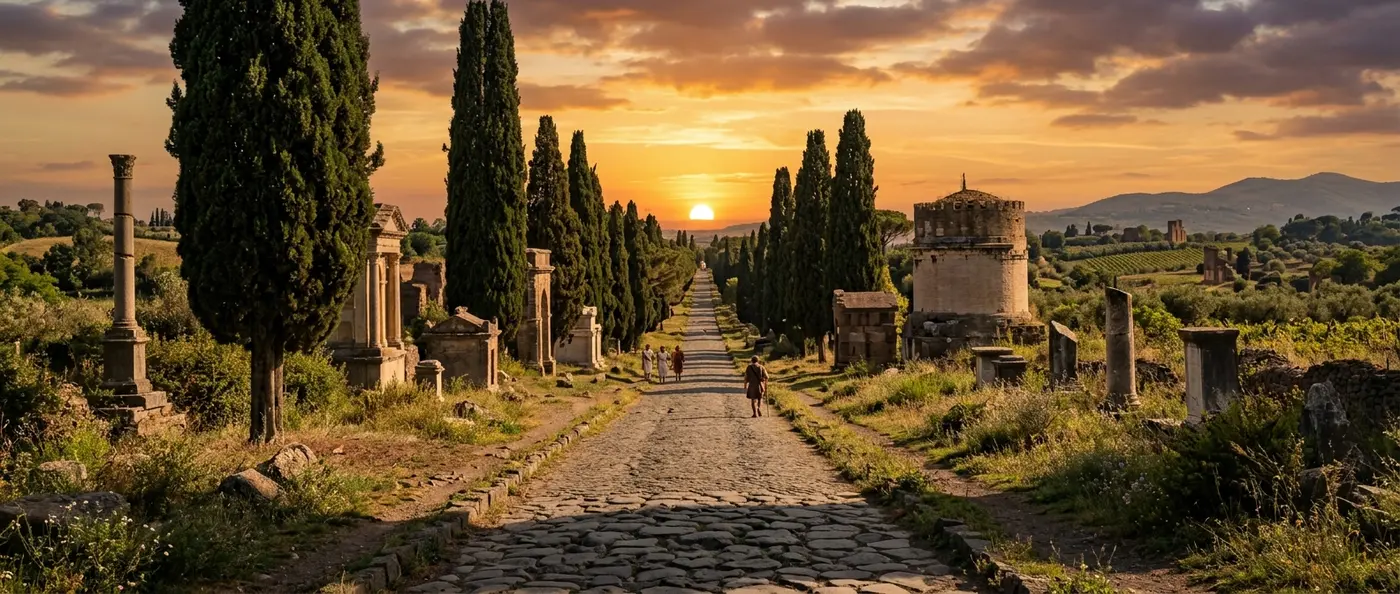
Beneath a McDonald's on Rome's outskirts, the remains of a road that once symbolized an entire empire's power lie preserved under glass. The Via Appia — known as Regina Viarum, the Queen of Roads — wasn't just pavement. It was the artery that pumped Roman expansion across 360 miles from Rome to Brindisi, carrying legions, goods, and ideas that would reshape the ancient world.
📖 Read more: Roman Roads: The Network That United an Empire
🛤️ Birth of Europe's First Superhighway
In 312 BC, Roman administrator Appius Claudius launched a project that would forever change how humans traveled and communicated. The Via Appia represented Roman engineering at its peak. Slaves and workers removed roughly 44,000 cubic meters of earth and stone for every mile paved with basalt.
Appius Claudius broke tradition by naming the road after himself — a bold move that showed just how crucial this project was to Rome's future. Tragically, he went blind and died before his masterwork was complete.
Building the road was a colossal undertaking. Roman engineers designed the route to run nearly straight, cutting through mountains, valleys, and marshes. The roadway stretched 13.5 feet wide — enough for two carts to pass in opposite directions. The surface was covered with massive basalt stones, placed with such precision that many remain in position today.
⚔️ The Highway of Conquest
The Via Appia wasn't built for sightseeing. It was a military weapon, designed for rapid legion movement toward southern Italy and eastern ports. From there, Roman armies boarded ships to conquer new territories in the East.
Along the route, Romans built stations every 10 miles for changing horses and inns every 20 miles for overnight stays. This system allowed messengers to cover vast distances in record time, carrying news and orders from Rome to distant provinces.
The road became a commercial artery too. Merchants transported wine, oil, grain, and luxury goods from the East. Animals, slaves, and ideas also traveled along the Via Appia, spreading Roman culture across the known world.
📖 Read more: Roman Camps: 1,700-Year-Old Discoveries in Germany
🏛️ Tombs and Monuments Along the Way
Because Roman law banned burials within city walls, the Via Appia became a massive cemetery. Wealthy Romans built imposing mausoleums along the road, competing for who could create the most impressive monument.
One of the most famous monuments is the tomb of Caecilia Metella, built in the 1st century BC. Standing 36 feet tall and clad in travertine, this cylindrical tomb of a Roman noblewoman still dominates the landscape. During the Middle Ages, the tomb was incorporated into a fortress, the Castrum Caetani.
Along the road we also find the famous catacombs — underground cemeteries carved into soft rock. The Catacombs of San Sebastiano contain labyrinthine tunnels with thousands of graves. Here lies Gian Lorenzo Bernini's final work — a bust of Christ carved from white marble.
Mausoleum of Caecilia Metella
Cylindrical 1st century BC tomb, 36 feet tall, later incorporated into a medieval fortress.
Catacombs of San Sebastiano
Underground cemetery with thousands of graves and Bernini's final sculpture.
Villa dei Quintili
Luxury villa that Emperor Commodus allegedly killed its owners to acquire.
📜 Historical Accounts and Literature
The first recorded journey on the Via Appia was by Latin poet Horace, around 35 BC. In his poem he describes travel hardships, uncomfortable inns, and annoying mosquitoes in the marshes.
Centuries later, in 1846, Charles Dickens described the road as filled with "temples and tombs, overturned and fallen." His description reflects the decay the Via Appia had suffered after the Roman Empire's fall in 395 AD.
The phrase "all roads lead to Rome" was inspired partly by the Via Appia and the other 28 roads that began from the capital. This road network allowed Rome to control a vast empire for centuries.
📖 Read more: Roman Gladiators: The Brutal Truth Behind the Arena
🗺️ Modern Revival of the Ancient Road
Today, much of the Via Appia lies buried beneath the asphalt of modern Strada Statale 7. But in 2015, the Italian government announced an ambitious plan to revive the historic road as a pilgrimage route.
Writer Paolo Rumiz and hiker Riccardo Carnovalini spent two months combining military maps, ancient shepherd paths, and satellite images to remap the route. Their work caught the attention of the Ministry of Cultural Heritage.
Architectural firm Studio Costa proposes 29 walking sections, each lasting about six hours. Travelers would explore ancient theaters, sleep in simple hostels, and taste local delicacies. An app would mark rest stops, accommodations, and attractions.
💡 McDonald's Meets Ancient Rome
At a McDonald's in Rome's suburbs, customers can enjoy their meal over a glass floor revealing ancient Via Appia stones and skeletons in a 2,000-year-old drain. When this road section was discovered in 2014, locals feared it would be buried again. Instead, it became a museum visitors can see without entering the restaurant.
🏺 Archaeological Discoveries and Conservation
Archaeological work continues along the Via Appia. At Villa dei Quintili, conservation students restore mosaic floors under specialist Serena di Gaetano's supervision. "This palace, if well preserved, can give tourists the complete experience of life in ancient Rome," she says.
At Italy's Central Institute for Restoration, specialist Adriano Casagrande repairs a bust known as the "Philosopher's Head" found in Villa dei Quintili excavations. New finds emerge each excavation season.
Archaeologist Pamela Cerino, who excavated the section beneath McDonald's, explains that many archaeological sites get reburied for conservation due to high maintenance costs. That's why glimpses of the ancient Via Appia are rare and precious.
📖 Read more: Pompeii: The City Buried Alive in 79 AD
🌾 The Via Appia Today: A Journey Through Time
Walking today's 11-mile stretch of Via Appia preserved as an archaeological park in Rome offers a unique experience. Wheel ruts from ancient carts remain visible in the basalt stones. Shepherds still drive their flocks along the road, like the scene from Fellini's "La Dolce Vita" where Anita Ekberg drives among sheep.
The route crosses four regions and one hundred towns, transforming from forest path to town square to modern highway. Rough and unpolished in places, it shows visitors an Italy most tourists never experience.
Before the pandemic, Rome's Via Appia Archaeological Park received about 100,000 visitors annually — tiny compared to the millions visiting the Forum downtown. The new plan hopes to change this, transforming the ancient road into a destination combining history, nature, and authentic Italian culture.
📊 Via Appia by the Numbers
🔮 The Ancient Road's Future
The vision for Via Appia is to become Italy's answer to America's Route 66 — not just a road, but an experience. Angelo Costa from Studio Costa explains that the "less-is-more" approach aims not to polish the rough sections, but to offer an honest experience.
As hiker Riccardo Carnovalini puts it, "walking is the most political act one can do to change the landscape." Walking the Via Appia, modern pilgrims will follow the footsteps of legions, merchants, slaves, and emperors.
The Via Appia symbolizes something deeper than a simple road. It's proof that great infrastructure can survive millennia. It's a bond with the past that reminds us humans always needed to connect, travel, explore. And perhaps, as Italy works toward its revival, the Regina Viarum will continue inspiring travelers for another two thousand years.