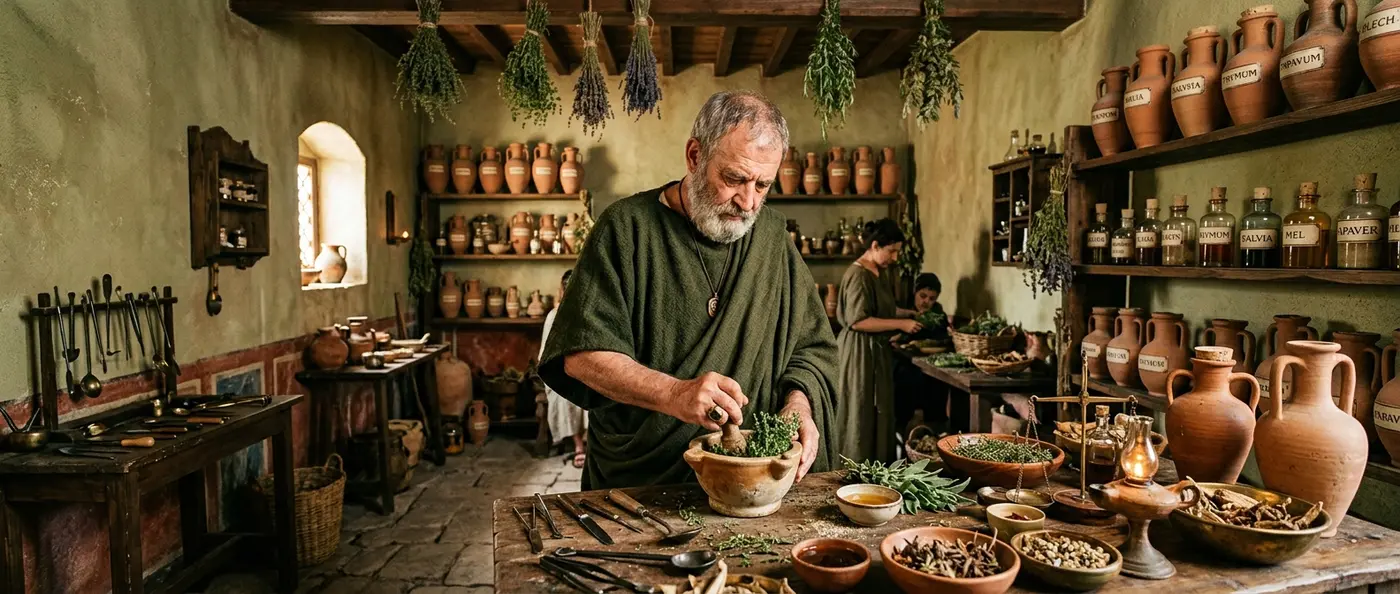
Dark brown flakes inside a 1,900-year-old glass vial have delivered the first direct chemical proof that Roman doctors actually used human excrement as medicine — and mixed it with thyme to mask the stench. The discovery, published in January 2026, came from a Roman unguentarium (medicine container) found in ancient Pergamon — birthplace of Galen, one of antiquity's most influential physicians — and confirms texts that scholars had dismissed for centuries as impossible.
📖 Read more: Hippocrates and Galen: Fathers of Medicine
🏺 The Discovery in Bergama Museum's Storage
The story began in the storage rooms of Turkey's Bergama Museum, where archaeologist Cenker Atila from Sivas Cumhuriyet University noticed that certain glass vessels contained residues overlooked for decades. "While working in the storage of Bergama Museum, I observed that some glass vessels contained residues," Atila explained. "Residues were found in a total of seven different vessels, but only one gave definitive results." The crucial vessel was an unguentarium — a thin glass vial shaped like a candlestick, the standard container for pharmaceutical preparations throughout the Roman Empire. Dating to the 2nd century CE, it came from an era when Pergamon ranked among the most important medical centers in the Roman world. When they opened it, there was no foul odor — after nearly two millennia, the contents had dried into dark brown flakes.
The research team used gas chromatography-mass spectrometry (GC-MS) to identify organic compounds in the dark residue. Two compounds they detected — coprostanol and 24-ethylcoprostanol — are characteristic fecal biomarkers, substances found in the digestive systems of animals that metabolize cholesterol. The ratio between these two stanols indicated human origin — not animal. "The consistent identification of stanols — validated fecal biomarkers — strongly suggests that the Roman unguentarium originally contained fecal material," the researchers wrote in their study, published in the Journal of Archaeological Science Reports.
🌿 Thyme: Ancient Aromatic Camouflage
The second major discovery inside the unguentarium was carvacrol — an aromatic organic compound found in essential oils of certain herbs, primarily thyme. "In this sample we detected human feces mixed with thyme," Atila explained. "Since we know the ancient written sources well, we immediately recognized this as a pharmaceutical preparation used by the famous Roman physician Galen." The use of aromatic herbs to mask odor wasn't random — ancient doctors knew their patients would refuse foul-smelling medicines, so they often added fragrant herbs, wine, or vinegar. This practice proves Roman pharmacology wasn't simple superstition — it was a system with practical solutions to real patient compliance problems.
Feces-based medicines weren't isolated phenomena in Roman healthcare. Several popular copro-therapies targeted inflammation, infections, and reproductive disorders. Galen himself described the therapeutic value of feces from children who had eaten legumes, bread, and wine — believing the "donor's" diet affected the preparation's medicinal properties. Roman doctors worked within the theory of four humors: blood, phlegm, yellow bile, and black bile. Every substance — even feces — was thought to possess specific properties (hot, cold, wet, dry) that could restore the body's lost balance.
The unguentarium is a thin glass or ceramic vial used throughout the Roman world for storing perfumes, herbal extracts, and pharmaceutical preparations. Its characteristic narrow neck prevented evaporation and kept contents in good condition. They're found at archaeological sites across the Roman Empire, often in tombs or medical facilities.