📖 Read more: Roman Baths: Where Society, Politics, and Power Converged
⚔️ How Rome Perfected the Art of Breaking Things
Romans didn't invent siege warfare. They stole it, studied it, then made it deadlier than anyone before them. Greeks gave them the basic principles. Carthaginians taught them naval siege tactics. Assyrians showed them battering rams and towers. But what made Rome unstoppable was their systematic approach — and their ability to adapt every technique to fit the job at hand.
Roman siege engineering wasn't just about bigger machines. Every legion carried specialized engineers called fabri who could build siege engines on-site using local materials. Tree becomes ram. Rocks become ammunition. This flexibility gave Rome a massive advantage during long campaigns where supply lines stretched thin.
Training made the difference. Every legionnaire learned to assemble a catapult, operate a ram, build protective structures. If the specialists died in battle, the siege continued. This redundancy meant Roman sieges rarely failed due to technical problems — they succeeded through sheer mechanical persistence.
🏗️ The Killing Machines That Built an Empire
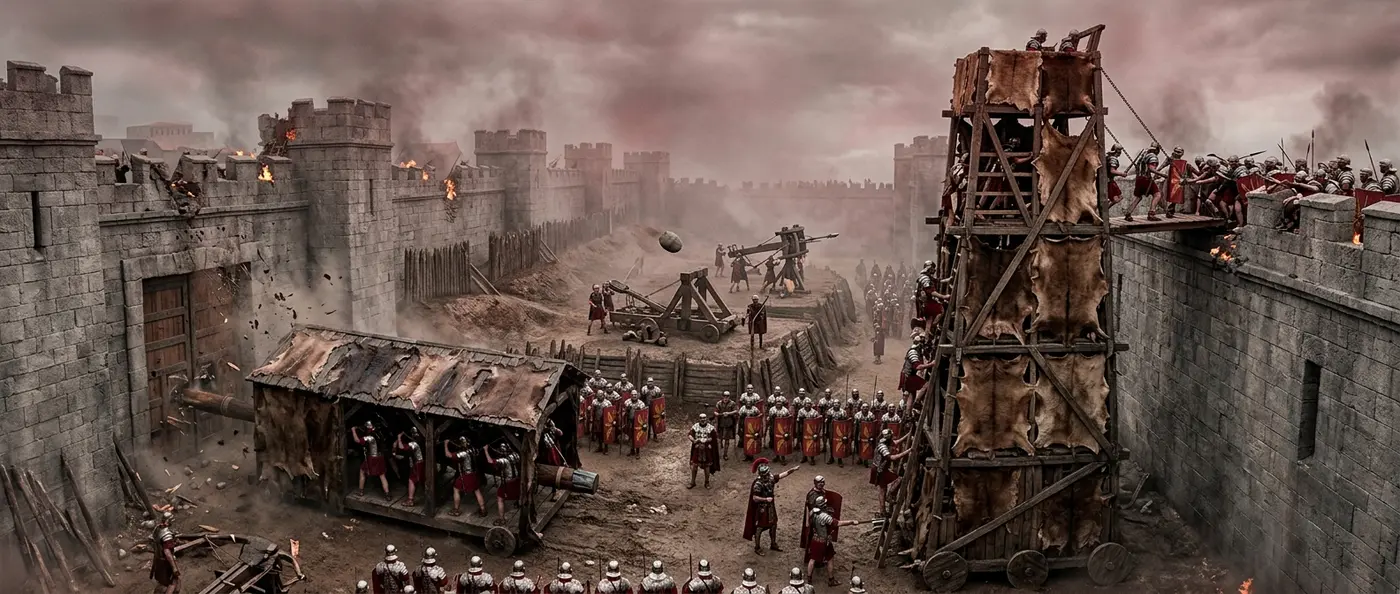
The aries — the battering ram — was Rome's signature weapon of destruction. Picture a tree trunk the size of a telephone pole, capped with a bronze ram's head, suspended by chains inside a protective frame. These monsters weighed several tons and required dozens of men swinging in perfect rhythm to punch through stone walls. The sound alone could break defenders' morale before the first stone cracked.
Ballistas turned warfare into a precision science. These giant crossbows could drive 10-foot bolts through multiple soldiers at 500 yards. Roman engineers calibrated them using mathematical tables that calculated rope tension based on projectile weight and desired range. The smaller scorpio variants picked off individual defenders with sniper-like accuracy.
Siege towers were mobile skyscrapers of death. Rising up to 100 feet tall, covered in fire-resistant hides soaked in vinegar, these rolling fortresses carried hundreds of soldiers to the same level as city walls. When the tower reached the wall, a drawbridge dropped and legionnaires poured out like an avalanche of steel and fury.
🔥 Psychological Warfare and Underground Terror
Romans understood that breaking minds was often easier than breaking walls. Their circumvallatio tactic — completely surrounding a city with Roman fortifications — created a prison of despair. Watching Roman walls rise higher each day, knowing escape was impossible, drove many cities to surrender before the real attack began.
Underground warfare was Rome's secret weapon. Teams of sappers, protected by mobile shelters called vineae, dug tunnels beneath enemy walls. Once they reached the foundation, they packed the tunnel with timber and set it ablaze. As the wooden supports burned away, entire sections of wall collapsed into the void.
Romans pioneered biological warfare. Catapults hurled diseased animal carcasses — sometimes human corpses — into besieged cities to spread plague. They poisoned water supplies. Fire wasn't just for burning buildings; it created panic, confusion, and the psychological terror that preceded surrender.
Construction Speed
Roman engineers could build a complete siege tower in under a week using local timber and prefabricated metal fittings they carried with the army. Speed meant surprise, and surprise meant victory.
Mathematical Precision
Ballista operators used calculation tables to determine rope tension based on projectile weight and target distance. Roman siege warfare combined brute force with engineering mathematics.
Protective Innovation
Testudo formations and mobile shelters protected soldiers approaching walls. Covered in wet hides and metal plates, these "tortoises" were nearly invulnerable to arrows and fire.
🏛️ Legendary Sieges That Changed History
Jerusalem, 70 AD. Titus commanded four legions and countless siege engines against the holy city. Romans built a 4-mile wall around Jerusalem in just three days. Catapults bombarded the walls with 55-pound stones. The siege lasted months, ending with the temple in flames and the city in ruins.
Masada presented an impossible challenge: a fortress on a 1,300-foot cliff. Roman solution? Build a ramp. They constructed a massive earthwork 300 feet high using thousands of tons of stone and dirt. Months of backbreaking labor brought their siege engines to the walls. The fortress fell, but its defenders chose death over slavery.
📖 Read more: Spartan Agoge: History's Most Brutal Military Training
Syracuse (214-212 BC) proved even Roman technology had limits. Archimedes, the brilliant mathematician, designed defensive machines that neutralized Roman advantages. Cranes with claws overturned ships. Mirrors focused sunlight to burn sails. Improved catapults outranged Roman artillery. The city fell only through betrayal, not superior technology.
💡 The Secret of Roman Success
Romans weren't just destroyers. After capturing a city, they often rebuilt it better than before, incorporating Roman technology like aqueducts, roads, and public baths. This "destroy and rebuild" policy ensured long-term loyalty to Roman rule.
⚓ Naval Siege Warfare: Dominating the Seas
The bronze ram discovered off Sicily reminds us that Roman siege craft extended beyond land. Naval rams were the primary weapon of ancient warships, designed to punch through wooden hulls below the waterline. This particular ram, decorated with a relief of a Roman Montefortino helmet with three feathers, showcases the technical and artistic skill Romans brought to warfare.
Naval siege required different tactics than land warfare. Romans developed the corvus — a rotating bridge with a hook that let legionnaires turn sea battles into land fights on enemy decks. They used incendiary projectiles and specialized fire ships to burn enemy fleets in their harbors.
For coastal cities, Romans combined land and sea forces. While legions besieged from land, the fleet blockaded harbors, preventing supplies and reinforcements. Floating catapults mounted on special ships bombarded coastal walls from the sea, creating a devastating crossfire.
🛡️ The Legacy of Roman Siege Warfare
Roman siege principles outlasted the empire itself. The fundamental concepts they developed — systematic approach, combining technology with psychology, adaptability — remain core to modern military thinking. Medieval siege towers, trebuchets, even early cannons built on Roman foundations.
Leonardo da Vinci studied Roman designs to create his war machines. The concept of "shock and awe" used in modern warfare traces back to Roman psychological tactics. Roman siege craft worked because of organization, not just better machines.
Moving thousands of men and tons of equipment across continents, then maintaining sieges for months — this demanded logistics few armies could manage. Romans built better systems, not just better machines.
📊 Roman Siege Engine Specifications
🔬 Modern Discoveries and New Insights
The bronze ram discovery off Sicily is just one of many finds enriching our understanding of Roman military technology. Archaeologists have located swords, coins, and other battle debris from the 241 BC naval engagement. Each artifact tells us more about how Rome dominated the Punic Wars and established Mediterranean supremacy.
Modern analysis techniques show details invisible to earlier archaeologists. Metallographic analysis of the ram shows the exact bronze alloy composition, revealing advanced Roman metallurgical knowledge. 3D scanning allows digital reconstruction of entire ships from single fragments.
Each new find changes what we know about Roman warfare. The Mediterranean floor holds more Roman wrecks. Sonar surveys have identified dozens of potential sites off the Italian coast alone.