📖 Read more: Roman Decimatio: The Army's Most Brutal Punishment
⚓ From Farmers to Fleet Commanders
Rome started as landlubbers. Until the 3rd century BC, Romans were farmers and foot soldiers who viewed the sea with deep suspicion. The Mediterranean belonged to others — Carthaginians, Greeks, pirates. That changed when Carthage forced Rome's hand during the Punic Wars.
In 260 BC, Romans achieved what seemed impossible — learning naval warfare from scratch. They built 120 warships in just 60 days, reverse-engineering a Carthaginian vessel that had run aground on their shores. This breakneck construction speed became Rome's signature move — practical, efficient, and utterly ruthless.
The game-changer was the corvus — a hinged boarding bridge with a massive spike that could slam down onto enemy decks. Suddenly, sea battles became land battles fought on wooden platforms. Romans couldn't out-sail experienced Carthaginian crews, but they could sure as hell out-fight them once they got close enough to board.
🏛️ Building a Naval Machine
Rome approached naval organization like everything else — systematically and without sentiment. The fleet split into permanent bases (classes) and mobile squadrons (squadrae) that could deploy anywhere trouble erupted.
Two massive naval bases anchored the system: Classis Misenensis near Naples controlled the western Mediterranean, while Classis Ravennatis in Ravenna dominated the Adriatic and eastern waters. Each base housed hundreds of ships and thousands of sailors — floating cities that could project Roman power across the known world.
The naval hierarchy mirrored the army's structure. A praefectus classis (fleet commander) sat at the top, followed by navarchi (ship captains) and centuriones classici (naval centurions). Sailors served 26-year terms and earned Roman citizenship upon discharge — powerful motivation for the many non-Romans who crewed the ships.
⚔️ Ships That Ruled the Waves
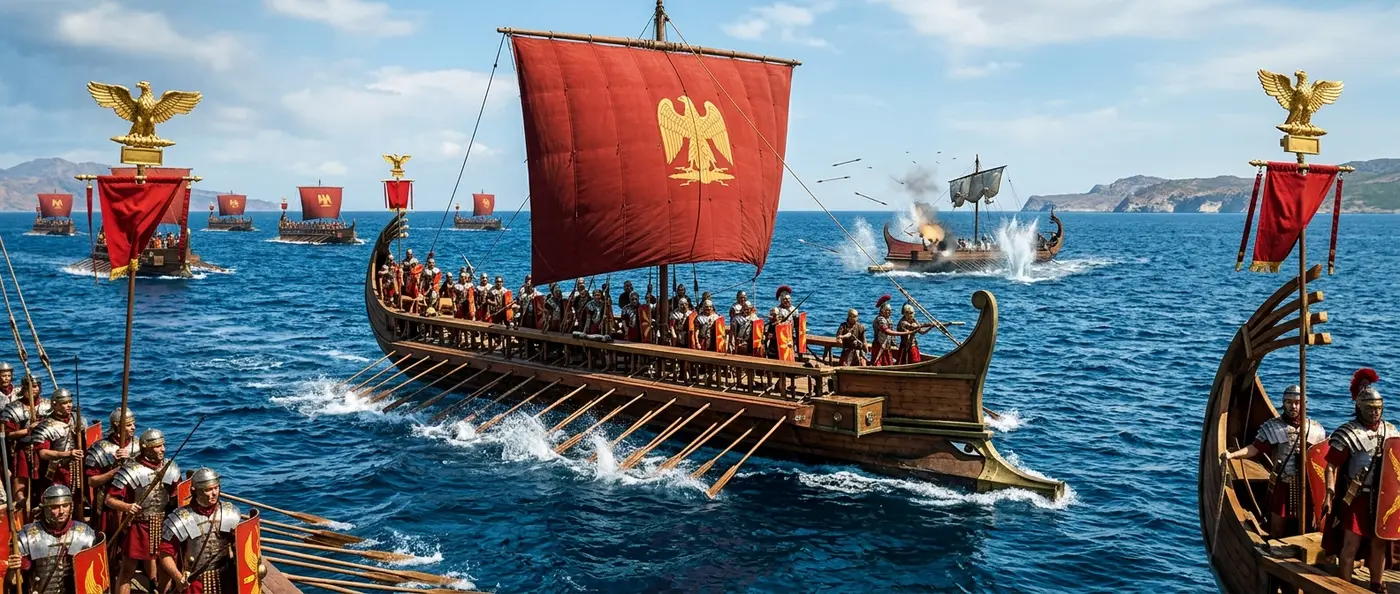
Triremes and quinqueremes formed the backbone of Roman naval power — ships with three and five rows of oarsmen that combined speed, maneuverability, and devastating ramming force. These weren't just boats. They were floating battering rams designed to punch holes in enemy hulls.
Beyond the heavy hitters, Rome deployed specialized vessels for different missions. Liburnas — light, fast ships perfect for patrol duty and chasing pirates. Onerariae — massive cargo vessels that could haul 1,200 tons of grain, weapons, and troops across the Mediterranean. Each ship type had its role in Rome's naval ecosystem.
Trireme
170 oarsmen, 37 meters long, 8 knots top speed. The workhorse warship with bronze ram for punching through enemy hulls.
Quinquereme
300 oarsmen, 45 meters long, heavy armament. Floating fortresses with catapults and fighting towers.
Liburna
Light and fast, 50-80 oarsmen. Perfect for patrols, pirate hunting, and hit-and-run attacks.
🗺️ Mare Nostrum: When Rome Owned the Sea
After crushing Carthage in 146 BC and conquering Greece, the Mediterranean became a Roman lake. "Mare Nostrum" wasn't propaganda — it was simple fact. Rome controlled every major port, every trade route, every strategic island from Gibraltar to the Levant.
The result was wealth on a scale the ancient world had never seen. For the first time in history, the entire Mediterranean was safe for commerce. Ships could sail from Spain to Syria without fear of pirates. Egyptian grain, African olive oil, Spanish metals — everything flowed freely toward Rome's hungry markets.
The Pax Romana at sea lasted nearly three centuries. During this golden age, the Roman Navy operated more like a coast guard than a battle fleet, hunting pirates and protecting merchant vessels. Trade flourished. Cities grew. The Mediterranean world had never seen such peace and prosperity.
💡 The Secret of Roman Success
Romans weren't natural sailors like Greeks or Phoenicians. Their genius lay in adaptation — taking the best ideas from everyone else and improving them. The corvus epitomized Roman thinking: if you can't win their game, change the rules.
📖 Read more: Roman Gladiators: The Brutal Truth Behind the Arena
🏺 Life Aboard the Fleet
A Roman sailor's life was tough but not without rewards. Most crews came from the eastern provinces — Greeks, Syrians, Egyptians — people with maritime traditions in their blood. Daily routine meant rowing practice, ship maintenance, and combat drills under the Mediterranean sun.
Ship rations centered on bucellatum (hardtack biscuits), posca (sour wine mixed with water), olives, cheese, and salted meat or fish. On long voyages, ships carried live animals for fresh meat. Water stored in clay jars often got mixed with vinegar to prevent spoilage — not exactly fine dining, but it kept crews alive and fighting.
Despite the hardships, naval service offered steady pay, medical care, and the promise of Roman citizenship. Many veterans settled in coastal towns after discharge, creating communities that preserved naval traditions and provided experienced recruits for future generations.
🔱 Battle Tactics That Changed Naval Warfare
Roman naval tactics evolved dramatically from the Punic Wars to the imperial period. Early battles relied on the corvus and boarding actions, but Romans gradually adopted more sophisticated techniques as they gained experience.
The basic tactic was ramming — ships accelerated to full rowing speed and smashed into enemy vessels with bronze-reinforced prows. Another technique was diekplous, where Roman ships broke through enemy lines, snapping oars and creating chaos in tight formations.
The Battle of Actium in 31 BC showcased peak Roman naval skill. Agrippa, Octavian's admiral, used lighter, more maneuverable ships to defeat the heavy fleet of Mark Antony and Cleopatra. Agrippa proved that smart beats strong — a principle Roman admirals never forgot.
⚔️ Naval Power Comparison
🏰 Ports and Naval Infrastructure
Roman naval supremacy rested on an extensive network of harbors and naval bases. Portus, the artificial harbor built by Claudius and expanded by Trajan near Ostia, was an engineering marvel — a hexagonal basin that could shelter hundreds of ships from Mediterranean storms.
Every major port featured shipyards (navalia) for construction and repair, warehouses (horrea) for supplies, and barracks for crews. Lighthouses like the famous Pharos of Alexandria, maintained by Roman engineers, guided ships safely to harbor through treacherous coastal waters.
The communication system was equally impressive. Signal stations along coastlines transmitted messages via fire and smoke, allowing rapid information flow across the entire Mediterranean. This network was crucial for fleet coordination and maritime security — Rome's version of naval radar.
💀 Decline and Fall
The Roman Navy started dying in the 3rd century AD, starved of money and men. Land-based threats demanded resources, and the navy found itself starved of funding and recruits. Meanwhile, new maritime powers like the Vandals in North Africa challenged Roman dominance.
In 429 AD, Vandals captured Carthage and built a powerful fleet that raided Roman coasts with impunity. The ultimate humiliation came in 455 AD when Vandal ships sailed up the Tiber and sacked Rome itself — an unthinkable scenario during the glory days of Mare Nostrum.
Despite revival attempts by emperors like Justinian, the Roman Navy never regained its former power. The Mediterranean ceased being a Roman lake and became a contested waterway between Byzantines, Arabs, and later the Italian maritime republics. The age of Mare Nostrum was over.