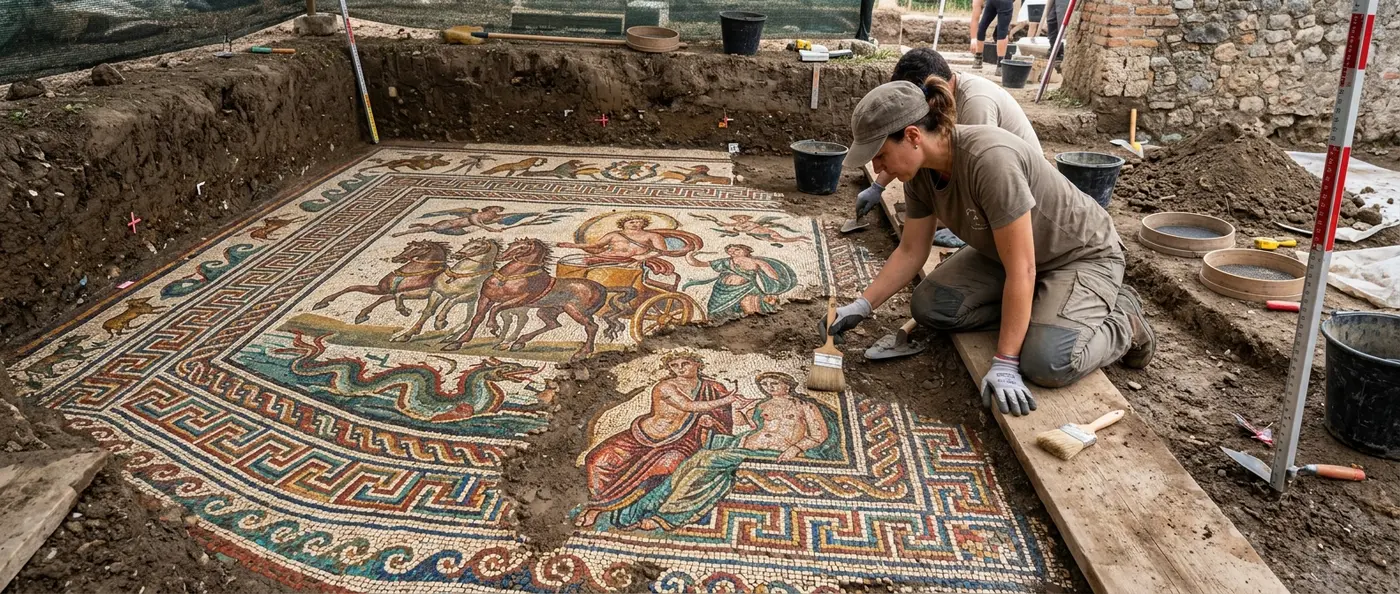
Picture the world's most impossible jigsaw puzzle. Thousands of fragments. No box cover. No corner pieces. And every piece is 1,800 years old. That's what conservators at the Museum of London Archaeology faced when they dumped crates of shattered Roman fresco onto their lab tables. Three months later, they'd reconstructed wall paintings that hadn't been seen since the 2nd century AD — intricate mosaics that once decorated 20 walls of a Roman villa discovered beneath London's Southwark district in 2021.
🏛️ The Art of Roman Mosaics
Roman mosaics have outlasted temples, aqueducts, and entire cities. Built from tiny cubes of stone, glass, or ceramic called tesserae, these artworks covered floors, walls, and ceilings across the entire Roman Empire. The technique demanded extraordinary patience and skill — a single misplaced cube could ruin an entire face or destroy a flowing line.
Mosaic art in Rome began with simple geometric patterns before craftsmen mastered complex mythological scenes, portraits, and daily life vignettes. Roman craftsmen developed new techniques that allowed incredibly detailed images with stunning color variety. They turned floors into canvases depicting anything from simple borders to elaborate hunting scenes.
🎨 Construction Techniques and Materials
Creating a Roman mosaic was a complex process requiring collaboration between multiple specialized craftsmen. First, the pictor imaginarius sketched the design on paper or directly onto the surface. Then the tessellarii carefully placed each piece in position, using special lime-based adhesive to lock them in place.
Materials varied depending on the mosaic's location and importance. For floors, they preferred durable stones like marble and granite that could withstand foot traffic. For walls and ceilings, where light reflection mattered, they used glass tesserae that created spectacular optical effects. According to Britannica, glass use in mosaics peaked in the 5th century AD, when entire mosaics were constructed from this material.
Stone Tesserae
Marble, granite, and other natural stones cut into small cubes. Used primarily on floors due to their resistance to wear from footsteps.
Glass Tesserae
Made from molten glass with metallic oxides added for color. Their reflective surface caught and scattered candlelight across walls and ceilings.
Ceramic Tesserae
Economical solution from fired clay, available in various colors. Often used for backgrounds or simple geometric designs.
🗿 The 1,800-Year-Old Puzzle
The Southwark discovery revealed an exceptional example of Roman art in Britain. As Han Li, a building materials specialist at the Museum of London Archaeology, explained, pieces from different walls had mixed together over the centuries, creating an archaeological nightmare. The fragments were extremely fragile and pieces from different walls had mixed together over the centuries.
After three months of painstaking work, the fresco was restored to its original layout. Intricate depictions of birds, fruits, flowers, and lyres emerged, along with ancient graffiti. Particularly intriguing was the discovery of the Latin word "fecit" meaning "made this," framed by decorative hatching that Romans used when signing artworks. Unfortunately, the spot where the signature would have appeared is broken.
💎 Themes and Symbolism
Roman mosaics depicted everything from wine-making to gladiator fights, from family portraits to scenes of the gods. From mythological scenes to nature depictions, every mosaic told a story. In the London discovery, the artists appear to have drawn inspiration from aesthetic trends across the Roman sphere of influence, mimicking designs from modern-day Germany and France.
The yellow color dominating parts of the mosaic is rare for the period, suggesting either special commission or access to unusual materials. The discovery of the Greek alphabet carved into plaster as ancient graffiti adds another dimension. Similar finds in Italy suggest the alphabet was used as a checklist or counting system.
💡 The Secret of Preservation
The mosaic's exceptional preservation resulted from a 3-meter layer of silt that covered it during flooding of the River Aude. This natural "protective blanket" kept colors vibrant and materials intact for nearly two millennia.
🏺 Mosaics and Social Status
Having mosaics in a Roman home wasn't just about aesthetics. It was a clear indicator of wealth and social position. The more complex and colorful the mosaic, the greater the owner's financial capacity. The Southwark villa, with its 20 decorated walls, suggests it belonged to someone with significant standing in Roman Britain.
Based on excavation evidence, the building may have functioned as a commercial property, perhaps related to storing or distributing pottery that arrived in London by ship from across the Roman Empire. This explains the luxury of the decoration — the owner wanted to impress visitors and business partners.
⚖️ Mosaic Technique Comparison
🔬 From Excavation to Museum
The process from discovery to exhibition of an ancient mosaic is long and demanding. In the Southwark case, the archaeology team first had to record each fragment's position before moving it. Every piece was photographed, numbered, and packed in custom foam inserts for the journey to the lab.
In the lab, conservators gently cleaned each fragment of centuries of accumulated dirt. Using special solutions and microscopic tools, they carefully removed deposits without damaging the original surface. Blues and reds emerged as if painted yesterday.
The next step was identifying and categorizing the fragments. Specialists searched for common patterns, colors, and textures that could indicate which pieces belonged to the same wall. This process required exceptional patience and keen observation, as many fragments were smaller than a coin.
🌍 Art's Spread Across the Empire
Mosaic art wasn't confined to Rome or the Italian peninsula. As the empire expanded, craftsmen traveled with it, spreading their techniques to every corner of the Roman world. From Britain to North Africa and from Spain to the Middle East, mosaics became a common feature of Roman architecture.
Each region developed its own variations and styles. In North Africa, for example, mosaics often depicted hunting scenes and wild animals, reflecting the local environment. In the East, Hellenistic tradition influenced more refined and detailed representations. Britain, though on the empire's periphery, produced exceptional examples that combined Roman techniques with local themes.
⚒️ Conservation Tools and Techniques
Conserving ancient mosaics requires specialized tools and techniques that have evolved significantly in recent years. Modern conservators use lasers for cleaning sensitive surfaces, ultrasound for removing hard deposits, and special resins for stabilizing fragile tesserae.
In the London mosaic case, conservators discovered faint designs that ancient artists had carved as guides. These designs, visible only under specific lighting, revealed that artists had changed their minds about certain design elements during construction. A flower within a circle had been sketched but never completed.
Three-dimensional scanning technology now allows researchers to create digital copies of mosaics with incredible accuracy. These digital models can be used for virtual restoration of damaged sections and analysis of construction techniques. They also enable access for researchers worldwide without risking the original's integrity.
Microscopic Analysis
Examination of material composition and identification of their origins through chemical analysis of tesserae.
Multispectral Imaging
Revealing hidden designs and colors invisible to the naked eye through special filters.
📚 The Legacy of Mosaics
Roman mosaic influence extends far beyond the empire's fall. The technique was adopted and evolved by the Byzantines, who used it to create some of the most impressive religious artworks. Churches in Ravenna, Constantinople, and later Venice are adorned with mosaics that continue to amaze visitors.
Today, mosaic art is experiencing a renaissance. Contemporary artists draw inspiration from ancient techniques to create new works that combine tradition and innovation. Schools in Italy, like the Scuola Mosaicisti del Friuli, teach traditional techniques to new generations of craftsmen, ensuring this ancient art won't be lost.
Mosaics discovered today, like London's find, remind us of art's timeless value. Despite nearly two millennia passing, these works continue to speak to us about the people who created them, their values, beliefs, and daily lives. They're windows to the past that help us better understand not only history but the continuity of human civilization.