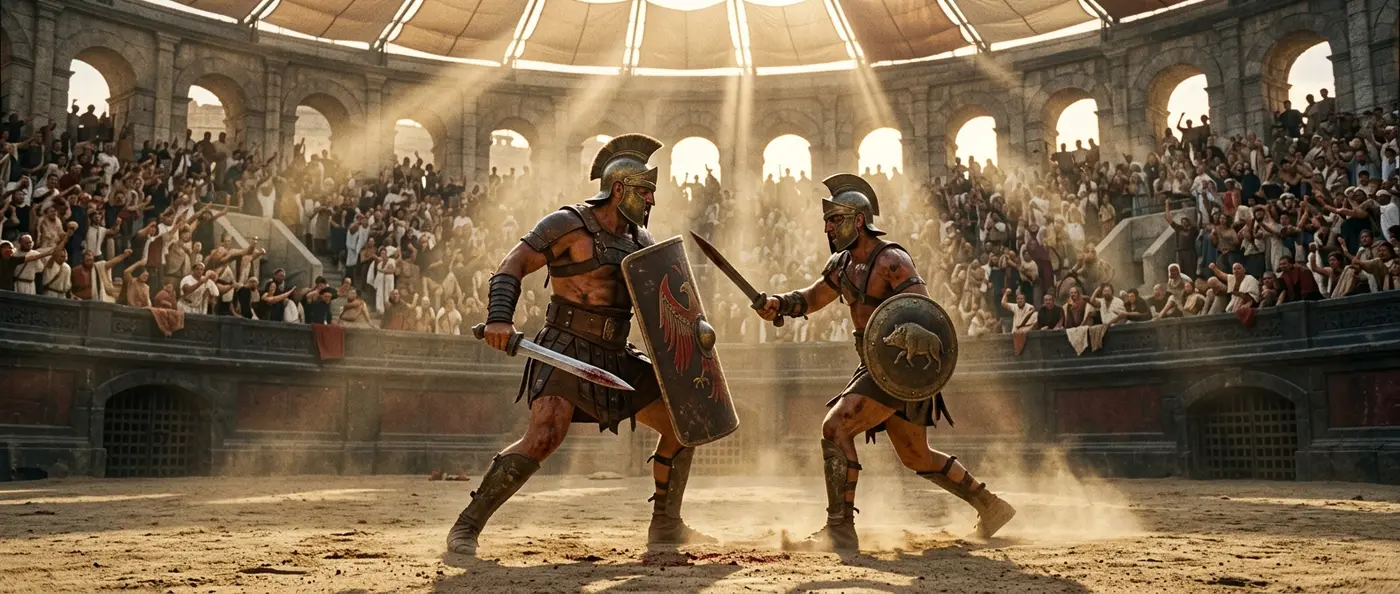
A brown bear skull cracked open in Serbia holds secrets Hollywood never told you. In 2016, archaeologists digging near the ancient amphitheater of Viminacium unearthed the fractured cranium of a 6-year-old male bear, its bones scarred by trauma and infection. This wasn't just another archaeological find — it was the first direct proof that Romans forced bears into their deadly arena games, and the evidence painted a grim picture of years-long captivity before the animal died 1,700 years ago, likely from wounds suffered in combat.
📖 Read more: Roman Slavery: The Dark Engine of Empire
🏛️ The Gladiatorial Machine of Rome
For over six centuries, gladiatorial combat defined Roman entertainment. What started as ritual funeral fights in the 4th century BC evolved into mass spectacles that packed tens of thousands into stone amphitheaters. The Viminacium arena, built in the 2nd century AD, seated roughly 7,000 bloodthirsty spectators who came to watch men and beasts tear each other apart.
Gladiators weren't just slaves thrown into death matches. Many were trained professionals who followed strict rules and specialized techniques. Different gladiator classes wielded distinct weapons and armor combinations. The "venatores" specialized in hunting wild animals, while others fought each other with carefully matched equipment designed to create dramatic, prolonged battles rather than quick kills.
⚔️ Death Rates: Hollywood Got It Wrong
Forget everything Ridley Scott taught you. Gladiators didn't always fight to the death. University of California researcher Alfonso Manas has spent years analyzing the evidence, and the mortality rates tell a story that changes dramatically across centuries.
Early tomb paintings from 4th-century BC Paestum show gladiators taking fatal wounds — spears driven through skulls, blood pooling on arena sand. Death was common in those primitive contests. But after 27 BC, under Augustus and Tiberius, sweeping reforms transformed the games and slashed mortality rates.
💡 The Surrender System
A gladiator could surrender by dropping his shield and raising his index finger. The "summa rudis" — a referee — could also stop fights when death seemed imminent, saving lives that would otherwise be lost.
By the 1st century AD, wall paintings in Pompeii reveal the new reality. Out of every 5 gladiatorial matches, only 1 ended with the loser's death — a 20% mortality rate. This figure held steady through the 2nd century AD, when gladiatorial combat reached its most refined and regulated form.
💰 The Economics of Blood
Gladiators were expensive investments. Virginia Campbell from the Open University explains that gladiators could be rented from their owners by officials organizing games. The contracts were brutal: if a gladiator returned seriously injured or dead, the rental became a purchase, and the price could skyrocket to 50 times the original contract cost.
This economic reality drove down death rates. Organizers had to think twice before ordering a defeated gladiator's execution — they'd face a massive bill to the owner. As mortality dropped, even free citizens began volunteering as gladiators, chasing glory and prize money in the arena.
Death Penalty
If a gladiator died, organizers paid up to 50 times the rental fee to compensate the owner for their lost investment.
Volunteer Fighters
Lower death rates attracted free citizens who signed up voluntarily, seeking fame and financial rewards in the arena.
Rental Contracts
Detailed contracts specified rental terms and compensation rates, treating gladiators as valuable business assets.
📖 Read more: Roman Navy: Mare Nostrum - Masters of the Mediterranean
🗿 Spartacus and the Great Rebellion
The most famous gladiator revolt erupted in 73-71 BC under Spartacus, a Thracian who had served in the Roman army before deserting. Captured and sold into slavery, he was destined for the arena.
In 73 BC, Spartacus and roughly 70 fellow gladiators broke out of a training school in Capua and fled to Mount Vesuvius. There he gathered other escaped slaves, and soon his army numbered at least 90,000 men. He defeated two Roman forces in succession and controlled most of southern Italy.
Spartacus proved himself a capable general who used guerrilla tactics against a powerful, well-organized enemy. He marched north toward the Alps, hoping to disperse his soldiers to their homelands. When his men refused to leave Italy, he turned south toward Sicily.
⚔️ Spartacus Rebellion
Marcus Licinius Crassus finally cornered Spartacus's army with eight legions. In the final battle, the rebel force was annihilated and Spartacus died fighting. Pompey captured many escapees fleeing north, and Crassus crucified 6,000 prisoners along the Appian Way — a gruesome reminder of Rome's power.
🐻 Wild Beasts in the Arena
Gladiatorial games weren't just human combat. The bear skull discovery at Viminacium reveals another dark aspect of Roman spectacles. DNA analysis showed the bear was male, local to the region, and about 6 years old when it died between 240-350 AD.
The skull bore a large frontal trauma that showed signs of healing but also infection. The bear's teeth displayed unusual wear patterns characteristic of captive animals that chew cage bars. Nemanja Marković and his team concluded the animal had been held in captivity for years, not just weeks.
Arena animals served various roles. They could be forced to fight "venatores," battle other animals, execute condemned criminals, or perform trained demonstrations. Previous research indicates animals killed in the arena were butchered nearby, their meat distributed and bones discarded around the amphitheater.
💀 The Untrained Condemned
Not everyone who entered the arena was a trained gladiator. Many were untrained prisoners condemned to death by wild animals. These condemned criminals had no training and often carried no weapons or only the most basic equipment.
They faced starved beasts with the expectation that the animals would tear them apart. These deaths served as "warm-up" entertainment before the real fights between trained gladiators. Because the condemned weren't trained and lacked weapons, they were relatively cheap to acquire.
🔱 Social Control
Placing condemned criminals in the arena served as a deterrent. The message was clear: commit crimes and you might end up here. Entertainment and social control achieved with one brutal spectacle.
📖 Read more: Rome's Via Appia: The Road That Never Ends
📜 The Evolution of Brutality
Gladiatorial mortality rates shifted dramatically over time. The 3rd century AD saw a return to increased brutality. Greater thirst for savagery became popular among the masses, with fights where the defeated wasn't allowed to ask for mercy becoming common again.
Third-century sources suggest one in two fights ended with the loser's death — a return to the high mortality rates of earlier eras. This elevated death rate may have continued into the 4th century. Mosaics at Torrenova show the defeated from a series of gladiatorial matches lying dead.
Gladiatorial games began declining in the 5th century, and the remaining contests probably weren't fought to the death. The gradual spread of Christianity and changes in social values contributed to the eventual abolition of these violent spectacles.
4th century BC
High mortality — most fights ended in death
1st-2nd century AD
20% mortality — reforms and rules reduced deaths
3rd-4th century AD
50% mortality — return to brutality
🏛️ The Gladiatorial Legacy
Despite their brutality, gladiatorial games left an indelible mark on Western civilization. Spartacus's name has been invoked by revolutionaries from Adam Weishaupt in the late 18th century to Karl Liebknecht and Rosa Luxemburg of the German Spartacus League in 1916-19.
Modern archaeology continues revealing new aspects of this phenomenon. The bear skull discovery at Viminacium provides the first direct osteological evidence for brown bear participation in Roman spectacles and offers insight into animal use and treatment in the Roman Empire.
Gladiatorial games were far more than simple entertainment. They reflected Rome's values, economy, and social structure. From trained professional fighters to condemned criminals and captive animals, the arena was a microcosm of Roman society — violent, hierarchical, and spectacular.