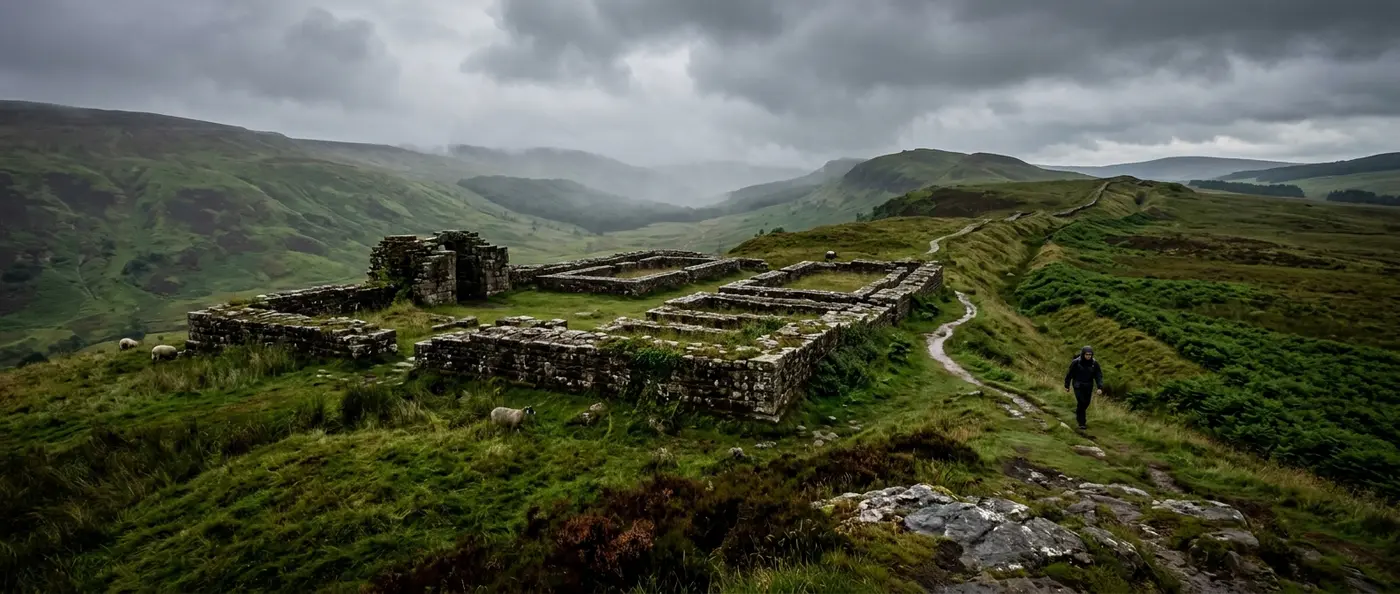
Hadrian's Wall was supposed to be the end of the Roman world. For 1,900 years, historians treated the 73-mile stone barrier as Rome's absolute northern limit — the place where civilization stopped and barbarian Scotland began. That story just got demolished. Archaeologists have discovered 134 ancient settlements scattered across the Scottish Highlands, far beyond the wall's reach, revealing a hidden network of Roman influence that rewrites everything we thought we knew about Britain's northern frontier.
📖 Read more: Roman Decimatio: The Army's Most Brutal Punishment
🏰 The Mystery of the Northern Frontier
Built in 122 AD under Emperor Hadrian's orders, the wall stretches from coast to coast across northern England. Textbooks call it the empire's final boundary. But the 2022 survey that uncovered these 134 settlements tells a different story entirely.
These weren't temporary camps or random outposts. The archaeological evidence points to permanent installations — houses, storage facilities, workshops. Real communities that thrived in territory supposedly controlled by hostile Pictish tribes. The settlements form a pattern that suggests organized colonization rather than haphazard expansion.
Remote sensing technology and aerial photography revealed what ground surveys had missed for centuries. Buried beneath Scottish soil lay the foundations of an extensive Roman presence that extended deep into what historians considered enemy territory. The find suggests Roman strategy in Britain was far more nuanced than previously understood.
Each settlement was positioned with military precision. High ground for surveillance. Fresh water access. Control of mountain passes and river crossings. The pattern points to deliberate colonization rather than simple border control.
⚔️ Strategy and Diplomacy at the Edge
Rome didn't conquer through brute force alone. The empire's real genius lay in turning enemies into allies, barbarians into trading partners. The Scottish settlements reveal this strategy in action — a complex web of alliances and commercial relationships that extended Roman power without requiring Roman legions.
Roman coins, pottery, and tools scattered throughout these sites tell the story. Active trade flowed both ways across Hadrian's Wall. Local craftspeople adopted Roman techniques while maintaining their cultural identity. Instead of conquest, the evidence points to cultural blending.
The wall itself begins to look less like an impermeable barrier and more like a customs checkpoint. Trade goods moved north and south. People crossed regularly. The settlements beyond the wall served as early warning posts, trading stations, and diplomatic outposts rolled into one.
Strategic placement wasn't random. Every settlement controlled key terrain — river fords, mountain passes, fertile valleys. The Romans and their local allies had turned Scotland's challenging geography into a defensive advantage, creating a network that could monitor vast territories with minimal manpower.
This matches Roman frontier policy elsewhere. Along the Rhine and Danube, Rome preferred client kingdoms and allied tribes to direct occupation. Cheaper than conquest, more effective than walls. The Scottish settlements suggest the same approach worked in Britain's harsh northern climate.
Strategic Heights
Settlements perched on hilltops commanded panoramic views, allowing surveillance of vast areas and control of mountain passes.
Water Access
Every settlement sat near freshwater sources — essential for survival and agriculture in Scotland's demanding climate.
Road Networks
Ancient road traces connect the settlements to each other and to the Roman road system south of the wall.
🏺 Cultural Fusion and Exchange
The artifacts reveal extensive cultural exchange between Roman and Celtic traditions. Roman objects sit alongside local crafts in the same archaeological layers. Pottery made with Roman techniques but decorated with Celtic designs. Jewelry that mixes styles. Tools that show technology transfer in both directions.
Animal bone analysis reveals dietary habits that combined Roman and local traditions. Imported wine and olive oil reached these remote outposts, but the dietary foundation remained local — meat, dairy, and grains suited to Scotland's climate and terrain.
Religious artifacts tell a similar story. Altars dedicated to both Roman gods and local deities suggest theological syncretism. This mixing of beliefs was classic Roman policy — absorb local traditions rather than suppress them. It worked in Gaul, Germania, and apparently in Scotland too.
The children growing up in these settlements lived in a unique cultural environment. They learned local traditions alongside elements of Roman civilization. Growing up bilingual and bicultural made them natural go-betweens for trade and politics.
💡 Did You Know?
Romans regularly recruited auxiliary units from British tribes. After 25 years of service, these soldiers received Roman citizenship, creating a new class of Romanized locals who served as bridges between civilizations. Many probably retired to settlements like these.
🔬 Modern Technology Reveals Ancient Secrets
The discovery of these 134 settlements was only possible through cutting-edge technology. Satellite imagery, LiDAR scanning, and geophysical surveys revealed structures invisible from ground level. These methods let archaeologists "see" beneath vegetation and soil without extensive excavation.
Data analysis revealed not just settlement locations but organizational details. Ditch systems, enclosures, building foundations, and agricultural plots became visible through digital processing. This allowed researchers to create detailed maps of ancient habitation patterns.
The scale and organization of this settlement network suggests long-term investment in the region. Romans weren't just defending a border — they were creating a new reality in northern Britain, one that combined Roman organization with local traditions.
Each settlement's position shows careful planning. Proximity to resources, defensive advantages, communication links — nothing was left to chance. The network could function as an early warning system, a trade hub, and a cultural bridge simultaneously.
⚖️ Roman Frontier Comparison
🌾 Daily Life in the Settlements
Archaeological evidence paints a vivid picture of daily life in these remote outposts. Residents engaged in farming, animal husbandry, and various crafts. Tools for weaving, metalworking, and carpentry indicate self-sufficient communities with diverse skills.
Diet centered on local products: barley, oats, beef and mutton, dairy products, and wild game. But imported Roman pottery suggests access to exotic goods — probably rewards for services to Rome or profits from cross-border trade.
Housing styles mixed Roman engineering with local materials and preferences. Stone foundations supported timber superstructures designed for Scotland's wet, cold climate. Hearths, storage pits, and workshop areas show these were year-round residences, not seasonal camps.
The presence of children's toys, women's jewelry, and elderly burials confirms these were family communities, not military outposts. Entire generations grew up in this hybrid Roman-Celtic culture, creating a unique frontier society.
🗿 Legacy of the Border Settlements
These 134 settlements show that Roman Britain's northern frontier was more complex than historians realized. Borders weren't simple lines on maps but zones of interaction, exchange, and cultural mixing.
For modern archaeology, this discovery emphasizes the importance of continued research and new technologies. Areas considered fully explored can still hide significant secrets. Each new discovery helps us better understand the complexity of the past.
Wine and olive oil reached these remote Highland settlements, while local metalworkers adopted Roman techniques for their own designs.
These communities represent something remarkable — successful cultural fusion in one of Europe's most challenging environments. They show that Rome's greatest strength wasn't its legions but its ability to create new identities that honored both imperial ambition and local tradition.