🏛️ Rome's Push Into Germania
Julius Caesar started it all. His Gallic campaigns in the 1st century BC brought Rome face-to-face with the Germanic tribes across the Rhine. The river became Rome's natural border — civilized provinces on one side, wild barbarian territory on the other. Then disaster struck in 17/16 BC when Legio V Alaudae lost its eagle standard to the Sicambri tribe. For Romans, losing the aquila was the ultimate humiliation.
Emperor Augustus hit back hard. He sent his stepson Drusus to conquer the region, creating two armies for the lower and middle Rhine — areas Romans called Germania Inferior and Germania Superior. In 12 BC, Drusus launched his campaign against the northern tribes. By year's end, he'd crushed them all.
Drusus built a massive fortress in the Lippe valley and pushed east to the Elbe River. After his death in 9 BC, his brother Tiberius took command and maintained peace by strategically positioning legions across the territory. Everything seemed under control.
⚔️ The Teutoburg Forest Massacre
Autumn 9 AD changed everything. A Germanic chieftain named Arminius orchestrated one of Rome's worst military disasters. Three entire legions — 20,000 men — vanished in the Teutoburg Forest. The twist? Arminius was a Roman citizen.
He'd grown up in Rome as a noble hostage, earned Roman citizenship, and held the title of eques (Roman knight). Using his position as mediator between Romans and Germans, Arminius fed false reports to Governor Publius Quinctilius Varus about a rebellion among the Bructeri tribe. Despite warnings from rival chieftain Segestes, Varus believed the lie and marched his legions from their base near the Weser River.
The battle lasted four days according to Cassius Dio. On day two, the Roman column reached a narrow pass between Kalkriese Hill and a massive bog. The 20,000-man formation stretched 11-13 kilometers. The pass was densely wooded and muddy from torrential rain.
German rebels had positioned themselves along the hill behind fortifications. From this elevated position, they rained javelins and arrows down on the Roman column. The legionaries, caught off-guard and at a tactical disadvantage, couldn't form defensive formations. A huge section of the Roman column was destroyed that day.
💀 The Legion Slaughter
Legions XVII, XVIII, and XIX were completely annihilated. Over 15,000 Roman soldiers died, and the legions' eagles fell into German hands. The defeat shocked Augustus so badly that he reportedly banged his head against walls, shouting "Quintilius Varus, give me back my legions!"
🗺️ Roman Camps in Germania
After Teutoburg, Romans adopted a defensive strategy. They built permanent camps along the Rhine and Danube rivers. These weren't just military installations — they were miniature cities with all the comforts of Roman civilization.
Every camp followed the standard Roman blueprint: rectangular shape with two main roads crossing at the center. They included barracks, warehouses, workshops, baths, hospitals, and temples. Around the camps, civilian settlements (canabae) developed where soldiers' families, merchants, and craftsmen lived.
Camp Structure
Standardized rectangular design with walls, towers, and ditches. The principia (headquarters) sat at the center with barracks in perfect symmetry.
Workshops
Blacksmith forges for weapon repair, cobbler shops, pottery workshops, and bakeries to meet soldiers' needs.
Religious Spaces
Temples dedicated to Roman gods, especially Jupiter and Mars, plus Mithras who was popular with soldiers.
🔬 Modern Archaeological Breakthroughs
Recent years have brought stunning discoveries about Roman camps in Germany. Using LiDAR (Light Detection and Ranging), archaeologists have spotted dozens of previously unknown camps hidden beneath dense forests.
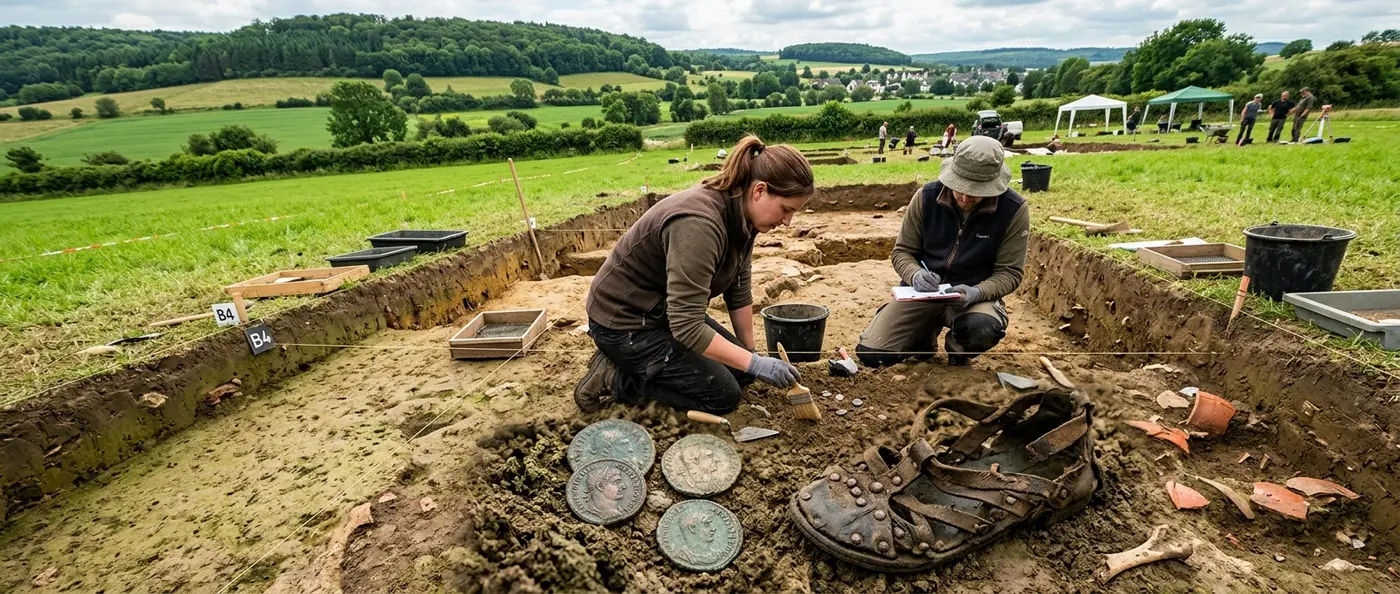
Excavations have revealed perfectly preserved artifacts that paint a vivid picture of legionary daily life. Helmets, armor, weapons, coins, jewelry, tools, pottery, and personal items like dice and game pieces have emerged from the soil.
The inscriptions and graffiti found on building walls tell personal stories. They reveal personal stories — love messages, complaints about food and weather. One inscription from Mogontiacum (modern Mainz) mentions a soldier who served 25 years and returned home with full pension.
🏺 Daily Life in the Camps
Life in a Roman camp in Germania was harsh but organized. Soldiers woke at sunrise for morning inspection. Intensive training followed — marches in full gear, weapons drills, and construction work.
The legionary diet was simple but nutritious. Wheat formed the base — soldiers ground it themselves to make bread or porridge. They supplemented with beans, vegetables, cheese, olive oil, and small amounts of meat. Watered-down wine (posca) was the standard drink.
Despite strict discipline, there were moments of relaxation. The camp baths served as social gathering places. Soldiers played dice and board games, watched traveling theater troupes, and participated in religious ceremonies.
📊 Roman Camp Comparison
🛡️ Military Technology
Roman camps in Germania pushed engineering to new limits. Legion engineers developed new techniques for building bridges, roads, and fortifications adapted to harsh northern conditions.
Heated spaces saw particular advancement. The hypocaust system (underfloor heating) was modified to handle brutal German winters. Archaeologists have found extensive networks of underground ducts that carried hot air beneath building floors.
Metallurgy also flourished in the camps. Workshops produced not just weapons and armor but sophisticated tools, medical instruments, and decorative objects. Roman steel forged in Germania matched anything produced in the empire.
🌍 Cultural Impact
Roman camps transformed the German landscape permanently. Many modern German cities — Cologne (Colonia Claudia Ara Agrippinensium), Mainz (Mogontiacum), and Regensburg (Castra Regina) — began as Roman camps.
Romans introduced new crops like grapes and agricultural techniques. Roman law and administrative organization influenced local communities. Latin left its mark on Germanic dialects, especially military and administrative terms.
Even after the legions withdrew in the 5th century AD, Roman camp influence remained. Local populations continued using Roman infrastructure, roads, and buildings. Many medieval churches were built with stones from Roman fortifications.
🔍 Unique Discovery
In 2019, archaeologists near Trier discovered an intact Roman helmet with gilded decoration. The helmet belonged to an officer and dates to the 3rd century AD. Coins depicting Emperor Aurelian were found alongside, confirming the dating.
🏛️ The Camps' Legacy
Today, Roman camps in Germany serve as major archaeological sites and tourist destinations. Many have become museums where visitors can see building reconstructions, military tactic demonstrations, and authentic artifacts.
In 2005, the Roman frontier in Germany (Limes Germanicus) was added to UNESCO's World Heritage List. This includes 550 kilometers of fortifications, 900 watchtowers, and 120 large and small camps.
Research continues at full speed. Each year new discoveries add pieces to the puzzle of Roman presence in Germania. Modern technologies allow exploration of previously inaccessible areas, revealing a rich and complex history that continues to surprise us.