📖 Read more: Battle of Actium: Cleopatra and Antony's Last Stand
📅 From Chaos to Order: The Evolution of Roman Timekeeping
Rome's first calendar was a disaster. Legend credits Romulus himself, Rome's mythical founder, with creating it around 753 BC. Ten months. 304 days. Starting in March, ending in December. Winter simply... didn't count.
Imagine the chaos. Farmers couldn't plan harvests. Merchants missed deliveries. Religious festivals drifted through the year like lost ships. Numa Pompilius, Rome's second king, tried fixing this mess by adding January and February. Now the year had 355 days, following a lunar system.
But problems persisted. The 355-day lunar year fell 10 days short of the solar cycle. To keep seasons aligned, Roman priests invented a bizarre solution: every two years, they'd insert an extra month called Mercedonius or Intercalaris — 22 or 23 days of pure confusion.
Here's where it gets wild. The priests who controlled this system regularly manipulated it for political gain. Need to extend a friendly politician's term? "Forget" to add the extra month. Want to cut short an enemy's time in office? Surprise intercalation!
🏛️ Did You Know?
Roman priests routinely weaponized the calendar for politics. They could extend or shorten terms of office by simply "forgetting" to add the intercalary month, or inserting it unexpectedly to favor allies!
⚔️ Julius Caesar's Revolutionary Fix
By Julius Caesar's time, the Roman calendar had completely derailed. In 46 BC, autumn religious festivals were happening in spring! Caesar, fresh from years in Egypt where he'd witnessed their precise 365-day solar calendar, decided to end the madness.
He summoned Sosigenes, an Alexandrian astronomer, to design a new system. The result was revolutionary: a solar calendar with 365 days and an extra day every four years (leap year). To synchronize the new calendar with the seasons, Caesar made 46 BC the longest year in history — 445 days, forever known as the "annus confusionis" (year of confusion).
The Julian calendar was mathematically elegant. One simple rule: 365.25 days per year. To handle that pesky quarter-day, Romans added a full day every fourth year. But they didn't do it our way, tacking February 29th onto the end. Instead, they repeated February 24th — literally having two "sixth days before the Kalends of March." The term "bis sextus" (twice sixth) gave us "bissextile" (leap year).
📖 Read more: Colosseum: Rome's Arena of Death and Glory
🗓️ Month Names: Gods, Emperors, and Numbers
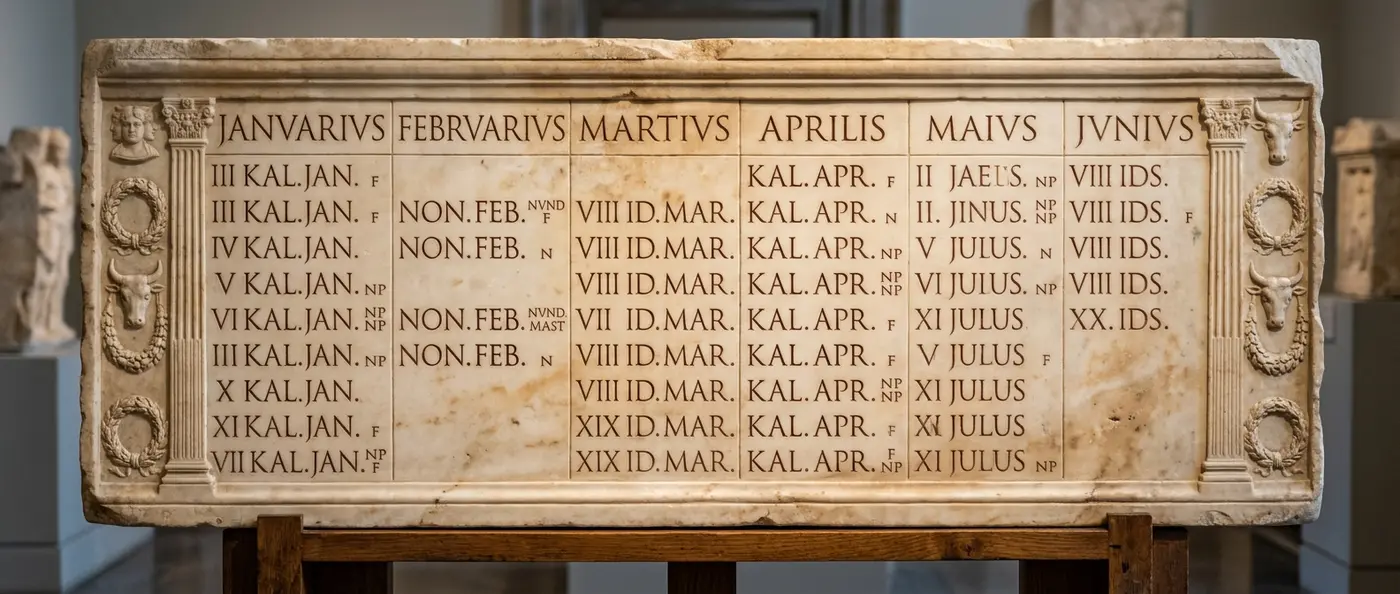
The month names we use today are virtually identical to ancient Roman ones, each carrying its own story. January (Ianuarius) honored Janus, the two-faced god who looked simultaneously at past and future. February (Februarius) came from "februa" — purification rituals performed that month.
March (Martius) belonged to Mars, god of war — logical, since spring marked the start of military campaigns. April (Aprilis) likely derives from "aperire" (to open), as flowers opened in spring. May (Maius) honored the goddess Maia, while June (Iunius) celebrated Juno.
Then comes the fascinating part. July was originally Quintilis (the fifth month in the old calendar), renamed for Julius Caesar. August started as Sextilis (the sixth), but took Augustus's name. The remaining months kept their numerical names: September (seventh), October (eighth), November (ninth), December (tenth) — even though they're now the 9th, 10th, 11th, and 12th months!
Lunar vs Solar
Early Romans followed a 355-day lunar calendar like the Greeks. The switch to a 365-day solar system was revolutionary for its time, requiring sophisticated astronomical knowledge.
Politics and Time
The calendar was a political weapon. Priests could manipulate time itself, extending or shortening terms of office by controlling intercalation — the ultimate power play.
Global Adoption
The Gregorian calendar, based on the Julian system, is used by the vast majority of the planet today for civil purposes — a testament to Roman engineering.
📐 The Mathematical Precision Behind Roman Innovation
Romans didn't count days like we do — 1, 2, 3... They counted backward from three fixed points each month: the Kalends (1st), Nones (5th or 7th), and Ides (13th or 15th). So February 24th was "ante diem sextum Kalendas Martias" (the sixth day before the Kalends of March).
This system seems clunky to us, but it worked brilliantly for Romans who thought in terms of market days and religious festivals. The Ides of March wasn't just March 15th — it was a specific point in the lunar cycle, a day when debts were settled and important business conducted.
📖 Read more: Parthian Empire: The Power That Crushed Rome
The Julian calendar's 365.25-day year was remarkably accurate. It only gained about 11 minutes per year compared to the actual solar year. That tiny error accumulated over centuries, eventually requiring Pope Gregory XIII's 1582 adjustment that gave us our current Gregorian calendar.
When you schedule that Tuesday meeting or celebrate New Year's on January 1st, you're using a system designed 2,000 years ago. The Roman calendar, with minor papal tweaks, became the global language of time.
Think about this: a system created to organize agricultural work and religious festivals in an ancient city-state now coordinates the lives of billions across the planet. From Tokyo stock exchanges to Argentine farms, from Oxford universities to Chinese factories, we all measure time the same way.
📊 Roman Calendar Evolution
🔬 Modern Discoveries and Ancient Calendars
Recent archaeological discoveries continue illuminating how ancient civilizations tracked time. A 2024 study of the Antikythera mechanism revealed this ancient "computer" followed the Greek lunar calendar with 354 days, not the Egyptian solar 365-day system scientists previously assumed.
Using statistical techniques developed for gravitational wave detection, researchers from the University of Glasgow analyzed hole positions in the mechanism's "calendar ring." Results showed the ring had 354 or 355 holes — one for each day of the lunar year. The finding shows how different timekeeping systems coexisted in the ancient world.
Romans borrowed elements from various cultures. Egyptian solar calendars provided the foundation for Caesar's reform, while the seven-day week came from Babylonians and was adopted later, in the 3rd century AD. Each day took its name from a planet-god: Dies Solis (Sun), Dies Lunae (Moon), Dies Martis (Mars), and so forth.
Every time you write a date, you're using a system invented by Roman priests and generals, perfected by Alexandrian astronomers, and refined by Catholic popes. No other human invention has spread so completely — a system that outlasted the empire that created it and now governs time from Wall Street to rural villages.