📖 Read more: Axum's Towering Giants: Ethiopia's Ancient Obelisk Mystery
🏛️ The Discovery That Stopped Construction
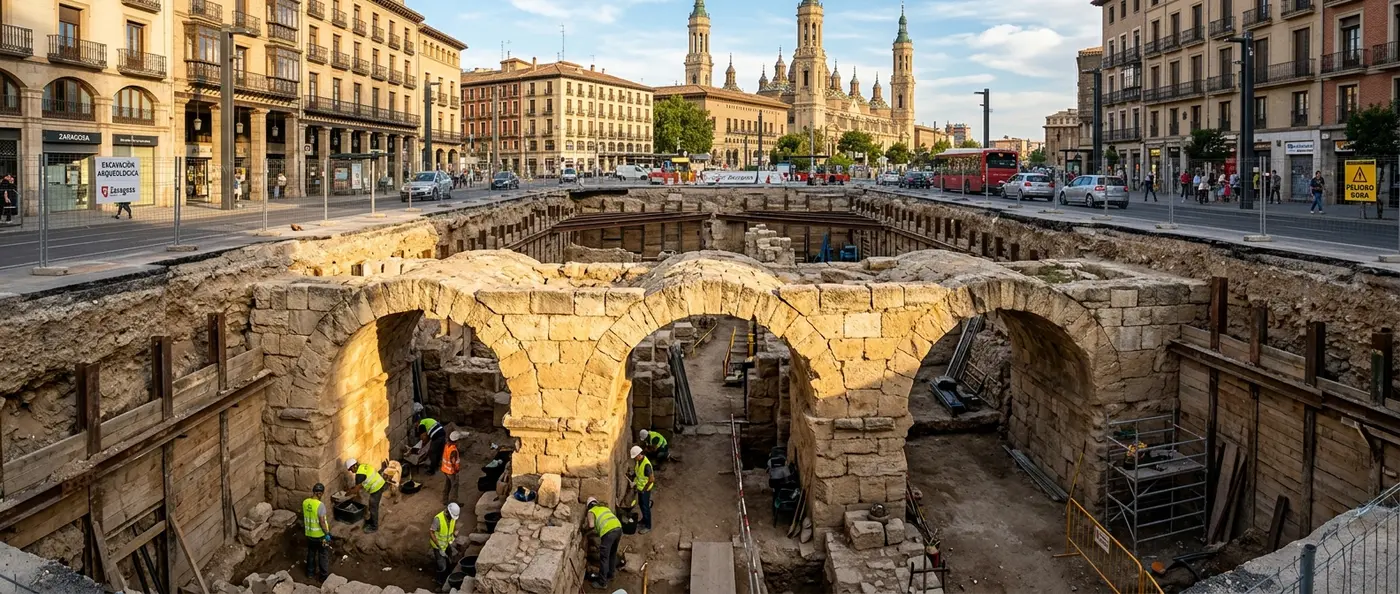
Construction crews were digging irrigation channels near Zaragoza when their equipment struck dressed stone. Smart move: they stopped immediately. The Aragon Archaeological Service took over within hours, and what they uncovered represents the most complete Roman bridge discovered in Spain since the 1970s.
The bridge stretches 127 meters across what was once the Ebro's main channel. Five arches remain nearly intact. The roadway still shows ruts carved by Roman wagon wheels 1,800 years ago. The bridge piers still bear their original decorative elements and inscriptions, preserved by centuries of river silt.
Dr. María Sánchez, the lead archaeologist, calls it a critical link in the Roman road network connecting Caesaraugusta (ancient Zaragoza) with northern provinces of Tarraconensis. The bridge's strategic position on the Ebro made it vital for trade and military movements across the Iberian Peninsula.
⚒️ Engineering Marvels That Shouldn't Exist
The construction analysis revealed techniques that haven't been documented in other Iberian Roman bridges. Roman engineers mixed local limestone with imported volcanic tuff, creating mortar with exceptional resistance to water erosion. No other Roman bridge in Iberia shows this combination of materials.
Each pier features V-shaped breakwaters on the upstream side, reducing water pressure during floods. The arch interiors contain hollow chambers that functioned as decompression spaces — a technique usually found in much later constructions. These Romans were thinking centuries ahead.
Lidar surveys revealed the bridge connected to an extensive system of embankments and flood control works protecting both the structure and nearby settlements. This integrated water management system shows sophisticated planning and deep understanding of local hydrology. They didn't just build a bridge — they engineered a solution.
📜 Inscriptions That Tell Stories
The central pier holds a monumental inscription stretching 3.2 meters. Elegant Latin letters record that the bridge was built under Emperor Hadrian, between 117 and 138 AD. The text names the sponsor: Lucius Valerius Maximus, a wealthy merchant who dedicated the work to his son's memory — the boy died in the Dacian campaigns.
Smaller inscriptions on other piers document repairs and maintenance over the centuries. One dated 287 AD describes extensive restoration work after a catastrophic flood. This maintenance archive offers rare insights into Roman Spain's public works management. They kept detailed records of every fix.
Architectural Innovation
Unique combination of materials and techniques not observed in other Roman bridges of the region. The breakwaters and decompression chambers represent advanced engineering thinking that predates similar solutions by centuries.
Historical Significance
Inscriptions provide rare details about public works financing and social structure of Roman Caesaraugusta. The sponsor's name and dedication offer personal dimension to imperial history.
📖 Read more: Easter Island's Moai: The Unexplained Giants
Strategic Position
The bridge was a critical node in the Via Augusta network, connecting Mediterranean and Atlantic coasts. Its location controls Ebro crossing at the river's narrowest navigable point.
🔬 Modern Tech Meets Ancient Stones
The research team deployed cutting-edge technology. Lidar mapping revealed the entire complex without extensive excavation. Millimeter-precision 3D laser scanning created digital models that will serve both research and restoration efforts.
Raman spectroscopy analysis of the mortar revealed its exact composition, explaining why it survived so well. Results show Romans added specific minerals that create a self-healing structure when exposed to water. When water enters hairline cracks, the mineral additives crystallize and seal the gaps.
DNA samples extracted from organic residues in bridge cracks provide information about local flora and fauna during the Roman period. They found traces of wheat, barley, and olives — evidence of goods transported across the bridge two millennia ago.
💡 Did You Know?
The Zaragoza Roman bridge is the only known structure in the Iberian Peninsula with an integrated water level measurement system. Carved scales on the piers allowed Romans to monitor and predict Ebro River floods with remarkable accuracy.
🏺 Artifacts That Illuminate Daily Life
Beneath the bridge lies a treasure trove of objects. Coins from various periods of the Roman Empire, ceramic vessels, tools, and jewelry emerged from river sediments. A bronze figurine of Poseidon stands out — likely an offering for safe passage.
Among the finds: a collection of lead curse tablets (defixiones). These appeals to gods for revenge or protection were thrown into the river from the bridge. One, written in colloquial Latin, asks goddess Nemesis to punish a thief who stole a mule. Ancient problems, ancient solutions.
Animal bones indicate the area beneath the bridge served for sacrifices. Sheep and pig bones dominate, but bull remains suggest major ceremonies possibly related to the bridge's inauguration or anniversaries. Religion and infrastructure intertwined in Roman life.
📖 Read more: Persian Royal Road: 2,700km Ancient Superhighway
🌊 Battle Against the Ebro: Engineering vs. Nature
Geological layer studies around the bridge reveal a continuous struggle between Roman engineers and the unpredictable river. The Ebro, notorious for violent floods, threatened every structure. Romans responded with innovative solutions that worked for centuries.
Beyond breakwaters, the bridge featured a water diversion system through artificial channels that directed flood flow away from the piers. Massive boulders placed upstream served as the first line of defense, breaking the current's force before it reached the structure.
Repair analysis shows the bridge suffered serious damage at least four times during the Roman period. Each time, repairs used improved techniques, showing continuous learning and adaptation to local conditions. They got better with every flood.
📊 Comparison with Other Spanish Roman Bridges
🔍 The Mystery of Abandonment
Why was such an important, well-preserved bridge abandoned and buried? Evidence suggests that sometime in the 5th century AD, the bridge was deliberately covered with earth and stones. This wasn't natural silting — it was intentional burial.
One theory: military burial to prevent barbarian tribe advances. Another hypothesis links abandonment to an Ebro channel change that made the bridge useless. Fire traces in certain sections suggest possible conflict. The Romans might have destroyed their own infrastructure to deny it to enemies.
Analysis of the latest coins found dates abandonment around 470 AD, a period of great upheaval in the Iberian Peninsula. The deliberate burial, while depriving the bridge of its function, ultimately preserved it for future generations. Destruction became preservation.
🏛️ Plans for Enhancement and Protection
The Spanish government, partnering with the European Union, has approved an ambitious plan for monument enhancement. The 12-million-euro project includes complete bridge excavation, conservation, and creation of an archaeological park.
Plans call for elevated walkways allowing visitors to view the bridge closely without stressing the structure. An interpretation center with virtual reality will recreate the bridge in Roman times, with vehicles and people crossing it. Visitors will walk through history.
A research center for Roman engineering studies is also planned. The bridge will serve as a living laboratory where students and researchers can study ancient construction techniques. UNESCO is already considering the monument for World Heritage status. This discovery changes everything we thought we knew about Roman engineering in Spain.