📖 Read more: Nefertiti's Tomb: 2026 Discovery Within Reach?
🏛️ The Rise of an Outsider Dynasty
Ramesses II's family weren't Theban elites. They were northerners from the Nile Delta who climbed to power through military service. His grandfather, Paramessu, served as vizier under Horemheb, the last pharaoh of the 18th Dynasty, before ascending the throne as Ramesses I.
When 14-year-old Ramesses II took the throne around 1279 BCE, the Hittites saw opportunity. They invaded and captured Kadesh, a crucial trading city in modern-day Syria. The young pharaoh led a military campaign to retake the city but fell into a trap set by spies who convinced him the Hittite army was far from the Egyptian camp.
They weren't. They were waiting nearby and attacked. The Egyptians teetered on the edge of defeat until reinforcements arrived at the last moment. Though Ramesses II won the battle, he didn't win the war. His battered forces withdrew from Kadesh.
⚔️ The Battle of Kadesh and History's First Peace Treaty
What made Ramesses II truly great wasn't his military skill — it was his diplomatic genius. Instead of admitting defeat, he ordered murals created in temples across Egypt showing him single-handedly defeating the invaders.
After years of negotiations, Ramesses II finally signed a peace treaty with the Hittites around 1258 BCE. This became the world's first surviving peace treaty. Among its provisions, both sides agreed to extradite refugees and not seek revenge after their return. They also agreed to help each other if attacked by foreign or domestic enemies.
One copy of the treaty, in hieroglyphs, was carved on a stela at Karnak. A second copy, written in Akkadian on a clay tablet, was discovered in Turkey in 1906. A copy of the tablet now hangs at United Nations headquarters in New York.
👑 Ramesses' Women: Nefertari and Isetnofret
Of all Ramesses II's wives, only two held prominent roles: Nefertari and Isetnofret, his first two great royal wives. Nefertari was clearly his favorite. Her beauty is documented in statues and paintings in her tomb in the Valley of the Queens.
Nefertari participated in official events alongside Ramesses. She appears celebrating his coronation, at festivals for the god Min, and at the installation of Nebwenenef as High Priest of Amun. Her diplomacy culminated in the peace treaty between Ramesses and the Hittites.
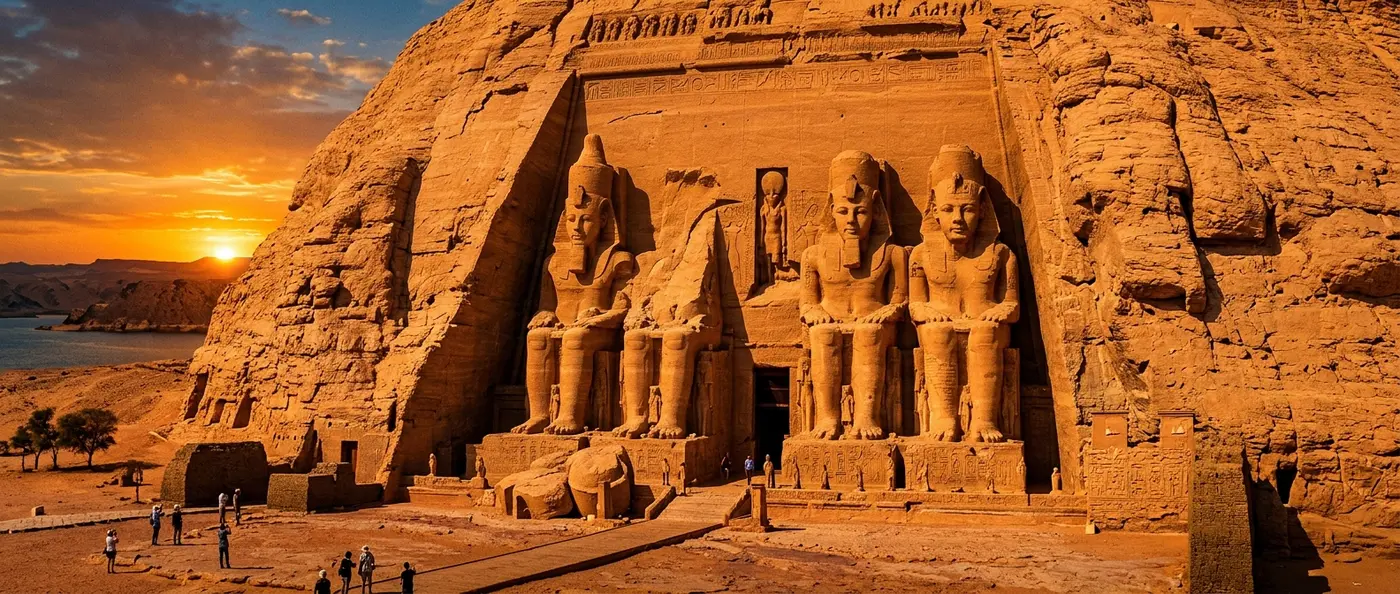
When Ramesses built the great temple at Abu Simbel, he ensured Nefertari, by then dead, was on the facade alongside Tuya, his mother. In this temple, Nefertari transforms into Sopdet, the star Sirius, whose appearance heralded the annual Nile flood. Further north, another smaller rock-cut temple is dedicated to Nefertari herself, where she's identified with the goddess Hathor.
Nefertari
Ramesses' beloved wife, depicted in countless monuments. She played a diplomatic role and was honored with her own temple at Abu Simbel.
Isetnofret
The "forgotten" wife who bore Ramesses' two most beloved children, including Khaemwaset.
📖 Read more: Senet: The World's First Board Game
Hittite Princess
Married Ramesses as a symbol of peace between Egypt and the Hittites after the treaty.
🏺 The Pharaoh's Children: A Dynasty in Crisis
From his harem, Ramesses II fathered roughly one hundred children. Of all his sons, Khaemwaset is believed to have been his favorite. Instead of taking up arms against his older brother (also named Ramesses), Khaemwaset became High Priest of Ptah, a title that in dogmatic Memphis was equivalent to High Priest of Amun in Thebes.
Khaemwaset is also known as one of the first archaeologists. He was fascinated by the millennia-old monuments of the Old Kingdom that surrounded him in Memphis. He inspected and restored several temples and pyramids. In each restoration, he carved the names and titles of the original "owners" of the building, as well as his own and his father's names.
The fact that Ramesses II lived to about 90 was achievement enough in ancient Egypt. Most people died well before their 40th birthday, and he was on the throne for two or three generations. Ramesses outlived many of his wives and children, and it was Merenptah, his 13th eldest son, who succeeded him as pharaoh.
💡 The Succession Paradox
Twelve of Merenptah's older brothers had died before him. When he finally ascended the throne, he was already in his sixties. While his accession went smoothly, his successors faced internal conflicts. The massive number of children Ramesses II had complicated succession issues as his descendants vied for power.
🗿 Ramesses' Monumental Legacy
Ramesses II launched the largest building campaign in pharaonic history. The temples at Karnak and Abu Simbel rank among Egypt's greatest wonders.
At the entrance to Abu Simbel, four seated statues over 18 meters tall serve as guardians. Dedicated to the sun gods, the temple extends 56 meters into the rock through a series of three imposing halls. Scenes depict Ramesses II at the Battle of Kadesh as well as the pharaoh and his chief wife, Nefertari, making offerings to the sun gods.
His mortuary temple, the Ramesseum, in the Valley of the Kings, contained a massive library of about 10,000 papyri. He honored both his father and himself by completing temples at Abydos. He also built a new capital called Per-Ramesses (also Pi-Ramesses), boldly named after himself, in the eastern Nile Delta near the modern village of Qantir.
🔬 What Ramesses' Mummy Reveals
CT scans of Ramesses II's mummy reveal how the pharaoh died. According to radiology professor Sahar Saleem from Cairo University, who has extensively studied the mummy, Ramesses II was likely disabled by arthritis and walked with a hunched back for several years in his final years.
📖 Read more: How Hieroglyphs Were Cracked: The Rosetta Stone Revolution
He also suffered from severe dental disease, which could have caused chronic pain or infection. However, no definitive cause of death was found in the CT scans. He most likely died of natural causes.
📊 Ramesses' Legacy in Numbers
🏛️ The Sarcophagus Discovery
The recent identification of Ramesses II's sarcophagus is a thrilling reminder that even the most famous pharaohs can hide secrets. The granite fragment discovered in 2009 had been used by two different people. The second was Menkheperre, a high priest of the 21st Dynasty who lived around 1000 BCE.
But the original owner remained a mystery until Egyptologist Frédéric Payraudeau from the University of Sorbonne deciphered a neglected cartouche — an oval carving representing a pharaoh's name — of Ramesses II himself.
Before being placed in the newly discovered sarcophagus, Ramesses II had been buried in a golden coffin that is now lost and transferred to an alabaster sarcophagus, which was found destroyed in his tomb by looters. He was later moved to the granite sarcophagus, which Menkheperre had transported to Abydos for his own use.
The sarcophagus proves that Valley of the Kings tombs faced both looting and recycling by later pharaohs.
⚡ The Enduring Influence of the Greatest Pharaoh
Ramesses II was so powerful he was worshipped during his lifetime as a living god. Even after death, his worship continued to some degree. Surprisingly, his worship isn't widely documented after his death — though pieces of evidence appear.
One sarcophagus mentions a priest dedicated to the worship of Ramesses II who lived in Abydos during the Ptolemaic period (roughly 304 to 30 BCE). This means some people continued worshipping Ramesses II 1,000 years after his death.
For all of Ramesses II's efforts to ensure his legacy would live on, there was one testament to his power he couldn't have foreseen. After his death, nine subsequent pharaohs took his name upon ascending the throne, cementing his reputation as "the great one" among ancient Egyptian rulers.