📖 Read more: Viking Religion Asatru: Thor Odin and Freyja Gods
🔥 The Prophecy That Haunted the North
Ragnarök, known as "Fate of the Gods" in Old Norse, represents the climax of Scandinavian eschatology. Ancient sources, particularly the Poetic Edda and Snorri Sturluson's works, describe it as a sequence of catastrophic events leading to the death of major gods, including Odin and Thor. Vikings carried this prophecy in their daily lives, believing the end would come whether they fought bravely or cowered in fear.
The word itself carries dual meanings that reveal different interpretations. The older form means "Fate of the Gods," while the later Ragnarøkkr, used by Snorri, translates as "Twilight of the Gods." This linguistic shift reflects evolving Norse concepts of cosmic ending—was it predetermined fate or gradual decline?
References to Ragnarök appear in various skaldic poems from the 10th and 11th centuries, but the fullest descriptions come from the Völuspá poem and the didactic poems of the Poetic Edda. These sources formed the foundation for Snorri's extensive account in his Prose Edda, written around 1220 CE.
⚔️ The Players in the Final Battle
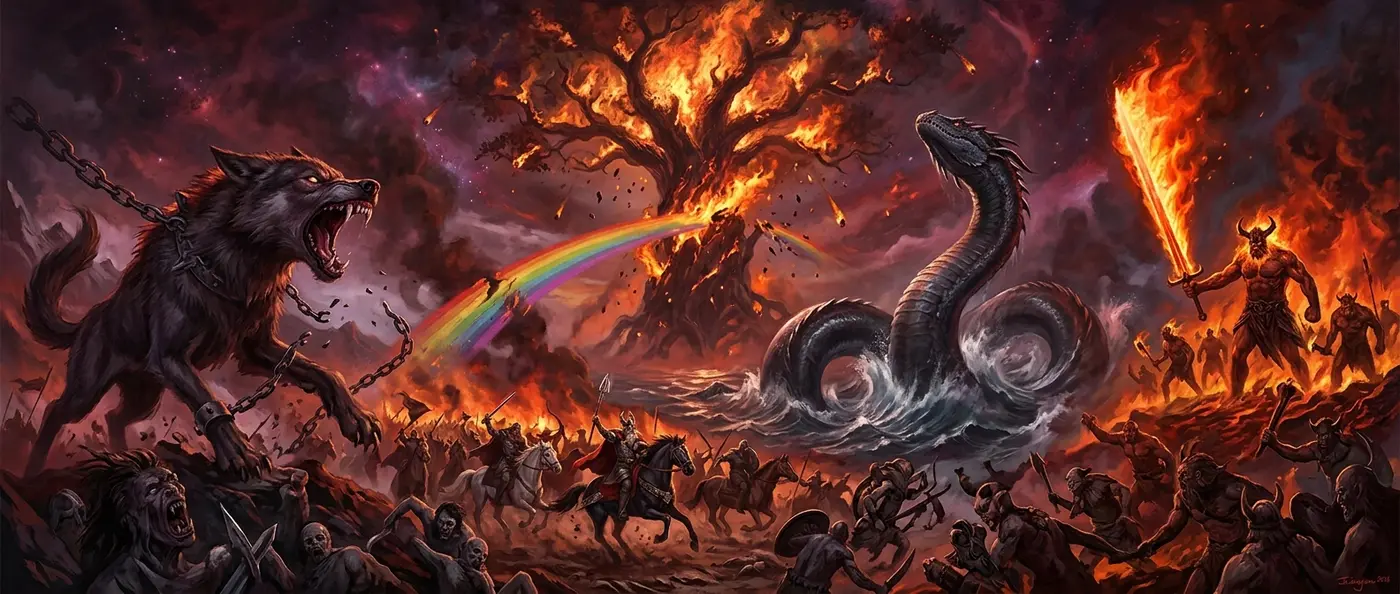
At Ragnarök's center stand the great gods of the Norse pantheon and their eternal enemies. Odin, the all-knowing father of gods, will face the monstrous wolf Fenrir, chained for ages while waiting for this moment. Thor, the thunder-wielding protector of Midgard, will clash with Jörmungandr, the world serpent that encircles the earth with its massive coils.
The gods won't face destruction alone. The entire universe will be dragged into this cosmic conflict. The dead warriors from Valhalla—the Einherjar—will fight alongside Odin. From the other side, frost and fire giants will attack from Muspelheim, led by Surtr and his flaming sword that burns brighter than the sun itself.
Loki's betrayal forms the prophecy's cruelest twist. The trickster god, once companion to the Æsir, will break free from his torturous bonds and lead the forces of chaos against his former allies. Loki's betrayal isn't merely personal—it symbolizes the collapse of cosmic order itself.
🌍 Signs of the Coming Catastrophe
Ragnarök won't arrive without warning. Ancient sources detail the signs that will herald the end. Fimbulvetr, the "Great Winter," will bring three years of ice with no summer relief. During this period, humanity will descend into war and fratricide as moral foundations crumble.
📖 Read more: Viking Runes: The Secret Symbols of the North
Society's ethical bedrock will collapse completely. Brothers will kill brothers, parents will betray children, and every sacred bond will shatter. The sun and moon will be devoured by the wolves Sköll and Hati, plunging the world into eternal darkness before the final battle begins.
🔮 The Völuspá and Its Prophecies
The Völuspá ("The Prophecy of the Seeress") provides our main account of Ragnarök. A dead völva is resurrected by Odin to reveal the future. Her verses describe with chilling detail the sequence of events leading to world's end—and its rebirth.
🏛️ The Final Battle at Vigrid
When the time comes, all forces of the universe will gather at Vigrid, a vast plain one hundred leagues in every direction. There the ultimate confrontation between order and chaos will unfold. Heimdall will sound Gjallarhorn, the horn heard across all nine worlds, summoning the gods to their final battle.
Each major god will find their destined opponent. Odin will be devoured by Fenrir, but his son Vidar will avenge his father by tearing the wolf's jaw apart. Thor will slay Jörmungandr but die from its poison after taking nine steps. Freyr will fall to Surtr's flaming sword, having given away his own magical blade to win Gerd's love.
Surtr and the Fire
The fire giant Surtr will come from Muspelheim with his flaming sword. After the battle, he'll unleash flames that will consume the entire world, including Yggdrasil, the cosmic tree that connects all realms.
The Great Flood
As the world burns, the seas will rise and swallow the land. Earth will sink back into the primordial waters from which it once emerged, returning to chaos before the cycle begins anew.
The End of Stars
Stars will fall from the sky, the sun will go dark, and the moon will disappear. The universe will return to the primordial darkness that existed before creation itself began.
📖 Read more: Vikings: Warriors, Explorers or Merchants?
🌱 Rebirth After Destruction
Ragnarök promises rebirth alongside destruction. According to the prophecies, after destruction, a new earth will emerge from the waters—green and fertile. The sun will be reborn through its daughter, who will follow her mother's path across the sky.
Some gods will survive the carnage. Vidar and Vali, Odin's sons, will dwell in Asgard's ruins. Modi and Magni, Thor's sons, will inherit Mjolnir. Baldr and Höðr will return from the world of the dead and reconcile their ancient feud.
Most significantly, two humans—Lif and Lifthrasir—will survive hidden within Yggdrasil's trunk. From them will spring a new human race, free from the mistakes of the past. The cycle of life will begin again, unmarked by the corruption that led to the previous world's destruction.
📜 Sources and the Myth's Spread
Our knowledge of Ragnarök comes primarily from medieval Icelandic sources recorded centuries after Scandinavia's Christianization. Scholars debate whether Christian apocalyptic ideas shaped these medieval accounts.
Tacitus, writing Germania around 98 CE, provides some of the earliest information about Germanic religion, though he doesn't specifically mention Ragnarök. Adam of Bremen, writing around 1072, describes the religious practices of Swedes who were still largely pagan at the time.
📚 Primary Sources for Ragnarök
🔬 Modern Interpretations and Influences
Wagner's "Ring of the Nibelung" launched Ragnarök into modern culture, spawning countless movies and video games. Yet scholars still debate the myth's deeper meaning.
Some researchers see in Ragnarök reflections of actual natural disasters, like volcanic eruptions or climate changes that ancient Scandinavians might have experienced. Others interpret it as an allegory for the eternal cycle of creation and destruction in nature.
📖 Read more: Viking Ash Pendant: Pregnant Woman Warrior Found in Grave
The idea of a cyclical universe, where the end is also a new beginning, finds parallels in many other mythologies. This suggests a deep human need to find meaning and hope even within destruction.
Scientists recently named a horned dinosaur Lokiceratops rangiformis after Loki's helmet from pop culture. Even paleontology now draws from Norse mythology.
💭 The Philosophical Dimension of Ending
Ragnarök explores whether fate can be changed or only faced with courage. Even the gods, despite their immense power, cannot escape their destiny. Odin, the all-knowing, understands he will die by Fenrir's jaws, yet still prepares for battle.
This acceptance of fate, combined with determination to fight until the end, reflects a deep aspect of Norse worldview. Victory doesn't matter—what counts is how one faces the inevitable. This life stance profoundly influenced Viking culture and their approach to war and death.
In Ragnarök's vision, endings become beginnings. Even gods die so the world can be born again, green and unmarked by the old corruption.