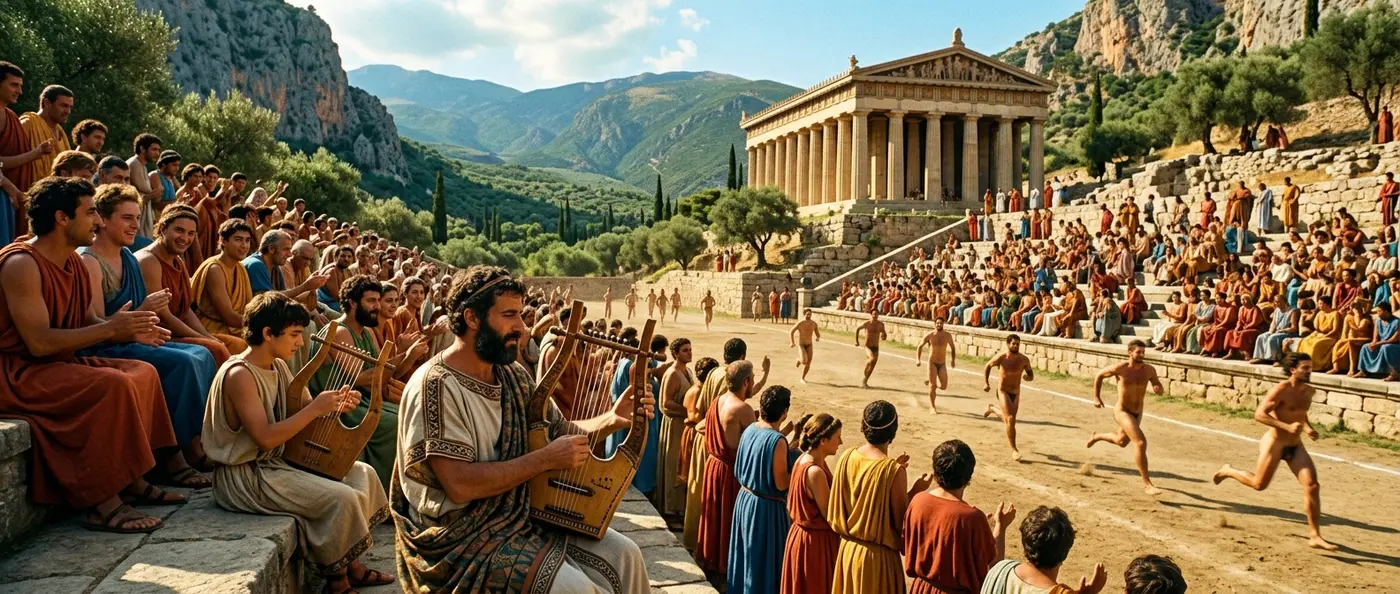
Picture this: 7,000 spectators packed into a mountain stadium, watching a solo singer accompany himself on a seven-stringed lyre, chanting hymns to Apollo while eagles circled overhead. This wasn't a concert. This was competition — the kind that could make or destroy a performer's reputation across the Greek world. The Pythian Games at Delphi started as something unique in the ancient world: a purely musical contest where singers performed solo with kithara accompaniment, honoring the god of light, prophecy, and harmony. Later they added wrestling, chariot racing, and boxing like the Olympics, but music never lost its central place. That made the Pythians the only Panhellenic games where artistic excellence stood equal to — or above — physical prowess, a radical idea that separated them from every other ancient athletic festival.
🏛️ Delphi: The Navel of the Earth
Zeus released two eagles — one flying east, one west — and where they met after circling the entire world became Delphi. That's how the Greeks explained why this rocky outcrop on Mount Parnassus was literally the center of everything. They marked the spot with the omphalos, a dome-shaped stone that sat outside Apollo's temple and represented the "navel" of the world. The sacred site clings to the steep lower slopes of Parnassus, about 10 kilometers from the Gulf of Corinth, in a landscape of sheer rock faces, dense vegetation, and gorges that made visitors feel they had entered another world. People first settled here during the Mycenaean period, between 1500 and 1100 BCE, but it gained religious significance around 800 BCE. The original name was Pytho, after the serpent Python that Apollo killed there according to myth. Python was the guardian of Gaia's oracle — a monstrous reptile protecting the older form of prophetic worship in the area. When the young god Apollo slayed it, he established his own oracle on that spot, marking the transition from earth-based chthonic cults to the brilliant Olympian religion.
Apollo's oracle at Delphi became the most famous in the entire Greek world — and beyond. The Pythia, Apollo's priestess, answered questions from city-states and individuals, guiding their actions for the future. The process was complex: first the priestess purified herself at the Castalian Spring, burned laurel leaves, and drank sacred water. Animal sacrifice followed — usually a goat — and petitioners offered pelanos before being allowed into the inner temple. There the Pythia, likely in a state of ecstasy induced by natural gases, issued her oracles. In 2001, geologists discovered traces of ethylene in the soil beneath the temple — a gas that causes euphoria and disorientation, scientifically explaining the Pythia's ecstatic states. The oracle's most famous client was probably Croesus, the legendarily wealthy king of Lydia, who asked whether he should fight the Persians. The Pythia replied that if he fought, a great empire would be destroyed — it was his own.
🎵 From Musical Contest to Panhellenic Festival
The Pythian Games began sometime between 591 and 585 BCE and were initially held every eight years. The only event was a musical competition: solo singers accompanied themselves on kithara, chanting hymns in honor of Apollo — god not only of light and prophecy, but of music itself. Music wasn't mere entertainment in the ancient Greek world: it was considered divine art, capable of healing souls, taming wild beasts, and bringing humans closer to the divine. The transformation came around 582 BCE, when the games were reorganized on a four-year cycle — following the Olympic model — and athletic events were added: sprint races, chariot contests, wrestling, boxing, and pankration. This change connected to the First Sacred War (around 590 BCE), during which the Amphictyonic League destroyed the city of Crisa, which had blocked access to Delphi and exploited pilgrims. After victory, the Amphictyony took over management of the sacred site and upgraded the games to a Panhellenic festival open to all Greeks.
Despite adding athletic events, musical competitions always remained the core of the Pythians. Beyond kitharoedia — singing with kithara accompaniment — they added aulodia (singing with aulos), kitharistics (solo kithara without singing), and auletics (solo aulos). Later, dramatic contests appeared. Greeks placed musical skill on the same level as athletic prowess — sometimes higher. The games were held in August of the third year of each Olympiad, and the period between two successive Pythians was called a Pythiad. They were open to all Greeks — and unlike the Olympics, the winner didn't receive a kotinos (olive wreath), but a laurel crown. Laurel was Apollo's sacred plant: according to myth, the nymph Daphne transformed into a laurel tree to escape his love, and he embraced the tree, crowning it his sacred symbol.
At the Olympics, the prize was kotinos — an olive wreath, sacred tree of Athena. At the Pythians, the winner was crowned with laurel, the tree dedicated to Apollo. At Nemea they used celery, and at the Isthmia pine. Each of the four Panhellenic crowns represented the patron god of the corresponding festival — a deeply symbolic system.
🏟️ Architecture and Competition Venues
Delphi's facilities were impressive in scale and design. The first temple of Apollo was built in the 7th century BCE as a replacement for earlier cult structures. The Doric temple that became the focal point of the sanctuary was destroyed by fire in 548 BCE. A second temple was completed around 510 BCE with help from the exiled Athenian family of the Alcmaeonids — measuring 60 by 24 meters, with six columns on the facade and fifteen on the sides. An earthquake destroyed this temple in 373 BCE, and a third temple was erected in its place in 330 BCE from poros limestone covered with stucco — the temple whose ruins survive today. Persian shields from the Battle of Marathon adorned the temple as spoils of victory.
Delphi's theater seated 5,000 spectators — it was the venue for part of the musical competitions. The stadium, higher up the hill, held 7,000 spectators for athletic events, while chariot races took place in the plain of Crisa below Delphi. Along the Sacred Way — which led from the sanctuary gate to Apollo's temple — stood about 20 treasuries, small temples that city-states built to house votive offerings and dedications. Among the most impressive were the Treasury of the Athenians, built after the victory at Marathon in 490 BCE, and the Treasury of the Siphnians with its caryatids, around 525 BCE. Victory monuments lined the Sacred Way: the Spartan general Lysander placed a monument for his victory over Athens at Aegospotami, while the bronze Bull of Corcyra (580 BCE) and a massive bronze Trojan Horse offered by the Argives (around 413 BCE) impressed visitors.
Musical Competitions
Kitharoedia, aulodia, kitharistics, and auletics formed the core of the Pythians — song and instrumental music dedicated to Apollo, god of harmony.
Athletic Events
Sprint races, wrestling, boxing, pankration, and chariot contests were added after 582 BCE — transforming a musical festival into a complete athletic festival.
Dramatic Contests
In later periods, dramatic presentations were added, reflecting the deep connection of Greek religion with the arts of speech and theater.
⚔️ Sacred Wars and Political Power
The history of the Pythians wasn't just music and athletics — it was deeply political. The site was administered by the Delphic Amphictyony, a council of representatives from neighboring city-states, which had power to collect taxes, gather offerings, fund construction projects — and even organize military campaigns. Four Sacred Wars were fought to punish sacrilegious acts against Apollo, committed by the states of Crisa, Phocis, and Amphissa. The First Sacred War (around 595-585 BCE) was decisive: the Amphictyonic League destroyed Crisa, which had blocked access to the sanctuary and economically exploited pilgrims. After victory, the Amphictyony took over management of the sacred site and upgraded the games to a Panhellenic festival nearly equal to the Olympics.
Delphi was attacked many times throughout its history. In 480 BCE the Persians attacked the sanctuary during Xerxes' invasion. In 279 BCE Gallic besiegers invaded, but according to legend were repelled by divine intervention — snowstorms, rolling rocks, and earthquakes that panicked the invaders. In the 3rd century BCE the Aetolian League took control of the site, and in 191 BCE Delphi passed into Roman hands. Under Roman rule, the sacred site and games continued to have cultural significance — Emperor Hadrian honored them particularly. Nero, around 67 CE, competed personally in both the Pythians and Olympics — though his victories are widely considered coerced. Conversely, he removed 500 statues from Delphi to decorate his palaces in Rome.
🔥 Decline and Legacy
The Pythian Games continued for nearly a thousand years — from the 6th century BCE until the end of the 4th century CE. In 393 CE the Christian emperor Theodosius I issued a decree banning all pagan sanctuaries and games — simultaneously closing the Olympics, Pythians, Nemeans, and Isthmians. A Christian community settled at Delphi and remained there for several centuries, until the final abandonment of the site in the 7th century CE. The archaeological site was "rediscovered" in 1880 by a French archaeological mission. Among the most important finds were the bronze Charioteer (480-460 BCE) — a masterpiece of the severe style — the marble Sphinx of the Naxians (around 560 BCE), the kouroi of Argos (around 580 BCE), and the richly decorated omphalos (around 330 BCE). In 1987 Delphi was inscribed on UNESCO's World Heritage List — recognition of its incalculable cultural value.
The legacy of the Pythians extends far beyond athletics. They were the only Panhellenic festival that recognized music as equal — or superior — to physical competition. This idea that intellectual excellence deserves public recognition equivalent to physical skill represents one of the most important cultural gifts of the ancient Greek world. At Delphi, the same crowds that cheered for runners also held their breath for singers. The mountain sanctuary proved that competition could honor both muscle and music — a lesson worth remembering.