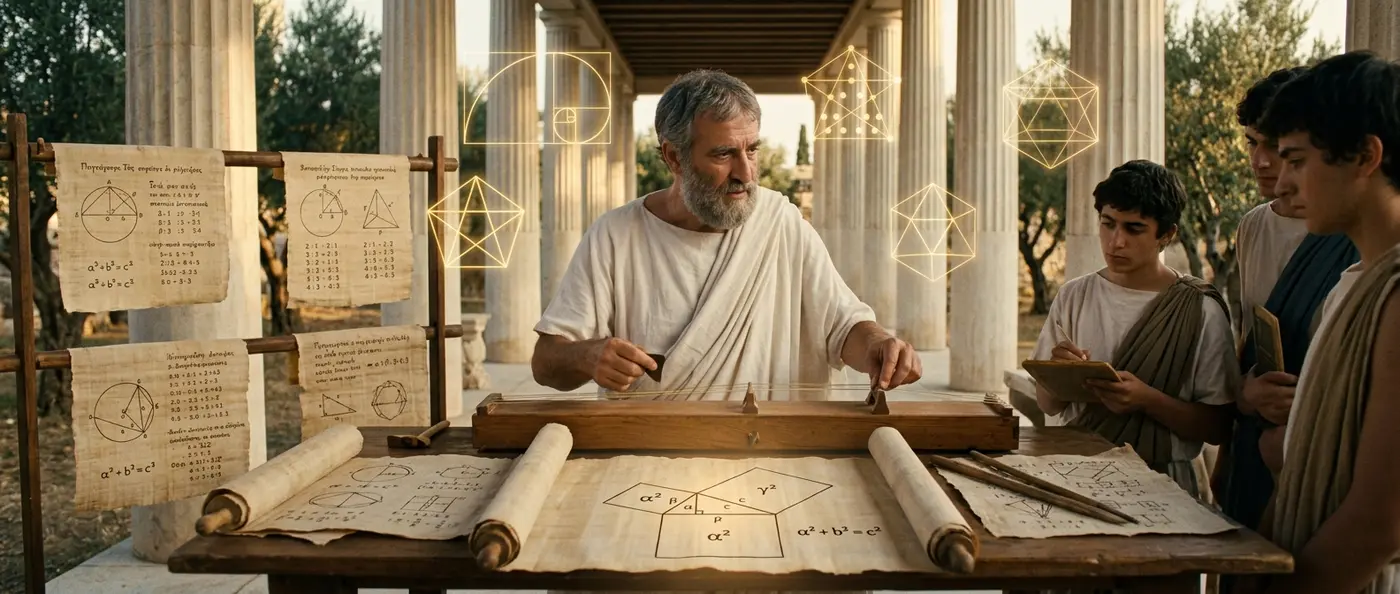
On the Greek island of Samos in the 6th century BCE, a long-haired man in a white tunic stood before a group of students. He held a lyre in his hands, and as he plucked its strings, he explained something that would forever change how we see the world: numbers aren't just counting tools—they're the very essence of the universe.
📖 Read more: Greek Geometry: Euclid and Pythagoras Foundations
🔢 Pythagoras and the Numbers Revolution
Pythagoras was born around 570 BCE on Samos, an island that served as a major trading and cultural hub of the ancient world. From an early age, he showed exceptional abilities in mathematics and philosophy, traveling to Egypt and Babylon to study the ancient knowledge of these civilizations.
His revolutionary vision was simple yet earth-shattering: numbers aren't human inventions—they're the fundamental structures that govern the universe. This idea became the foundation of mathematics, Western philosophy, and science.
Around 530 BCE, Pythagoras settled in Croton in Magna Graecia (modern-day Southern Italy), where he founded his famous school. There, alongside his students, he developed a comprehensive system of thought that combined mathematics, philosophy, music, and religion.
🎵 The Music of the Spheres
Pythagoras's most famous discovery came from a simple experiment with strings. He noticed that when two strings have lengths in simple numerical ratios (2:1, 3:2, 4:3), they produce harmonious sounds. The octave, the fifth, and the fourth—the basic harmonies of music—are pure mathematical relationships.
This discovery led Pythagoras to a bold hypothesis: if music, which touches our souls so deeply, is based on mathematical relationships, then perhaps the entire universe operates the same way. Thus was born the idea of the "harmony of the spheres"—the belief that planets and stars move in perfect mathematical orbits, producing a cosmic music that only the soul can hear.
The mathematical achievement that made Pythagoras famous is his theorem: in any right triangle, the square of the hypotenuse equals the sum of the squares of the two perpendicular sides (a² + b² = c²). While the Babylonians and Egyptians knew this relationship empirically, the Pythagoreans were the first to prove it with rigorous mathematics.
What mattered wasn't just the theorem—it was the method. For the first time in history, a mathematical truth wasn't based on observation or practical experience, but on logical proof. This approach laid the foundation for all mathematics that followed.
The Pythagoreans also discovered irrational numbers—numbers like the square root of 2 that cannot be expressed as a ratio of two integers. This discovery threw the school into crisis. It shattered their core belief that the universe could be expressed in simple numbers and ratios.
Geometric Discoveries
Beyond the famous theorem, the Pythagoreans discovered the properties of regular polygons and polyhedra, laying the foundations of geometry.
Irrational Numbers
The discovery that there are numbers that cannot be expressed as fractions shook the foundations of Pythagorean philosophy.
Perfect Numbers
The Pythagoreans studied "perfect" numbers like 6 and 28, which equal the sum of their divisors.
🌟 The Secret School of Croton
The Pythagorean school was less classroom than cult. Members followed strict rules and secret rituals. Students passed through various stages of initiation, starting as "akousmatics" who listened silently to teachings for years, before becoming "mathematikoi" with the right to ask questions and participate in discussions.
The Pythagoreans followed a strict lifestyle. They were vegetarians (except for certain sacrifices), avoided beans for religious reasons, and believed in metempsychosis—the idea that the soul reincarnates in different bodies until it achieves purification through philosophy and mathematics.
Each morning, school members began with walks and contemplation, followed by lessons in music and mathematics, and in the evening they participated in communal meals where they discussed philosophical topics. The community included women—radical for ancient Greece—with Theano, Pythagoras's wife, being an important philosopher and mathematician.
💡 Did You Know?
The Pythagoreans had a secret recognition symbol—the pentagram (pentalpha). When they met a stranger, they would draw the symbol in the sand. If the other person recognized it and completed the drawing, they knew they were a fellow Pythagorean.
🔮 The Mystical Numbers and Cosmology
For the Pythagoreans, each number had particular meaning and symbolism. The number 1 represented unity and the beginning of all things. The number 2 symbolized duality and opposition. The number 3 was the first "true" number, as it had beginning, middle, and end. The number 4 was connected to justice (2x2, perfect balance), while 10—the sum of the first four numbers—was considered the perfect number containing all the harmony of the universe.
Pythagorean cosmology placed at the center of the universe not the Earth, but a "central fire" around which the Earth, Sun, Moon, and planets revolved. Though wrong in detail, the idea was revolutionary: Earth wasn't the center of everything. Copernicus would revive this notion 2,000 years later.
Around 500 BCE, the Pythagorean community faced serious crisis. The secrecy and political influence of the school provoked the hostility of Croton's citizens. One night, an enraged mob attacked and burned the building where the Pythagoreans met. Many members were killed, and according to some sources, Pythagoras himself was among them, though other traditions say he managed to escape and died shortly after in Metapontum.
Despite the tragic end, Pythagoras's influence on Western thought was enormous. Plato, who visited Italy and met Pythagorean philosophers, incorporated many of their ideas into his own philosophy. The belief that mathematics constitutes the language of nature profoundly influenced Galileo, Kepler, and Newton.
Today, 2,500 years later, the Pythagorean idea that the universe is fundamentally mathematical remains central to modern physics. From Einstein's equations to quantum mechanics, science continues to reveal the mathematical structure of reality.
🏛️ Pythagoras's Influence on Later Thinkers
🌍 The Eternal Mystery of Numbers
Pythagoras left us with a question that philosophers and scientists still debate: Are mathematics a human invention or a discovery? Do we create numbers and equations, or do we simply discover them like an explorer discovers new lands?
Pythagoras firmly believed the latter. For him, numbers existed independently of the human mind, and their discovery was a way to understand the divine order of the world. This "Pythagorean" view continues to have supporters among modern mathematicians and physicists.
What's striking is how modern Pythagoras sounds. In an age when computers convert everything into numbers—from music and images to human relationships and behavior—the Pythagorean belief that "all things are number" seems less mystical and more prophetic.
From the algorithms that shape our daily lives to the equations that describe the universe, we live in a world that Pythagoras would recognize: a world where numbers truly govern everything. His revolution continues.