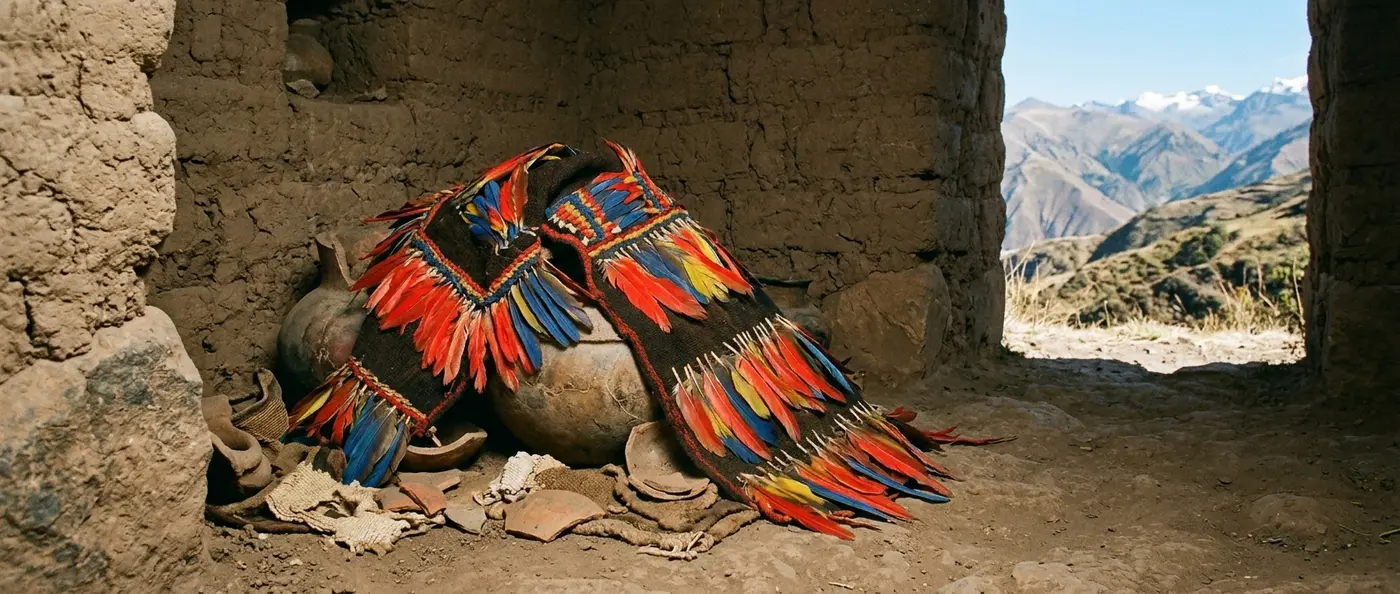
Picture this: 3,500 meters above sea level, archaeologists crack open an ancient tomb. Inside, brilliant red and blue feathers still gleam after a thousand years, arranged around a mummified figure like a rainbow halo. These aren't local bird feathers — they traveled 600 kilometers from Amazon rainforests to reach this windswept Andean grave.
📖 Read more: Hittites: The Empire History Forgot
🦜 The Discovery That Rewrote Ancient Trade
Recent excavations in the central Andes unearthed something extraordinary. Hundreds of parrot feathers, carefully placed in tombs dating from 800 to 1200 CE, weren't just pretty decorations. Their precise arrangement screams ritual significance — and reveals trade networks that spanned continents.
These feathers came from parrot species living deep in Amazon rainforests, hundreds of miles from where archaeologists found them. Someone carried these delicate, colorful treasures across mountain passes, through river valleys, up impossible slopes. The logistics alone boggle the mind.
The preservation blows you away. Thanks to the bone-dry Andean climate, these feathers look like they were plucked yesterday. Vivid reds, electric blues, sunshine yellows, forest greens — colors so intense they seem to pulse with life. Researchers can reconstruct exactly how these burial ornaments looked when fresh mourners first arranged them around their dead.
🏺 Before the Inca Empire Existed
Long before Inca rulers built Machu Picchu, the Andes buzzed with sophisticated civilizations. The Wari built cities. The Tiwanaku carved monumental stone heads. The Chimú crafted gold that Spanish conquistadors would later melt down by the ton.
Each culture developed unique burial practices, but they shared core beliefs. Ancestor worship wasn't just reverence — it was practical politics. Dead rulers stayed active community members who could bless harvests or curse enemies. Death was a career change, not retirement.
Exotic materials in tombs served dual purposes. They showed off wealth and status, sure. But they also connected the deceased to spirit worlds. Birds, capable of flying between earth and sky, made perfect messengers to the gods. Wrap yourself in their feathers, and maybe you'd soar to the afterlife instead of crawling.
⚱️ Mummification Without Egypt's Fuss
Forget everything you know about Egyptian mummification. No brain-scooping through the nose. No organ-removing surgery. Pre-Inca peoples had a simpler, more elegant solution: let the desert do the work.
Bodies got positioned sitting up, knees pulled to chest like they were waiting for a bus. Then came the wrapping marathon — layer after layer of cotton and wool textiles, creating what archaeologists call "mummy bundles." Between those layers went the good stuff: gold jewelry, ceramic vessels, food for the journey, and those precious parrot feathers.
The sitting position wasn't random. It mimicked the fetal position, symbolizing rebirth. Death wasn't an ending but a return to the womb of Mother Earth, ready to emerge transformed in the spirit world.
Wrapping Technique
Multiple layers of cotton and wool textiles created protective cocoons. Feathers were strategically placed between layers for maximum visual impact when unwrapped.
Grave Goods
Alongside feathers, tombs contained ceramics, gold and silver jewelry, textiles, and food provisions for the afterlife journey.
Ritual Positioning
The seated pose with bent knees symbolized the fetal position, suggesting rebirth and continuity of life after death.
🌈 Color Codes of the Afterlife
Feather colors followed strict symbolic codes. Every hue carried meaning in their cosmic worldview. Red meant blood and life force. Yellow channeled solar power and divine authority. Blue connected to sky and water. Green promised fertility and renewal.
Feather arrangements followed strict patterns. Concentric circles around the head or chest created symbolic "auras" to protect the dead during their otherworldly journey. Some tombs contained complete feathered crowns, marking their occupants as elite members who ruled in life and expected to rule in death.
These crowns match depictions on ceramics and murals from the same period. Living priests and rulers wore identical feathered regalia during ceremonies. The message was clear: power transcends death, and the right accessories prove it.
🎨 The Andean Color Palette
Ancient Andean artisans used natural dyes from plants and minerals to enhance feather colors. Cochineal insects produced deep reds, turmeric yielded golden yellows, and indigo created intense blues.
🗺️ Trade Routes That Defied Geography
Moving tropical parrot feathers to Andean mountaintops required crossing terrain that challenges modern vehicles. Traders crossed impossible terrain — from steaming rainforests through river rapids to oxygen-thin mountain passes. These weren't casual shopping trips.
The networks carried more than goods. Ideas traveled these routes. Religious beliefs. Artistic techniques. Marriage alliances. The similarity in burial practices across vast distances proves these cultures stayed connected despite geographic barriers that would challenge modern transportation.
📖 Read more: Ziggurats: Babylon's Stairways to the Gods
Feathers were currency in a complex economy. They traded for coastal salt, Pacific shells, Andean gold and silver, coca leaves from eastern slopes. Each transaction strengthened bonds between communities separated by hundreds of miles and thousands of feet of elevation.
🔬 Modern Science Meets Ancient Mysteries
Today's archaeologists wield tools their predecessors couldn't imagine. DNA analysis identifies exact parrot species with courtroom precision. So far, feathers from at least five different species have been catalogued, all native to the Amazon basin.
Isotope analysis reveals where these birds lived and what they ate. Results suggest some parrots were raised in captivity specifically for their feathers — an early form of exotic bird farming that predates similar practices in other civilizations by centuries.
Microscopic examination shows processing techniques. Many feathers were precisely cut and treated with plant oils to maintain their luster. Some bear traces of plant-based adhesives that held them in position. These weren't hastily gathered decorations but carefully prepared ritual objects.
🔍 Analysis Techniques Comparison
👑 Status Symbols That Outlasted Empires
Parrot feathers weren't democratic. They clustered in elite tombs — rulers, priests, wealthy merchants who could afford such exotic luxuries. Access required resources, connections, and serious social clout.
The quantity and quality varied dramatically. The richest burials contained hundreds of feathers from rare species. Modest graves might hold just a few feathers from common birds. This gradation mirrors social hierarchies that persisted for centuries.
Children's tombs also contained feathers, proving that status was inherited. Elite kids got the same prestige symbols as adults, even in death. Social position wasn't earned — it was birthright, defended with rainbow-colored proof.
🌅 Legacy of the Feathered Dead
When Inca armies conquered these regions in the 15th century, they absorbed local traditions rather than destroying them. Feathered regalia became even more elaborate under Inca rule. Emperors wore crowns that would make peacocks jealous.
The tradition survived Spanish conquest. Many Andean communities still use feathers in ceremonies and festivals, though wild parrot feathers have been replaced with domestic bird plumage for conservation reasons.
Modern descendants of pre-Inca peoples keep these memories alive. Stories passed down through generations speak of "bird-people" who could travel between worlds, dressed in feathers of every rainbow color. The past lives in the present.
Bird Mythology
In Andean myths, parrots served as divine messengers, carrying communications between heaven and earth across impossible distances.
Modern Ceremonies
Many communities continue using feathers in traditional ceremonies, keeping ancient heritage alive through contemporary practice.
🔮 What's Next in the Dirt
Excavations continue revealing new treasures. A recently discovered tomb contained over a thousand feathers — the richest find yet. Its study promises fresh insights into pre-Inca beliefs and practices.
Researchers hope to map exact trade routes by comparing ancient feather DNA with modern parrot populations. This genetic detective work could reveal which Amazon regions supplied which Andean communities.
Analysis of organic residues on feathers might reveal whether aromatic oils scented these burial ceremonies — adding smell to the rainbow spectacle that greeted the dead.
Each feather carries DNA evidence of its jungle origins, isotope signatures of ancient rainfall, and microscopic traces of the hands that arranged it around a mummified ruler. The dead wore rainbows, and science can now read every color.