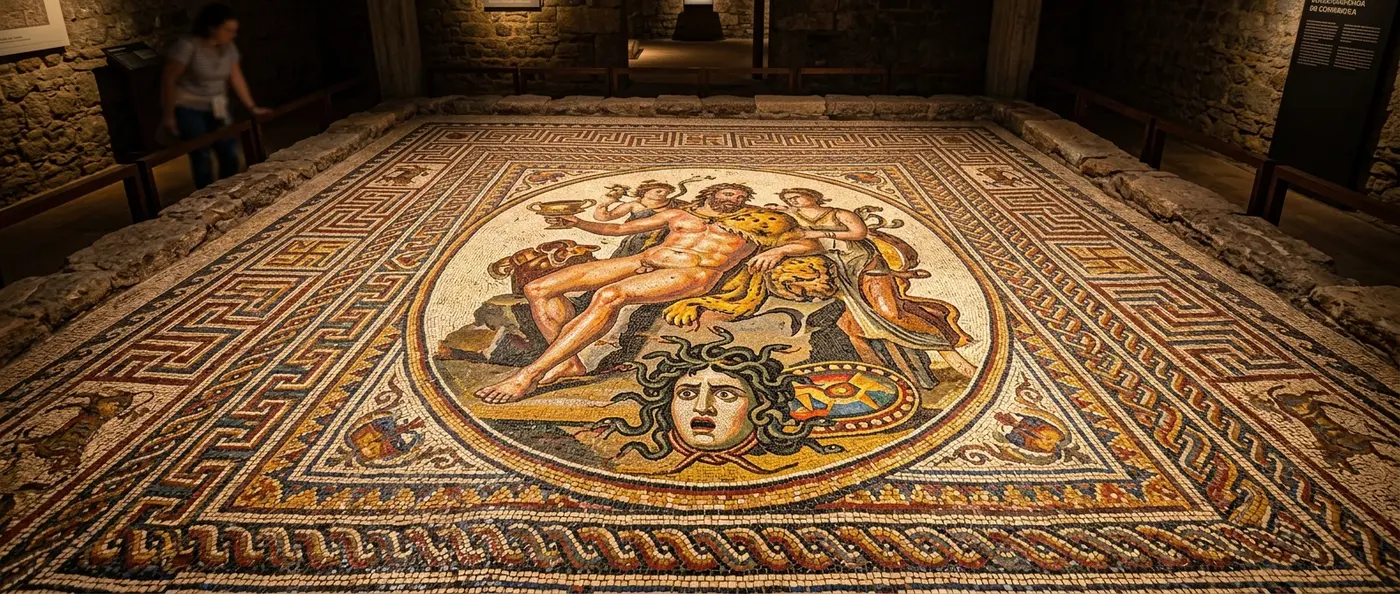
Two thousand years underground. That's how long Hercules waited, frozen mid-celebration in thousands of tiny stone tiles, for archaeologists to uncover his wine-soaked grin. Beside him, across Portugal's ancient landscape, Medusa's serpentine stare pierced through centuries of accumulated earth. These aren't just pretty pictures—they reveal how Romans living in distant Lusitania saw themselves and their gods.
📖 Read more: Dog Teeth Baby Carriers: 5,000-Year-Old German Burials
🏛️ The Discovery That Stunned Archaeological Circles
The two mosaics date from the 2nd to 4th centuries CE and surfaced at separate Portuguese sites. Each reflects different aspects of Roman art and religion. The first captures Hercules in a rare moment of relaxation. The second presents Medusa's terrifying head in all its glory.
Archaeologists who studied the finds say the construction quality and design complexity point to wealthy Roman citizens as the original owners. These weren't mere decorative elements. They were status symbols and cultural identity markers rolled into intricate stone artwork.
The construction technique follows the classic Roman tradition of opus tessellatum. Thousands of microscopic tesserae made from stone and ceramic form the detailed images. Each tessera was placed with millimeter precision, creating pictures that retain their vibrancy nearly two millennia later.
⚔️ Hercules Caught in Human Weakness
The Hercules mosaic shows the hero in an unusual depiction. Instead of the familiar muscled warrior battling monsters, we see a "drunken Hercules"—a scene referencing the episode where the hero became captive to Queen Omphale and lived through a period of pleasure and relaxation.
The Romans chose this theme deliberately. In Roman society, Hercules was worshipped not only as protector of warriors but also as god of wine and prosperity. Depicting him in a moment of human weakness made him more accessible to mortals and reminded viewers that even heroes have their moments.
The mosaic was found in a triclinium (dining room) of a luxurious Roman villa, suggesting the image of "relaxed" Hercules matched the atmosphere of symposiums held there. Guests would enjoy their food and wine while watching the mythical hero do the same.
The second mosaic depicts Medusa's head—the Gorgon with snakes for hair who turned anyone who looked at her to stone. In Roman art, Medusa had evolved from terrifying monster to powerful apotropaic symbol that protected against the evil eye and malevolent spirits.
Placing the mosaic at the building's entrance wasn't accidental. It functioned as a visual warning to anyone entering with bad intentions, while simultaneously displaying the owner's education and wealth. The detailed rendering of the snakes and the intense facial expression create an image that still inspires awe today.
The artists created Medusa's eyes using a sophisticated technique. The artists used tesserae from different materials and colors to create the sensation that her gaze follows the viewer—an optical trick that enhanced her protective power.
💡 Did You Know?
In Roman mythology, Medusa's head carried by the goddess Athena on her shield was called the "Gorgoneion" and was considered the most powerful protective symbol. Romans depicted it everywhere: from mosaics and frescoes to jewelry and weapons.
🎨 The Art of Mosaic-Making in Roman Lusitania
Lusitania—the Roman province corresponding to modern Portugal and part of Spain—was a major center of mosaic production. Local craftsmen combined classic Roman techniques with regional motifs and materials, creating works of unique beauty.
Lusitanian mosaics are distinguished by their use of local stone that gave special hues to the works. Gray and blue tesserae from schist, red from terracotta, and white from marble created a palette characteristic of the region.
Analysis of construction techniques reveals that craftsmen followed a complex process. First they sketched the motif on a surface, then laid a mortar layer, and finally embedded the tesserae one by one, working from center outward. A single square meter took craftsmen weeks to complete.
Construction Techniques
Opus tessellatum for backgrounds with 1-2 cm tesserae, opus vermiculatum for details with 2-4 mm tesserae. Used local and imported materials.
📖 Read more: Nazca Lines: Ancient Designs Only Visible from Above
Production Workshops
Major centers in Mérida, Conimbriga, and Milreu. Each workshop had its own style and techniques that distinguished it from others.
Cost and Prestige
A mosaic floor cost as much as 5-10 workers' annual wages. Only wealthy merchants and officials could afford it financially.
🏺 Mythology and Daily Life
Choosing mythological themes for mosaics wasn't simply a matter of aesthetics. Each depiction had specific symbolism and purpose. Hercules symbolized strength but also human nature. Medusa represented protection from evil. Other popular themes included Dionysus (for symposium halls), Poseidon (for baths), and the Muses (for libraries).
Mosaics also functioned as social status indicators. The more complex and expensive the mosaic, the greater the owner's prestige. Visitors to a villa "read" the mosaics and immediately understood the host's economic power and education.
Many mosaics contained hidden messages or references to local myths. Archaeologists have identified cases where Roman deities are depicted with characteristics of local Lusitanian gods, showing the cultural synthesis happening in the region.
Conserving ancient mosaics is a delicate process requiring specialized knowledge and technology. Modern conservators use lasers for cleaning, special polymers for stabilization, and digital imaging to document every tessera.
Material analysis through spectroscopy reveals the origin of tesserae. We learn that blue glass was imported from Egypt, porphyry from Egypt, while most other materials came from local quarries. This shows the extensive trade network of the Roman Empire.
New technologies like photogrammetry and 3D scanning allow creation of digital copies of mosaics. This not only helps in studying them but also in creating virtual reconstructions of the spaces where they were found, giving us a complete picture of what Roman villas in Lusitania looked like.
⚖️ Mosaic Technique Comparison
🌍 The Legacy of Roman Mosaics
Portugal's Roman mosaics today constitute precious testimonies of the past. Beyond their artistic value, they tell us stories about the people who commissioned them, the craftsmen who created them, and the society that enjoyed them.
Many of these mosaics are exhibited today in Portuguese museums, while others remain in situ, protected in archaeological sites. Visiting these sites offers a unique experience, as one can walk (metaphorically) in the same rooms where Romans of Lusitania once lived.
The study of mosaics continues, with new discoveries coming to light every year. Each new find deepens our knowledge of Roman civilization in the Iberian Peninsula and the unique synthesis created from the encounter between Roman and local cultures.
Two thousand years later, these mosaics still do what their creators intended: they command attention, display wealth, and invoke divine protection. Hercules grins eternally from his dining room floor, while Medusa's serpentine stare guards an entrance that no longer exists—yet both continue to fulfill their ancient purpose.