📖 Read more: Cleopatra: The Last Pharaoh of Egypt
🏺 The Tanis Discovery
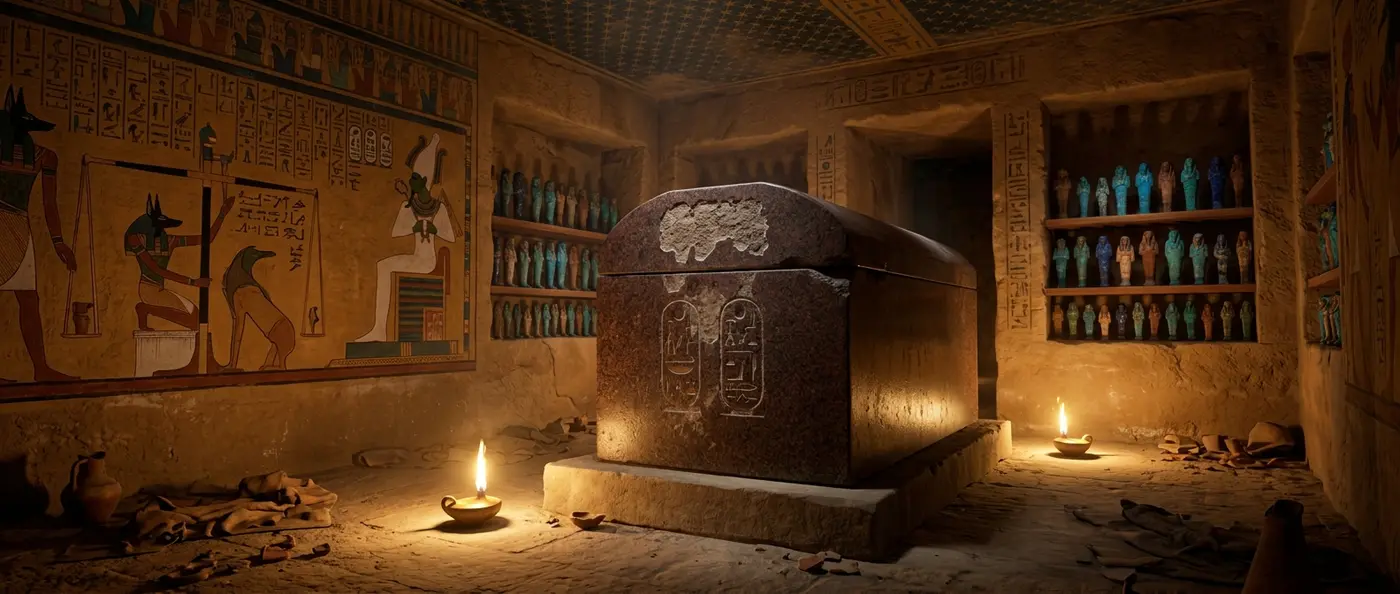
The French-Egyptian archaeological team led by Frédéric Payraudeau made the find during conservation work in Osorkon II's tomb. The 225 shabtis, crafted from faience (glazed ceramic), lay scattered in the tomb's northern chamber near an anonymous sarcophagus. Hieroglyphs carved into the figurines revealed their true owner: Shoshenq III.
Osorkon II's tomb had been discovered back in 1939, but the shabtis went unnoticed until now. Alongside the figurines, the team uncovered new wall inscriptions still under analysis. The shabtis and inscriptions prove that Shoshenq III wasn't buried in his own prepared tomb but in that anonymous sarcophagus inside his predecessor's burial chamber.
Here's the twist: Shoshenq III had already built his own tomb at Tanis. He'd constructed a magnificent gateway at the central temple's entrance and prepared a burial chamber worthy of his 52-year reign. So why did he end up in someone else's tomb?
⚔️ An Era of Civil Wars
Shoshenq III's reign was brutal. As Payraudeau explains, "his kingship was long but difficult, with a bloody dynastic war between the kings of the North and two kings in southern Egypt." The southern kings were his own cousins, making the conflict a family bloodbath.
Egypt wasn't unified during this period. The 22nd Dynasty, which included both Osorkon II and Shoshenq III, faced constant challenges from rival dynasties. Despite the chaos, Shoshenq III managed to build multiple monuments at Tanis, including that impressive temple gateway.
But civil war takes its toll. Resources drained. Alliances shifted. And when pharaohs died, their successors sometimes made ruthless calculations about who deserved which tomb.
🗿 The Successor Who Stole the Tomb
Evidence points to Shoshenq IV of the 23rd Dynasty as the tomb thief. Professor Aidan Dodson from the University of Bristol notes that some objects in Shoshenq III's original tomb bear Shoshenq IV's name. This suggests the later pharaoh seized his predecessor's burial chamber and moved the body to Osorkon II's nearby tomb.
Tomb reuse wasn't uncommon in ancient Egypt. But moving a pharaoh's corpse from his prepared resting place to another tomb was extreme. The reasons remain murky. Maybe ongoing succession disputes drove the decision. Maybe Shoshenq IV simply wanted a more impressive burial site for himself.
Whatever the motive, the act reveals the harsh reality of pharaonic power. Even in death, kings weren't safe from their successors' ambitions.
💡 Did You Know?
Shabtis were small figurines that ancient Egyptians believed would come to life in the afterworld to serve the deceased. The wealthy and powerful were buried with hundreds — Tutankhamun had over 400!
👑 Other Cases of Tomb Theft
Shoshenq III's case isn't unique. One of the most famous examples involves Pharaoh Ay, who ruled from 1323 to 1320 BCE. Evidence suggests Ay appropriated both Tutankhamun's tomb and mortuary temple in Thebes. The young pharaoh ended up buried in a hastily converted private tomb in the Valley of the Kings, while Ay claimed a much larger monument in the nearby western valley.
Ay had risen through the ranks of civil service and military. He served as advisor to Akhenaten and likely Tutankhamun before becoming pharaoh himself after the young king's premature death. While he continued honoring his predecessor's memory by adding his own texts alongside Tutankhamun's, the tomb appropriation reveals a darker side of his power grab.
The pattern repeats throughout Egyptian history. Horemheb erased predecessors' names from monuments and possibly seized tombs. Ramesses II famously usurped countless monuments, slapping his cartouche over earlier pharaohs' names. Death didn't end the competition — it just changed the rules.
Pharaoh Ay
Appropriated Tutankhamun's tomb and mortuary temple. The young pharaoh got buried in a smaller tomb instead.
Shoshenq IV
Seized Shoshenq III's tomb and moved the corpse to Osorkon II's burial chamber.
Horemheb
Erased predecessors' names from monuments and possibly appropriated some tombs.
🔬 New Discoveries Reveal the Past
This year alone, archaeologists announced two new royal tomb discoveries. In February 2025, researchers found Thutmose II's tomb west of the Valley of the Kings. Thutmose II was half-brother and husband to Hatshepsut, who took the throne after his death about 3,500 years ago.
Even more recently, in March 2025, archaeologists discovered an unknown king's tomb at Abydos. The tomb dates to the Second Intermediate Period (roughly 1640-1540 BCE), when northern Egypt was ruled by the Hyksos and the southern region by multiple Egyptian kings. Unfortunately, ancient tomb robbers destroyed the hieroglyphs that would have revealed the king's name.
Each discovery fills gaps in Egyptian history. The Second Intermediate Period saw competing dynasties and frequent power struggles across Egypt. Finding intact tombs from this period is rare — most were looted or repurposed centuries ago.
🏺 The Significance of the Discoveries
Anna-Latifa Mourad-Cizek, assistant professor of Egyptian archaeology at the University of Chicago, calls these discoveries "extremely significant" because they add evidence to a very limited body of proof about rulers from these periods. Each tomb provides more evidence of the political upheavals and power struggles in ancient Egypt.
Tomb appropriation reveals the brutal reality of pharaonic power. Even in death, pharaohs weren't safe from their successors' ambitions. Tombs meant for eternity could change hands, and dead kings could be moved around like furniture.
The practice also shows how resource-constrained even mighty pharaohs could be. Building a proper royal tomb required enormous resources — skilled workers, precious materials, years of labor. Sometimes it was easier to steal than to build.
📊 Tomb Appropriation Timeline
🗺️ The Future of Excavations
Archaeologists continue investigating the area where the unknown king's tomb was found at Abydos. Josef Wegner from the University of Pennsylvania, who leads the team, believes the region "may reveal more royal tombs of the same period that could shed light on the identity and ownership of this new royal tomb."
Meanwhile, at Tanis, conservation work continues on Osorkon II's tomb and analysis of the shabtis and inscriptions. Every new piece of evidence helps reconstruct the puzzle of ancient Egyptian history and reveals the dark side of royal succession.
The Tanis team is also investigating whether other tombs at the site show signs of reuse or appropriation. Given what they've found with Shoshenq III, it wouldn't be surprising if more pharaohs had their final resting places hijacked by ambitious successors.
These discoveries remind us that ancient Egyptian history is far more complex than romantic images of golden masks and magnificent pyramids suggest. Behind the glamour lurk stories of betrayal, appropriation, and political maneuvering that would make even modern politicians blanch.