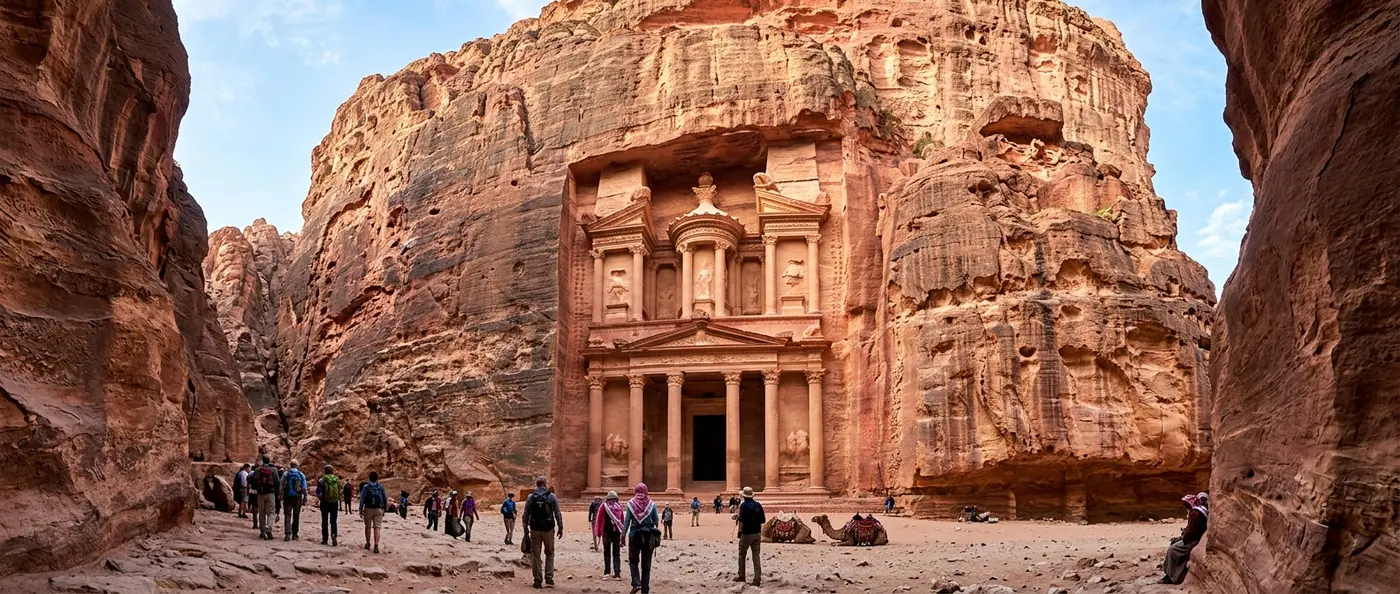
Twelve skeletons. One mysterious chalice-like vessel. A 2,000-year-old tomb hidden beneath the most famous monument in Petra. Archaeologists working under Jordan's iconic Treasury have uncovered a burial chamber that would make Indiana Jones jealous — and it's located exactly where Hollywood placed the Holy Grail in "The Last Crusade."
📖 Read more: Athens Mosaic Discovery 2026: 4th Century Find
🏛️ The Treasury: Al-Khazneh
The Treasury stands 130 feet tall, carved directly into rose-colored sandstone. Known in Arabic as "Al-Khazneh" — literally "the pharaoh's treasury" — this Hellenistic masterpiece has puzzled archaeologists for decades. Most experts believe it served as a mausoleum for Nabataean King Aretas IV Philopatris, but its exact purpose remained elusive.
The monument's Greek-style facade dominates Petra's entrance, greeting visitors with columns, pediments, and intricate carvings that have survived two millennia of desert winds. For decades, the Treasury remained one of the few major sites in Petra that hadn't been thoroughly excavated below ground level.
Dating the structure has sparked fierce academic debates. Laurent Tholbecq, professor at the Free University of Brussels' Center for Archaeological Research and Heritage, now places its construction in the first quarter of the 1st century CE. The newly discovered tomb beneath the monument should finally confirm this timeline.
🎬 Did You Know?
The Treasury became globally famous when Steven Spielberg used it as the hiding place for the Holy Grail in "Indiana Jones and the Last Crusade" (1989). In reality, the interior is far simpler than the movie's elaborate temple chambers — just a few plain rooms carved into rock.
🔍 The 12-Skeleton Discovery
Ground-penetrating radar surveys by Richard Bates, a geophysicist at the University of St Andrews in Scotland. Using advanced subsurface scanning technology, his team detected anomalies beneath the Treasury that suggested underground chambers.
When excavations began — a collaboration between Jordan's Department of Antiquities and the American Center of Research — they uncovered a tomb containing 12 complete skeletons. The most striking find was a ceramic vessel resembling a chalice, clutched by one of the deceased.
Tim Kinnaird, a researcher at St Andrews' School of Earth and Environmental Sciences, analyzed sediments and materials from the burials. His dating places them between the mid-1st century BCE and early 2nd century CE — right at the height of the Nabataean kingdom's power.
Who were these 12 people? Their identities remain unknown. Archaeologists continue investigating why they were buried in such a significant location, directly beneath one of Petra's most iconic monuments.
Lucy Wadeson, an archaeologist at the University of Edinburgh, emphasized the discovery's importance: "This find will reveal burial practices of the Nabataeans, as so few intact tombs have been excavated. With the human remains and grave goods found in their original context, we can finally reconstruct the burial rituals associated with these magnificent tombs."
Megan Perry, an anthropology professor at East Carolina University who has worked extensively at Petra, cautions against overhyping the discovery. She points out that a tomb right next to this one was excavated in 2003, so finding another burial chamber wasn't entirely unexpected.
🏺 The Nabataeans: Masters of the Desert
The Nabataeans settled in this region around the 4th century BCE. These Arab nomads transformed themselves into one of antiquity's most successful trading peoples, controlling caravan routes that connected Arabia with the Mediterranean.
Petra flourished as their capital, strategically positioned at the crossroads of ancient trade networks. Its inhabitants developed sophisticated water collection and storage systems — essential for survival in this arid landscape. Channels, cisterns, and dams captured precious rainwater, allowing a thriving city to exist in the desert.
Their kingdom maintained independence until the 2nd century CE, when the Romans absorbed the territory. After Roman conquest, Petra gradually lost its importance as a trading hub and was eventually abandoned.
🗿 Petra's Architectural Legacy
Petra holds hundreds of monuments carved into sandstone cliffs beyond the famous Treasury. The Royal Tombs — a series of impressive facades cut into a massive rock wall — served as final resting places for wealthy Nabataeans.
Among these stands the Urn Tomb, named for its urn-shaped decoration. Sunset bathes its sandstone walls in golden light, creating a mesmerizing spectacle that draws thousands of visitors annually.
Geography
Petra sits in a valley surrounded by towering cliffs and narrow gorges, providing natural protection and control over trade routes.
Water Systems
The Nabataeans built complex networks of channels, cisterns, and dams to collect and store precious rainwater in the desert.
Art & Decoration
The monuments blend Nabataean, Hellenistic, and Roman elements, creating a unique architectural style.
🥾 The Jordan Trail to Petra
Today, visitors can reach Petra via the Jordan Trail, a 675-kilometer path traversing the entire country. The 80-kilometer section from Dana village to Petra ranks among the most spectacular.
The route crosses the Araba desert, a scorching landscape dotted with wadis (dry riverbeds) decorated with ancient petroglyphs. Hikers often encounter semi-nomadic Bedouins who still use ancestral water-collection techniques.
Despite its fame, surprisingly little of Petra has actually been excavated. Archaeologists estimate only 15% of the ancient city has been systematically explored, leaving vast potential for future discoveries.
This latest find beneath the Treasury highlights how modern technology revolutionizes archaeological research. Ground-penetrating radar and other non-invasive methods allow scientists to locate underground structures without disturbing the soil.
Each new discovery builds our picture of Nabataean history. From burial practices to daily life, Petra keeps revealing its secrets to those with the patience and expertise to seek them.
📊 Petra by the Numbers
🌟 Why This Discovery Matters
Richard Bates, the geophysicist who located the tomb, stated: "This discovery is of international significance as very few complete burials from the early Nabataeans have ever been retrieved from Petra. The burials, their goods, and the human remains can all be expected to help fill in the gaps in our knowledge of how Petra came to be and who the Nabataeans were."
This discovery offers new evidence for dating the Treasury and insight into Nabataean burial customs and social structures. Each skeleton, each ceramic piece, each tiny artifact could reveal information about diet, health, trade relationships, and religious beliefs of this enigmatic people.
For archaeologists and historians, Petra holds vast stores of undiscovered knowledge. While the Treasury may not hide the legendary Holy Grail, the real treasures it reveals — the history, culture, and heritage of the Nabataeans — are far more valuable than any mythical artifact.