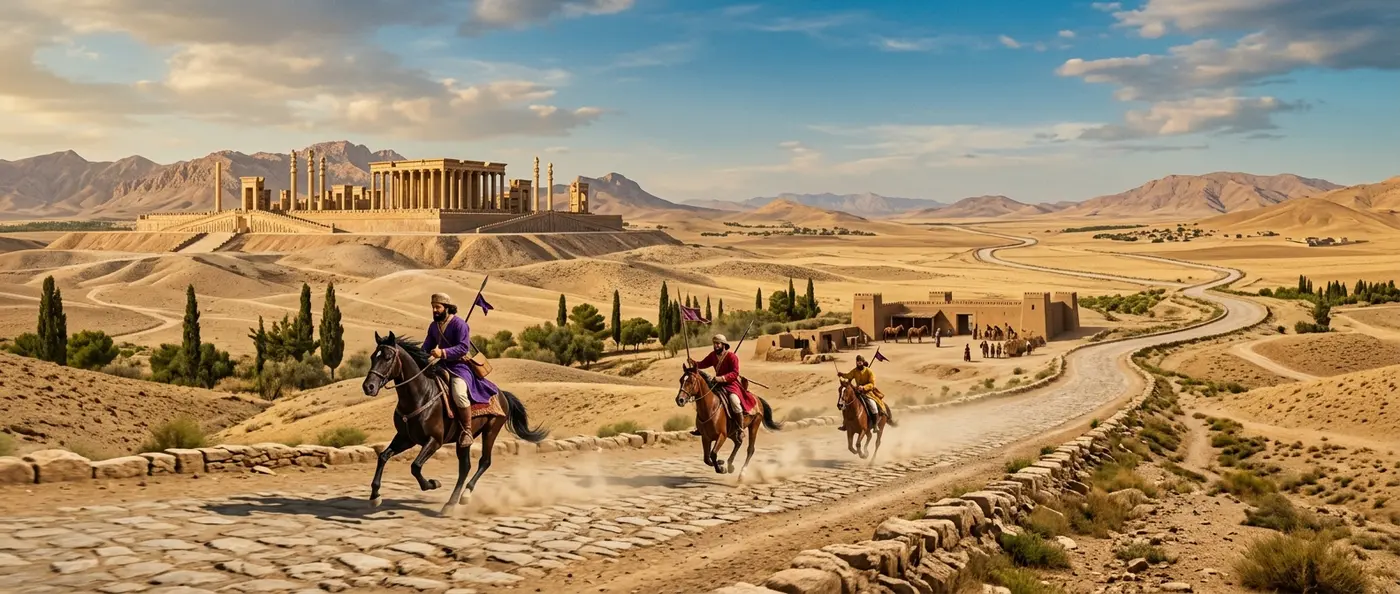
Nine days. That's how long it took a royal messenger to carry urgent news across nearly 3,000 kilometers of desert, mountains, and rivers in the ancient world. No modern highway existed. No telegraph wires. Just horses, determination, and the most sophisticated road network the world had ever seen. The Persian Royal Road wasn't just a path—it was the internet of its time, connecting the heart of the Persian Empire to its western frontiers with breathtaking speed.
🛤️ Building History's Greatest Highway
King Darius I had a problem. His empire stretched from India to the Aegean Sea, but news traveled at the pace of a walking horse. Rebellions could fester for months before reaching the capital. Trade routes remained dangerous and unpredictable. So between 522-486 BCE, he ordered the construction of a superhighway spanning continents.
The Royal Road began at Susa, the administrative capital of Persia in modern-day Iran. From there, it carved northwest through Mesopotamia, crossed the Tigris River, and wound through the highlands of Anatolia before ending at Sardis and Smyrna on the Aegean coast.
Stretching over 2,400 kilometers, this was a complete infrastructure system. Every 25-30 kilometers, engineers built relay stations stocked with fresh horses, supplies, and lodging. Fortified posts guarded dangerous passes. The Persians had essentially invented the first interstate highway system, complete with rest stops.
🏛️ From Susa to the Aegean: The Route
The road began at Susa, where Persian kings held court in massive palaces decorated with glazed brick reliefs. Leaving the capital, messengers rode northwest into the Zagros Mountains, following ancient trade routes that connected Mesopotamia to the Iranian plateau.
After crossing the Tigris, the road entered the heart of what had once been the Assyrian Empire. Here, Darius's engineers rebuilt and expanded existing routes, creating a unified system from fragments of older roads. The path wound through modern-day Iraq and eastern Turkey, connecting diverse peoples under Persian rule.
The final stretch descended through the highlands of Anatolia toward the wealthy cities of Lydia. At Sardis, the former capital of King Croesus, the road branched toward Greek settlements along the coast. From there, ships could carry messages and goods across the Aegean to mainland Greece—a connection that would prove crucial during the Persian Wars.
📜 The Royal Messenger Service
The road's genius wasn't its length—it was the communication system that ran along it. Herodotus described the royal messengers with admiration: "Nothing mortal travels so fast as these Persian messengers. Neither snow nor rain nor heat nor gloom of night stays these couriers from the swift completion of their appointed rounds."
Sound familiar? That phrase became the unofficial motto of the United States Postal Service, borrowed directly from Herodotus's account of Persian efficiency.
Each station operated like a pit stop. Fresh horses waited at each station. Messengers handed off dispatches to riders already mounted and ready to gallop. No single person rode the entire route—the message itself flew from station to station, covering 300 kilometers per day.
Regular travelers took three months to complete the journey. Merchants moved slowly, their pack animals loaded with silk, spices, and precious metals. But when the king needed to communicate with his western provinces, his words could reach Sardis in just over a week.
💡 The World's First Express Mail
The Persian messenger system predated the famous Pony Express by over 2,000 years—and covered ten times the distance. While the Pony Express connected Missouri to California across 3,100 kilometers, the Royal Road linked civilizations across three continents with unprecedented speed and reliability.
⚔️ Military and Administrative Control
Speed meant power. Before the Royal Road, rebellions in distant provinces could rage for months before the king even learned of them. Local governors operated with dangerous independence, sometimes switching allegiances or declaring themselves autonomous rulers.
The road transformed imperial control. Royal inspectors could appear without warning in remote provinces. Military reinforcements could march from the heartland to trouble spots in weeks rather than months. Tax collectors moved efficiently between regions, ensuring steady revenue flowed back to Susa and Persepolis.
Most importantly, the road allowed centralized control of the world's largest empire. Satraps (provincial governors) received regular instructions from the king. They sent detailed reports about local conditions, potential threats, and economic opportunities. For the first time in history, a single ruler could effectively govern territories spanning from the Indus Valley to the Mediterranean.
Military Mobility
Troops could deploy rapidly to any threatened frontier, giving Persia decisive advantages over slower-moving enemies.
Administrative Unity
Royal decrees reached provincial governors quickly, ensuring consistent policy across the vast empire.
Economic Flow
Taxes and tribute moved efficiently from provinces to the capital, funding imperial expansion and infrastructure.
🌍 Highway of Cultures
The Royal Road carried more than messages and soldiers—it transported ideas. Persian merchants met Greek traders at roadside inns. Lydian craftsmen learned techniques from Mesopotamian artisans. Religious concepts, artistic styles, and technological innovations spread along the route like wildfire.
Zoroastrian fire temples appeared in western Anatolia. Greek architectural elements influenced Persian palace design. The road became a cultural superhighway, creating the first truly cosmopolitan trade network.
Archaeological evidence reveals the road's cosmopolitan character. Coins from different regions turn up at the same sites. Pottery styles show clear influences from multiple cultures. Even languages mixed—Aramaic became the diplomatic tongue of the empire partly because it spread so effectively along the Royal Road.
🗺️ Alexander's Highway to Conquest
The road that strengthened the Persian Empire ultimately contributed to its downfall. When Alexander the Great launched his invasion in 334 BCE, he didn't have to hack through wilderness or navigate unknown terrain. The Persians had thoughtfully provided him with a superhighway straight to their capital.
Alexander's army moved with shocking speed across Anatolia, following the Royal Road's well-maintained surface and using its supply stations. What the Persians had built for defense became the invasion route that brought their empire crashing down. Within a decade, Alexander had conquered every major Persian city, often by following the very roads Darius had constructed to protect them.
🔬 Archaeological Evidence and Modern Research
Today, archaeologists continue uncovering remnants of the Royal Road across Turkey and Iran. Sections of ancient paving stones still exist, worn smooth by millennia of traffic. Foundation walls of relay stations emerge from excavations, revealing the road's sophisticated infrastructure.
The richest discoveries reveal the road's multicultural character. Inscriptions in Persian, Aramaic, and Greek appear at the same sites. Coins from across the empire cluster around former stations. Tools, weapons, and pottery fragments tell stories of the diverse peoples who traveled this ancient highway.
Modern highways in Turkey and Iran often follow routes established by the Royal Road. GPS mapping reveals how Persian engineers chose optimal paths through mountain passes and river valleys—routes so well-planned that they remain the most efficient connections between these regions today.
🏛️ Ancient Road Comparison
💭 The Road's Lasting Legacy
The Persian Royal Road pioneered concepts that define modern communication networks. The relay system inspired later postal services across multiple civilizations. Roman roads adopted Persian engineering techniques. Even today's internet follows the same basic principle: break information into packets, send them through the fastest available routes, and reassemble them at the destination.
The road proved that information is power. Whoever could communicate fastest across vast distances could control those distances. This lesson shaped every subsequent empire, from Rome to Britain to the modern United States.
Perhaps most importantly, the Royal Road demonstrated that infrastructure creates civilization. By connecting distant peoples with reliable, safe passage, the Persians didn't just build a road—they built a world. Different cultures, languages, and traditions merged into something larger and more complex than any single society could achieve alone.
Before fiber optic cables and satellites, the Royal Road solved the same problem we face today: moving information across vast distances at speed. For the first time in human history, a message could travel thousands of kilometers in days rather than months. That breakthrough changed everything: how empires governed, how armies moved, how cultures mixed, and how ideas spread.
The Persian Royal Road reminds us that the desire to connect across vast distances is fundamentally human. Twenty-five centuries before fiber optic cables and satellite networks, Persian engineers solved the same basic challenge we face today: how to move information quickly and reliably across a complex, interconnected world.