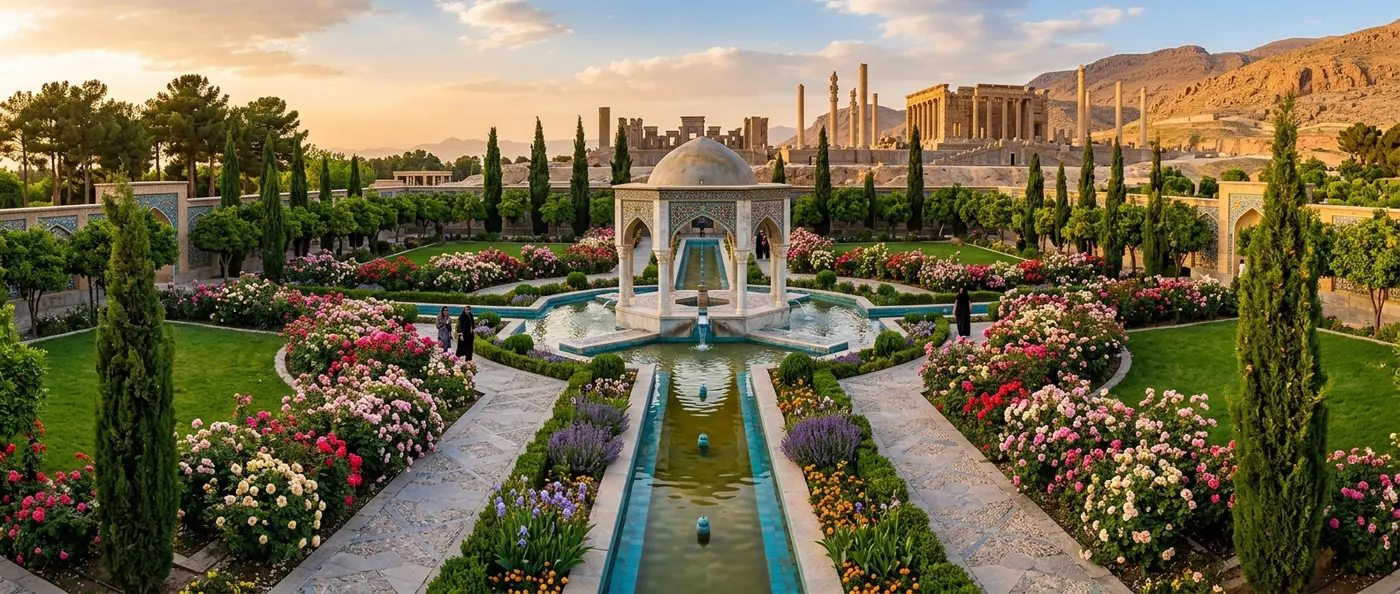
Behind the walls of ancient Persia, 2,600 years ago, someone had a radical idea. Instead of just growing food, why not create heaven on earth? The Persians didn't just plant gardens — they engineered paradise itself, designing geometric oases that would reshape how humans think about landscape forever.
🌺 Birth of the Paradise Concept
The word "paradise" comes from the ancient Persian "pairidaēza" — literally "walled around." For the Persians, these weren't decorative spaces. They were statements of power over nature, miniature universes where divine order conquered desert chaos.
The first Persian gardens appeared around 600 BCE during the Achaemenid dynasty. Cyrus the Great, founder of the Persian Empire, was obsessed with gardens. At his capital Pasargadae, he created sprawling landscapes that merged beauty with function — a revolutionary concept for its time.
These gardens followed strict geometric principles rooted in Zoroastrian cosmology. The universe, according to Persian religion, was divided into four elements: earth, water, air, and fire. This four-fold division became the template for garden design that would spread across three continents.
Water as Life Force
Channels and fountains carved through gardens, symbolizing the four rivers of paradise. In a desert empire, water wasn't decoration — it was proof of abundance and divine favor.
Trees and Sacred Shade
Cypresses, plane trees, and fruit trees planted in symmetrical rows offered cooling shade. Each species carried mythological significance in Persian lore, creating layers of meaning beneath the canopy.
Geometric Perfection
The square layout with cross-shaped water channels represented cosmic order and balance between natural elements. Every line had meaning, every angle served the greater harmony.
🏛️ The Chahar Bagh: Four-Fold Paradise
The signature Persian garden form is the Chahar Bagh — "four gardens." This design splits the space into four equal sections with two perpendicular water axes intersecting at the center. There, a pavilion or fountain marked the heart of the earthly paradise.
Each quadrant represented a season and a stage of life. Walking through the garden became a symbolic journey through time and existence. The pathways, usually paved with marble or stone, guided visitors along predetermined routes of contemplation and discovery.
The planted beds overflowed with aromatic herbs and flowers. Roses, jasmine, narcissus, and irises created a shifting mosaic of color and fragrance that changed with the seasons. But this wasn't random planting — every flower had its place in the cosmic order.
💎 The Royal Gardens of Isfahan
The golden age of Persian gardens came with the Safavid dynasty (1501-1736). In Isfahan, Shah Abbas I created gardens that became legendary across the East. The Chehel Sotoun ("Forty Columns") used reflection to double its twenty columns in the pool, creating the illusion of forty pillars supporting heaven itself.
These weren't just pleasure grounds. They functioned as diplomatic centers where the Shah received ambassadors and conducted negotiations. The garden's beauty was part of Persian diplomatic strategy — visitors left stunned by the empire's wealth and sophistication.
Foreign ambassadors wrote home about walking through what seemed like paradise itself. The flowing water, geometric precision, and riot of scents created an experience unlike anything in Europe or Asia.
🌊 Water Engineering Mastery
The most impressive aspect of Persian gardens was their water systems. In a region with minimal rainfall, the Persians developed qanat — underground channels that carried water from mountains across dozens of kilometers.
These weren't simple pipes. They were engineering marvels that exploited gravity and geology. Water arrived cold and clean, naturally filtered through rock layers. The system required precise surveying and construction techniques that wouldn't be matched in Europe for centuries.
Within the gardens, water circulated through complex networks of channels, pools, and fountains. The sound of flowing water created an acoustic curtain that isolated the garden from the outside world. Meanwhile, evaporation cooled the air, turning the gardens into climate-controlled oases in the brutal heat.
🗿 Influence on Mughal India
When the Mughals conquered India in the 16th century, they brought Persian garden traditions with them. Babur, the first Mughal emperor, was disappointed by India's lack of formal gardens and immediately began creating Persian-style landscapes.
The culmination of this fusion was the gardens of the Taj Mahal. Here, Persian geometry meets Indian architecture in perfect harmony. The Taj garden, with its four quadrants and central reflecting channel mirroring the mausoleum, is perhaps the most famous interpretation of the Persian paradise concept.
But the Mughals didn't just copy — they innovated. They adapted Persian water features to India's monsoon climate and integrated local plants and architectural elements. The result was a new hybrid style that influenced garden design across South Asia.
🌟 The Secret of Timeless Design
Persian gardens survived for millennia because they weren't just decorative spaces. They were living ecosystems that merged aesthetics with practicality, religion with science, art with engineering. Every element had purpose.
⚓ Legacy in the Modern World
Today, nine Persian gardens are UNESCO World Heritage Sites. From the Eram Garden in Shiraz to the Fin Garden in Kashan, these landscapes still draw visitors into their geometric embrace.
Persian garden influence extends far beyond Iran's borders. From Granada's Alhambra to Versailles' formal gardens, elements of Persian design appear in landscapes worldwide. The idea of the garden as earthly paradise — as a space where nature meets art — may be Persia's most lasting export.
But beyond aesthetic value, Persian gardens teach us something deeper. In a world facing climate change and water scarcity, the ancient techniques of water management and microclimate creation that the Persians developed gain new relevance. Their gardens weren't luxury — they were answers to environmental challenges.
🔬 New Discoveries and Research
Recent archaeological research on the Iranian plateau has revealed new evidence about the antiquity and evolution of Persian gardens. According to recently published studies, the Persian plateau was a crucial hub for human evolution and civilization for thousands of years.
Researchers have identified traces of early irrigation systems dating well before the Achaemenid period. This suggests that the tradition of creating artificial paradises in Persia may have roots reaching deep into prehistory.
Study of ancient texts and inscriptions reveals that Persian gardens weren't just recreational spaces but centers of scientific research. Here they cultivated and studied medicinal plants, experimented with new growing techniques, and developed innovative irrigation systems.
🏛️ Persian Gardens vs Other Ancient Gardens
🌾 The Philosophy of Paradise
For ancient Persians, gardens weren't just beautiful spaces. They were philosophical statements — attempts to create earthly reflections of heavenly paradise. Every element carried symbolic weight: water symbolized life and purification, trees represented eternity, flowers embodied beauty and life's fragility.
This philosophy deeply influenced Islamic civilization. The Quran describes paradise as a garden with flowing waters, shady trees, and eternal spring — a description drawing directly from Persian tradition.
Even today, visiting a Persian garden evokes this timeless search for perfection. In the symmetry of pathways, the sound of water, the fragrance of flowers, something speaks to the soul. It's like entering a space where time stops and harmony reigns.
Persian gardens remind us that humans have always sought ways to create beauty and meaning in the world around them. In an age when our relationship with nature is often problematic, these ancient paradises teach us that harmonious coexistence with the environment is possible — creating spaces that nourish both body and soul.