📖 Read more: Gaugamela: Alexander Crushes Persian Empire Forever
🏛️ Building a City for Kings
Darius I didn't mess around when he chose this spot. Around 515 BC, the Persian king looked at the barren plateau beneath Mount Kuh-e Rahmat and saw something nobody else did: the perfect stage for imperial theater. Natural protection on three sides. Commanding views across the fertile Marv Dasht plain. And enough space to build something that would make visiting dignitaries wet themselves with awe.
The Persians called it Parsa—"City of the Persians." Construction took more than 150 years. Each successive king added his own architectural flex: Xerxes built the Gate of All Nations, Artaxerxes I expanded the treasury, and their successors kept piling on the grandeur. This wasn't just a city. It was a statement carved in stone.
Unlike other ancient capitals, Persepolis wasn't really meant for everyday living. Think of it as the ultimate corporate headquarters—a place where the "King of Kings" held court during Nowruz, the Persian New Year. Delegations from across the empire's 28 provinces would trek here bearing tribute: gold from Lydia, ivory from Ethiopia, camels from Arabia. The message was clear: bow before the throne or get crushed.
⚔️ The Empire That Ruled Everything
The Achaemenid Persian Empire was stupidly big. From the Indus River to the Aegean Sea. From the Caucasus Mountains to the deserts of Egypt. At its peak, it controlled roughly 44% of the world's population. That's not a typo—nearly half of all humans alive answered to the Persian king.
The Persians broke the ancient playbook: they were surprisingly chill conquerors. Instead of crushing local cultures, they let people keep their gods, their customs, their languages. The secret sauce was the satrap system—regional governors who reported to the king but worked with local elites. It was imperial management 101, executed with ruthless efficiency.
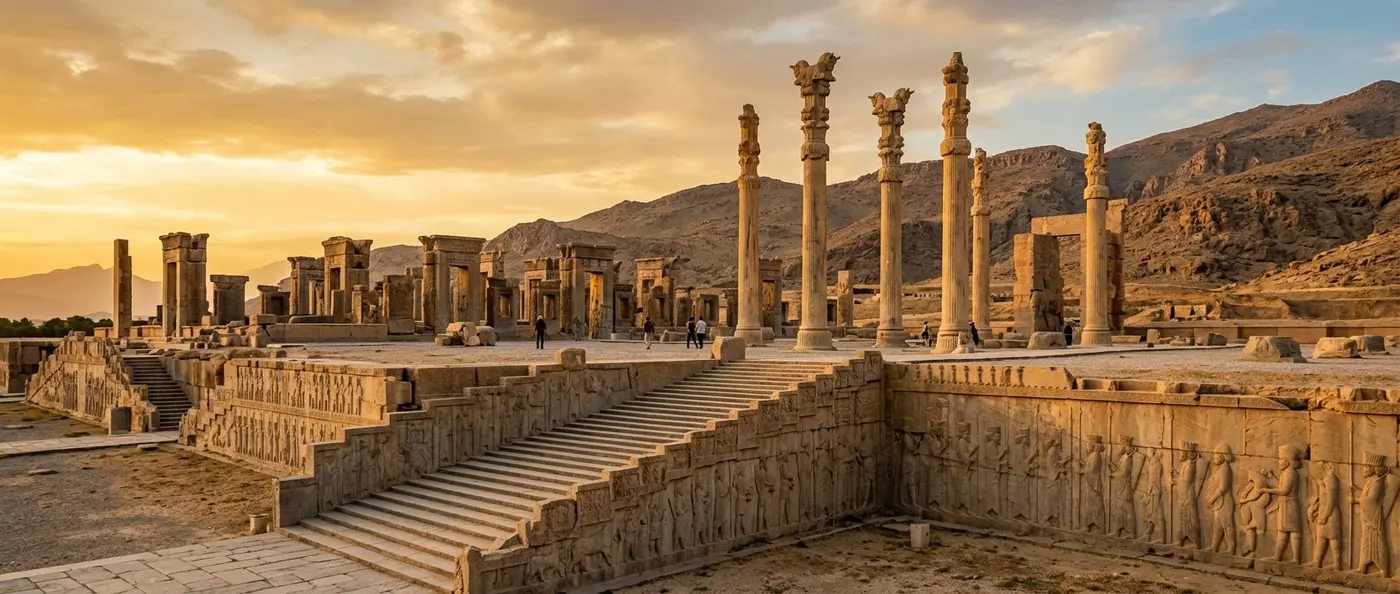
Persepolis showcased this multicultural approach. The reliefs in the Apadana (audience hall) show 23 different peoples bringing tribute, each rendered in exquisite detail. Medes in flowing robes. Babylonians with golden vessels. Indians leading elephants. Scythians with pointed caps. Every delegation carved with ethnographic precision that would make modern anthropologists weep.
🗿 Architecture That Defied Physics
The columns at Persepolis are engineering masterpieces. Some reach 65 feet high—taller than a six-story building. Each one was assembled from multiple stone drums fitted together with such precision that you can't slide a knife blade between the joints. The capitals (column tops) were carved into fantastic creatures: bulls, lions, griffins. Imagine walking into a forest of stone animals holding up the sky.
The Apadana could pack 10,000 people under its cedar roof. Seventy-two columns created a stone forest that seemed to stretch forever. The walls blazed with polychrome reliefs—red, blue, gold—that caught torchlight and threw it back in dazzling patterns. Visitors would have felt like ants in a hall built for gods.
Xerxes' Gate of All Nations was pure psychological warfare. Two massive lamassu—bull-bodied creatures with human heads—guarded the entrance. Trilingual inscriptions in Old Persian, Elamite, and Babylonian welcomed visitors while making damn sure they understood who was boss. The message was unmistakable: you are entering the center of the known world.
Giant Columns
Each column weighed dozens of tons and was assembled from multiple stone drums fitted so precisely you can't slide a knife blade between joints. The animal-shaped capitals—bulls, lions, griffins—turned visiting dignitaries into slack-jawed tourists.
Polychrome Reliefs
The reliefs were originally painted in vivid colors—red, blue, gold. They depicted court ceremonies and tribute processions with incredible detail, creating a visual encyclopedia of the empire's diversity.
Hydraulic System
A complex network of underground channels and cisterns supplied water to the city. The drainage system was so advanced that parts of it still function today, 2,500 years later.
🔥 Alexander's Bonfire
January 330 BC: Alexander the Great walks into Persepolis and finds the jackpot. Two centuries of tribute had turned the treasury into history's greatest piggy bank. Gold, silver, precious stones—enough wealth to fund his army for decades. The Macedonian conqueror had just hit the ancient world's equivalent of Fort Knox.
Four months later, the palace was ash. What happened on that May night remains one of history's great mysteries. Ancient sources tell conflicting stories. Some say it was an accident during a drunken party. Others claim Alexander torched the place deliberately, payback for the Persian destruction of Athens 150 years earlier. Maybe both versions are true.
The fire that destroyed Persepolis also preserved it. Thousands of clay tablets in the treasury got baked hard as pottery, creating an accidental archive of imperial administration. Collapsed debris protected reliefs from weathering. The destruction became conservation, freezing a moment in time like ancient Pompeii.
💡 The Fortification Archive
In 1933, archaeologists discovered about 30,000 clay tablets in the fortification walls. This "Fortification Archive" contains detailed records of wages, food distributions, and official travel, revealing daily life in the empire with unprecedented detail.
🔬 Modern Excavations Rewrite History
Systematic excavation began in the 1930s under Ernst Herzfeld and Erich Schmidt from the University of Chicago's Oriental Institute. They uncovered not just the grand palaces but the workers' quarters, workshops, and storerooms that kept the city running. Persepolis wasn't just a ceremonial stage—it was a functioning administrative center.
Modern technology has revolutionized our understanding. Photogrammetry and laser scanning create detailed 3D models. Spectroscopic analysis reveals traces of original paint on the reliefs. In 2014, drones spotted unknown underground structures that might hide more treasures. The site keeps yielding secrets.
Iranian and international archaeologists now work together on conservation. A major stabilization project for the Apadana columns wrapped up in 2019. The tablet archives are being digitized, revealing Persian administrative details that overturn old assumptions about ancient empires.
🏺 Life in the Imperial Capital
Despite its ceremonial role, Persepolis buzzed with life. Thousands worked there: craftsmen, guards, scribes, servants. The archives reveal a surprisingly cosmopolitan society. Greeks, Babylonians, Egyptians, Indians worked side by side, earning equal pay for equal work. The Persian Empire was an equal-opportunity employer.
Women had remarkable presence in the records. They owned property, managed workshops, traveled on business. A woman named Irtashduna appears to have supervised teams of hundreds of workers. Pregnant women received special food and wine rations. Gender equality wasn't perfect, but it was centuries ahead of its time.
The diet was rich and varied. Beyond basics like wheat, barley, and dates, the archives mention meat, fish, cheese, honey, various fruits and vegetables. Wine and beer were distributed regularly. Workers doing dangerous or strenuous jobs got bonus rations. Even ancient Persians understood the value of hazard pay.
👥 Persepolis Society
🌍 Legacy That Outlasted Empires
Persepolis remains a symbol of Iranian cultural pride. In 1971, the Shah of Iran staged lavish celebrations there for the 2,500th anniversary of Persian monarchy, inviting world leaders to party among the ruins. In 1979, UNESCO declared Persepolis a World Heritage Site, recognizing its universal value.
Persian architectural and artistic influence spread across the ancient world. Elements from Persepolis appear in Hellenistic and Roman buildings. The Achaemenid governmental system influenced later empires. Even Alexander adopted many Persian practices after his conquest.
Today, hundreds of thousands of visitors annually come to marvel at the ruins. Despite the destruction, Persepolis continues to mesmerize. The stone columns that still stand after 2,500 years testify to the grandeur of a civilization that left an indelible mark on history.
The lessons of Persepolis remain relevant. An empire that respected diversity, allowed religious freedom, and rewarded merit regardless of origin or gender. Perhaps that's why, despite its fall, the legacy endures—not just in stone but in the ideas it continues to inspire.