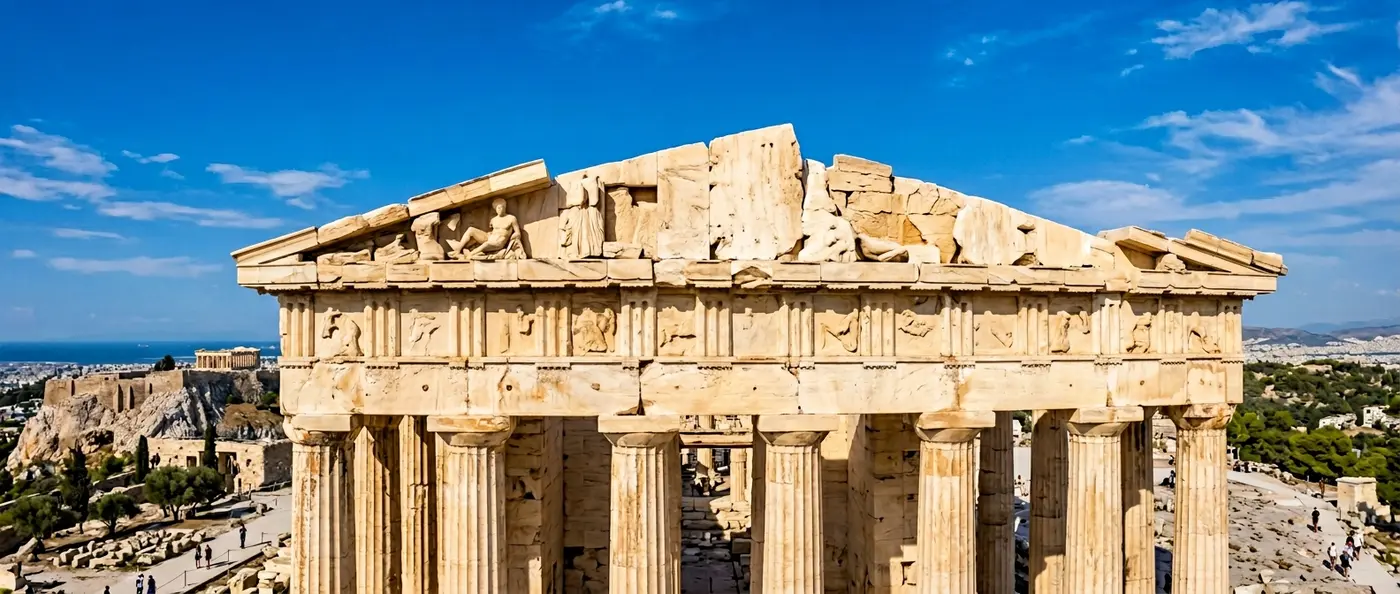
🏛️ The Parthenon: Phidias's Masterpiece
Between 447 and 432 BC, on the highest point of the Acropolis, a temple was built that would become the symbol of Western civilization. Architects Ictinus and Callicrates, under sculptor Phidias's supervision, designed a building from 22,000 tons of Pentelic marble — more marble than any Greek temple before it. The Parthenon measured 69.5 meters long and 30.88 meters wide, with a 4:9 ratio repeated throughout every dimension of the structure.
No previous Greek temple had such rich sculptural decoration. The Parthenon featured 92 metopes carved in high relief, a 160-meter frieze wrapping the entire building with 380 human figures and 220 animals, and two pediments filled with approximately 50 sculptures in the round. Athens was celebrating. The Persians had been crushed at Salamis (480 BC) and Plataea (479 BC).
Inside the temple, Phidias had placed a chryselephantine statue of Athena Parthenos, over 12 meters tall. The statue contained 1,140 kilograms of gold over a wooden frame, with ivory flesh. A shallow pool of water in front reflected light from the entrance. The statue was lost — likely moved to Constantinople in the 5th century AD.
⚔️ The Destruction of 1687
The Parthenon stood nearly intact for over 2,100 years. It was converted to a Christian church in the 5th century AD — an apse was added to the eastern side, destroying part of the frieze. In 1458, the Ottomans converted it to a mosque and added a minaret to the southwest corner.
The great destruction came on September 26, 1687. Venetian general Francesco Morosini was besieging the Acropolis, where the Turks had stored gunpowder inside the Parthenon. A Venetian bomb struck the ammunition depot directly. The explosion blew out all interior walls except the eastern one, toppled columns on the north and south sides, taking half the metopes with them.
Morosini wasn't finished. He tried to remove the central sculptures from the west pediment. The lifting mechanism collapsed. The horses of the west pediment shattered on the ground. From the ruins, the Turks built a smaller mosque inside the destroyed temple, making no effort to protect the fallen sculptures.
🗿 Lord Elgin and the Removal
In the early 19th century, Thomas Bruce, 7th Earl of Elgin, arrived in Constantinople as British Ambassador to the Ottoman Empire (1799-1803). According to his own account, he was concerned about the deterioration the Acropolis sculptures were suffering due to Ottoman neglect.
Initially, he requested permission from the Sublime Porte to send artists to measure, sketch, and copy the sculptures. Permission was granted — along with authorization "to remove pieces of stone with old inscriptions or figures." Elgin stretched that permission beyond recognition.
Between 1802 and 1812, a series of expeditions transported the sculptures to England. Elgin removed 14 metopes (mainly from the south side), large sections of the frieze, and figures from the pediments — including the torso of Athena, Poseidon, Hermes, a relatively well-preserved Dionysus, and a horse's head. He also took a Caryatid from the Erechtheion.
One ship, HMS Mentor, sank in a storm near Kythera in 1804. The entire cargo was later salvaged — an operation that took years. Elgin returned to England in 1806, but the collection remained private until 1816, when the British Parliament purchased the sculptures for £35,000 — roughly half what Elgin had spent.
💡 Contemporary reactions
Lord Byron, the great British philhellene poet, publicly condemned Elgin's actions, calling him a plunderer. Several British intellectuals accused Elgin of rapacity, vandalism, and dishonesty. He published a defense of his actions in 1810, but the controversy never ceased.
📜 What Exactly Is Missing from the Parthenon
Let's examine the numbers. The Parthenon sculptures today are divided mainly between Athens and London, with smaller fragments in museums in Paris, Rome, Copenhagen, and Vienna.
Metopes
Of the 92 original metopes, 14 are in the British Museum (mainly southern ones), while another 13 survive in the Acropolis Museum. The rest were destroyed beyond recognition.
Frieze
The frieze was 160 meters long with 380 human figures and 220 animals. Elgin removed the best-preserved slabs — depicting the Panathenaic Procession with horsemen, officials, musicians, and gods.
Pediments
The pediments measured 28.55 meters long with approximately 50 sculptures in the round. The east depicted Athena's birth, the west the contest between Athena and Poseidon. Most surviving pieces are split between Athens and London.
The frieze is perhaps the most impressive element. It depicts the Panathenaic Procession — the great festival held every four years, where a new peplos-bearing procession delivered a new robe to the ancient wooden cult statue of Athena in the Erechtheion. This was a bold thematic choice: instead of mythological scenes, Phidias carved the Athenians themselves in celebration.
🔱 The Battle for Repatriation
For decades, Greece has demanded the sculptures back. The British Museum refuses, claiming it saved them from destruction. Athens's atmospheric pollution in the 20th century was indeed devastating: the frieze slabs that remained on the Parthenon were only removed in 1993, after suffering severe corrosion.
In 2009 (opened 2011), Greece gained a powerful argument: the new Acropolis Museum. Built 300 meters from the Parthenon, with modern climate control and lighting facilities. An entire floor was dedicated to the Parthenon sculptures, with authentic pieces placed in their correct positions and plaster casts in the gaps — silent reminders of absence.
⚖️ British Museum vs Acropolis Museum
🏺 Architectural Secrets of the Temple
Beyond the sculpture, the Parthenon itself holds surprises. Nothing in the building is truly straight. The architects knew that perfectly straight lines at such scale appear curved from a distance. Their solution was the opposite: they built subtle curves so the eye perceives perfect straight lines.
The floor (stylobate) isn't level — it rises slightly at the center. The columns lean imperceptibly inward and have entasis (slight swelling in the middle). The four corner columns are slightly thicker than the rest, so they don't appear thinner when backlit against the sky. These refinements give the building a vitality that "perfect" Roman copies never achieved.
The temple was structurally unique too. It combined Doric order (external colonnade 8x17 columns, instead of the usual 6x13) with Ionic elements (interior Ionic columns in the opisthodomos and the Ionic frieze around the cella). This combination was unprecedented in Greek architecture.
🔬 The Ongoing Restoration
Modern restoration of the Parthenon began in 1975 and continues today. Laser technologies are used for cleaning, new Pentelic marble for replacing damaged sections, and titanium instead of iron in internal connections (iron used in earlier restorations rusted and cracked the marble).
Every stone is photographed, 3D scanned, and digitally recorded. Broken pieces are reunited with millimeter precision. The process is slow — deliberately. Each new marble piece is deliberately a different shade. Visitors must be able to distinguish what's authentic from what's modern. No illusions.
There's more. Pentelic marble — known for its pure white appearance — contains iron traces that oxidize over time, giving a soft honey tint. This means the Parthenon was never exclusively white. In fact, the sculptures were vividly painted — blue, red, gold — while bronze fittings added details like weapons and bridles. Colored glass was used for eyes. The white Parthenon we imagine is a misunderstanding of centuries.
🎨 The secret of colors
Modern analysis with UV lighting revealed traces of pigments on the Parthenon sculptures. Figures' hair was painted reddish-brown, clothing blue and red, weapons bronze. The metope backgrounds were vivid blue, making the white figures stand out dramatically.
📚 Why It Matters Today
The Parthenon Sculptures case isn't just about Greece and Britain. It has become a symbol of a broader question: who owns cultural heritage? Museums worldwide — from Nigeria to China — face similar repatriation demands.
For the Parthenon, the question remains open. The marbles divided: half in Athens, half in London, fragments in six other European museums. The temple still stands high on the Acropolis, incomplete but unsurpassed, waiting. The gaps speak louder than the sculptures.