🏺 The Sacred Trinity That Ruled an Empire
The story of Osiris, Isis, and Horus forms the core of Egyptian mythology. According to the ancient Pyramid Texts dating from 2350-2100 BCE, this divine family shaped Egyptian beliefs about life, death, and rebirth. Their myth wasn't just a story — it was the blueprint for royal succession, marriage, and the afterlife.
Priests of Heliopolis, followers of the sun god Ra, developed the myth that would dominate Egyptian religious thought. Isis and Osiris were children of Geb, god of the earth, and Nut, goddess of the sky. Together with their siblings Seth and Nephthys, they formed the second generation of Egyptian gods.
Their influence ran so deep it crossed Egypt's borders. By the 2nd century CE, Roman writer Apuleius praised Isis as "mother of the stars, parent of the seasons, and mistress of all the world." In 1912, archaeologists in London discovered a Roman amphora from the 1st century CE inscribed "Londini ad fanum Isidis" — London, next to the Temple of Isis.
⚰️ Osiris: The King Who Conquered Death
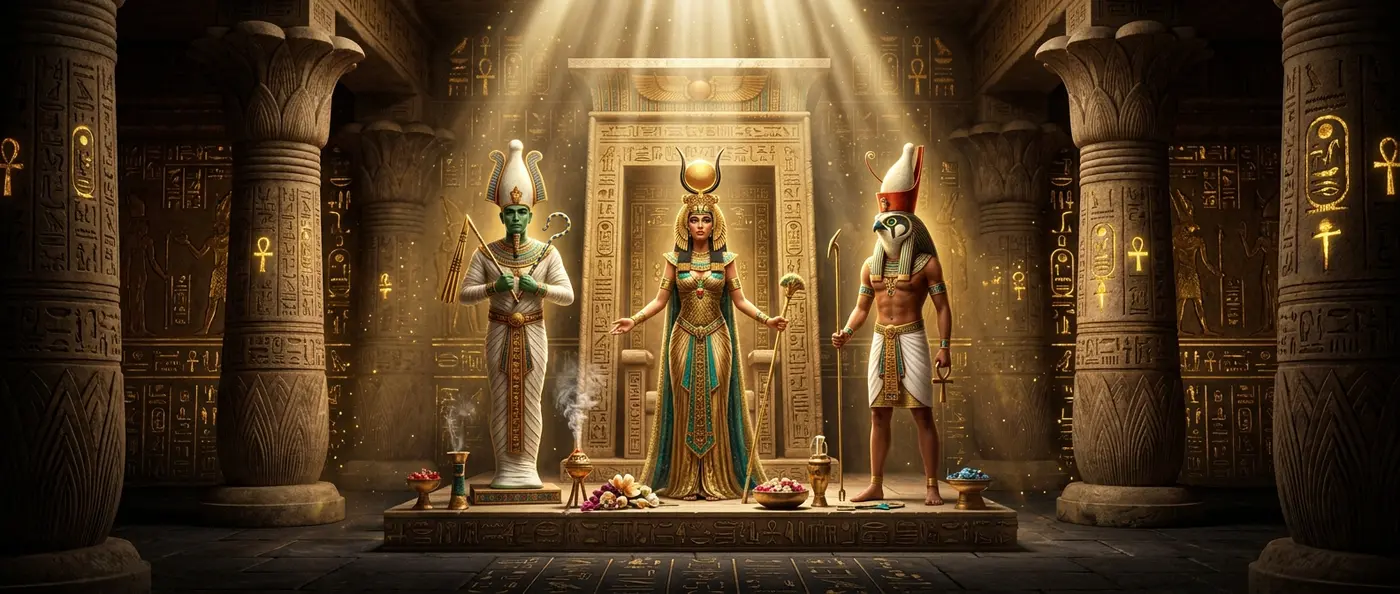
Osiris was one of ancient Egypt's most important deities — god of the underworld and symbol of death, resurrection, and the Nile's flood cycle. He appeared as a mummified king, wrapped in bandages that left only his green hands and face exposed. The green symbolized rebirth and fertility.
The myth preserved in sacred texts tells how Osiris ruled Egypt before his brother Seth murdered and dismembered him. Seth, god of chaos and storms, envied his brother's power. He trapped Osiris in a decorated wooden chest, sealed it with lead, and threw it into the Nile.
Seth's murder of Osiris encoded the eternal struggle between order and chaos, life and death. Every pharaoh was considered the living embodiment of Horus while alive, and after death became one with Osiris in the underworld.
🌙 Isis: The Great Magician and Protector
Isis, whose Egyptian name "Aset" means "throne," started as a relatively unknown deity without her own temples. Within centuries, she had eclipsed all other goddesses in the Egyptian pantheon. Her worship spread across the Roman Empire, from England to Afghanistan.
When Seth murdered Osiris, Isis refused to accept the loss. Transformed into a bird and aided by her sister Nephthys, she searched for and reunited her dead husband's scattered limbs. Using her magical powers, she made Osiris whole again. Bandaged, neither alive nor dead, Osiris had become the first mummy.
Magical Powers
Isis was considered the most powerful magician in the pantheon, with abilities that surpassed even Ra and Osiris. Her magical skills were used to heal the sick and protect the dead.
Divine Protection
As a protective mother, Isis defended her son Horus from snake and scorpion attacks in the Nile Delta marshes, establishing her role as goddess of protection.
Royal Connection
Isis had strong ties to Egyptian royalty. Every pharaoh was considered under the goddess's protection, and queens tried to emulate her virtues.
Her depiction evolved over time. Initially shown as a slender woman in a tight dress with a throne on her head. As she became associated with motherhood, she adopted Hathor's headdress — cow horns with a solar disk. This adaptability kept her worship alive for over a millennium.
🦅 Horus: The Avenger Who Became King
Nine months after Osiris's resurrection, Isis gave birth to Horus. Depicted as a falcon or a man with a falcon head, Horus was god of the sky connected to war and hunting. He was also the embodiment of divine kingship — every pharaoh was considered the living manifestation of Horus.
Isis hid young Horus in the Nile Delta marshes until he grew old enough to avenge his father. Horus and Seth fought an epic battle that lasted eighty years. In one tradition, Horus lost his left eye in battle, but the god Thoth magically healed it. Since Horus's right and left eyes were associated with the sun and moon respectively, the loss and restoration of the left eye gave mythical explanation for lunar phases.
👁️ The Eye of Horus
The "wedjat" or Eye of Horus became one of ancient Egypt's most powerful protective symbols. It was used as an amulet to ward off evil and ensure good health. Even today, this symbol is recognized worldwide.
Eventually, after many adventures and with his mother's help, Horus defeated Seth and claimed Egypt's throne. Osiris was forced to retreat to the underworld, where he became king of the dead, while Horus became king of the living.
🌍 The Spread of Worship Beyond the Nile
When Alexander the Great conquered Egypt in 332 BCE, Isis worship flourished and expanded beyond the country's borders. Alexander absorbed Egyptian religion rather than suppressing it. During his visit to Memphis, he made sacrifices to Apis, an Egyptian bull-god connected to Osiris.
Under the Ptolemaic dynasty, the syncretic god Serapis was created, combining characteristics of Osiris and Apis with Greek gods like Zeus and Hades. Isis became Serapis's consort, and their worship center was Alexandria, a major trading hub of the era.
🏛️ Temples of Isis in the Ancient World
As Ptolemaic influence spread across the eastern Mediterranean, Isis worship traveled along trade routes. In Greece she merged with Demeter, goddess of agriculture. In Lebanon with Astarte. In Roman cities with Fortuna and Venus.
💫 The Legacy of the Sacred Trinity
The influence of Osiris, Isis, and Horus extends far beyond ancient Egypt. Some scholars believe depictions of Isis with infant Horus influenced Christian iconography of the Virgin Mary with the Divine Child. The idea of a god who dies and resurrects, like Osiris, finds parallels in many religions.
Today, more than 1.5 million people in the United States identify as pagans — a number that grew from 134,000 in 2001. Many continue to honor Isis as a symbol of feminine power and magical wisdom. The #witchtok hashtag on TikTok has over 35 billion views, showing renewed interest in ancient spiritual practices.
The ancient Egyptians believed every pharaoh was the living Horus and every dead king became Osiris. This cyclical understanding of power and rebirth maintained Egyptian state stability for three millennia. Isis, as the perfect wife and mother, provided the model for all Egyptian women.
The myth of Osiris, Isis, and Horus isn't just an ancient story. It's a timeless narrative about love transcending death, the power of maternal protection, and the triumph of justice. From the banks of the Nile to London's streets, these deities continue to captivate and inspire, reminding us that some stories are truly eternal.