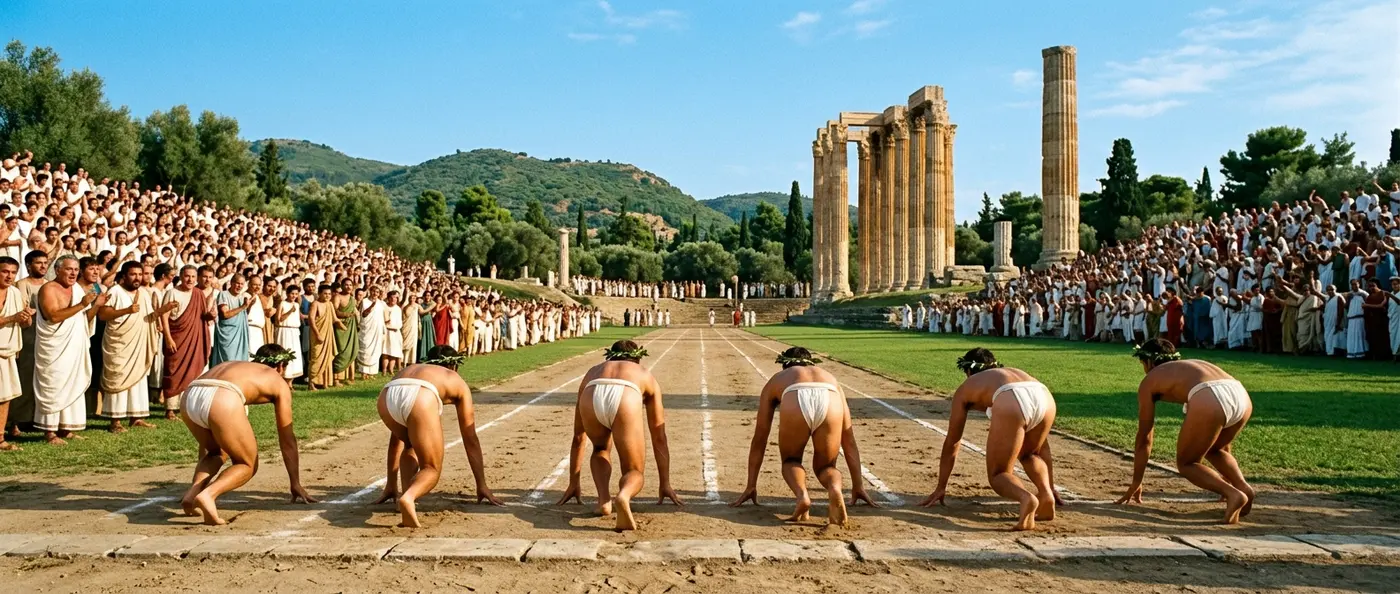
🏛️ The Sacred Birthplace of Athletic Glory
Olympia wasn't built for sports. Zeus came first. This sprawling religious complex in western Greece served as the most important sanctuary dedicated to the king of the gods, where pilgrims traveled hundreds of miles to worship at his golden throne. The athletics started as religious ritual: honoring Zeus with displays of human excellence.
The site itself commanded respect. Nestled between the Alpheus and Kladeos rivers, Olympia's sacred grove (the Altis) contained dozens of temples, treasuries, and monuments. The centerpiece was Zeus's temple, completed in 456 BC, housing Phidias's gold-and-ivory statue of the god — one of the Seven Wonders of the Ancient World. Standing 40 feet tall, it made visitors feel like ants in the presence of divine power.
That first recorded Olympics in 776 BC featured exactly one event: the stadion, a sprint roughly the length of the stadium. Koroibos from Elis won it, earning his place as the first Olympic champion in recorded history. The Greeks were so impressed they started counting years in "Olympiads" — four-year cycles marked by the games.
But the real genius wasn't the competition. It was the timing. The games coincided with the second full moon after the summer solstice, when roads were passable and crops were in. For five days, Olympia became the center of the Greek world, drawing crowds that would make modern Super Bowl organizers jealous.
🔱 Myths, Heroes, and the Gods Who Started It All
Ask an ancient Greek how the Olympics began, and you'd get a different story depending on who was talking. Each version reflected different aspects of Greek culture — heroic strength, royal power, or divine intervention.
The most popular version starred Heracles. After completing his fifth labor — cleaning the Augean stables in a single day — the hero founded the games to honor his father Zeus. Legend says Heracles himself paced off the stadium's length: exactly 600 of his feet. The math works out to about 192 meters, which matches archaeological evidence of the original track.
Another tale featured Pelops, the mythical king who gave his name to the Peloponnese. He won a deadly chariot race against King Oenomaus to claim the king's daughter Hippodamia as his bride. The victory was so spectacular that Pelops established the games to celebrate his triumph. This version explained why chariot racing became the most prestigious Olympic event.
A third story involved King Iphitus of Elis, who consulted the Oracle at Delphi about ending the constant wars plaguing Greece. The Pythia told him to revive the Olympic Games, and in 884 BC (according to this version), he did exactly that. The games brought peace to the region and established the Sacred Truce that would protect athletes and spectators for centuries.
Modern scholars think the truth combines elements from all these stories. Archaeological evidence suggests athletic competitions existed at Olympia for centuries before 776 BC. That date probably marks when the Greeks started keeping official records, not when the games actually began.
⚔️ The Sacred Truce: When Wars Stopped for Sports
Picture this: two armies facing each other across a battlefield suddenly lay down their weapons. Not because they've made peace, but because Olympic heralds have arrived announcing the Sacred Truce. For three months, warfare throughout Greece ground to a halt so athletes could compete and spectators could travel safely to Olympia.
The truce (ekecheiria) started as a one-month ceasefire but expanded to three months as the games grew in popularity and athletes traveled from farther away. Special heralds called spondophoroi carried the announcement to every corner of the Greek world, wearing olive wreaths and carrying staffs that granted them diplomatic immunity.
Breaking the truce meant facing divine punishment. In 420 BC, Sparta was banned from the games for violating the ceasefire by attacking a fort in Elis. The mighty Spartan military machine — the most feared army in Greece — had to accept the humiliation because challenging the Olympic judges meant challenging Zeus himself.
The truce protected more than just athletes. Merchants, artists, diplomats, and ordinary citizens could travel freely during the Olympic period. Roads that were normally dangerous became safe passages. Pirates and bandits respected the sanctity of Olympic travelers, knowing that harming them would bring down the wrath of the gods.
💡 Did You Know?
The ancient Olympic Truce inspired the modern "Olympic Truce" promoted by the UN, which calls for a cessation of hostilities worldwide during the Olympic Games. While not legally binding like its ancient predecessor, it represents the same ideal of sport transcending conflict.
🏃 From Single Sprint to Athletic Spectacle
The Olympics started small and grew into a monster. That single footrace in 776 BC spawned an athletic festival that would eventually feature 18 different events spread across five action-packed days.
New events arrived every few Olympiads. In 724 BC, they added the diaulos — a two-stadium sprint that required runners to turn around a post at the far end. Eight years later came the dolichos, a grueling distance race covering 20 to 24 laps of the stadium. Think of it as the ancient marathon, except the runners stayed in the stadium where spectators could watch them suffer.
708 BC brought the pentathlon: five events that tested complete athletic ability. Competitors had to excel at the long jump, sprint, discus, javelin, and wrestling. No specialization allowed — you had to be good at everything. The scoring system remains a mystery, but we know that winning three of the five events guaranteed victory.
Combat sports arrived with boxing in 688 BC. Ancient boxing made modern MMA look gentle. No weight classes, no time limits, no breaks until someone gave up or couldn't continue. Fighters wrapped their hands in leather straps that could split skulls and shatter bones.
The ultimate combat sport was pankration, introduced in 648 BC. This "total power" event combined wrestling and boxing with almost no rules. Competitors could punch, kick, choke, and break bones. Only biting and eye-gouging were forbidden. Matches ended when someone submitted, passed out, or died.
Running Events
Stadion (192m), diaulos (384m), dolichos (3,800-4,600m), and the hoplite race where runners wore 25-30kg of armor.
Combat Sports
Wrestling, boxing, and pankration. Pankration allowed almost everything except biting and eye-gouging.
Equestrian Events
Chariot races with two or four horses and horse racing. Owners, not drivers, received the victory crowns.
🏆 The Athletes: Elite Warriors of Sport
Becoming an Olympic athlete required more than talent. You needed the right bloodline, serious money, and a year of your life. Only free-born Greek males could compete — no slaves, no foreigners, no women. Citizenship mattered more than talent.
Training started a full year before the games. Athletes had to swear an oath that they'd trained for ten months in their home city. This wasn't casual fitness — it was professional-level preparation that consumed their entire lives. Wealthy families hired the best coaches and provided specialized diets heavy on meat for strength athletes and grains for distance runners.
One month before the games, all competitors gathered in Elis for final preparation under the watchful eyes of the Hellanodikai — the Olympic judges. These officials checked credentials, verified training, and made sure athletes met the physical and moral standards. Cheaters faced public humiliation and hefty fines.
The athletes competed naked, a tradition that started in 720 BC when runner Orsippus lost his loincloth during a race and kept running, winning the event. Nudity became the norm, symbolizing equality among competitors and honoring the gods with displays of physical perfection. It also made cheating nearly impossible to hide.
Professional coaching reached sophisticated levels. Trainers understood nutrition, developed specialized techniques for different events, and even used early forms of sports psychology. The best coaches commanded huge fees and traveled with their athletes like modern entourages.
🌿 Victory's Price: Glory Beyond Gold
Forget the medals. Ancient Olympic champions received something far more valuable: a simple olive wreath cut from the sacred tree of Zeus. The kotinos crown looked modest, but it carried the power to transform lives forever.
Olympic victors became instant celebrities. Their home cities welcomed them as conquering heroes, sometimes tearing down sections of the city wall so they could enter in triumph. In Athens, Olympic champions received free meals at the Prytaneion for life. Other cities offered cash prizes, tax exemptions, or front-row seats at the theater.
Poets like Pindar composed victory odes that immortalized champions in verse. Sculptors created statues that stood in Olympia and the victor's hometown. Some athletes, like the wrestler Milo of Croton who won six Olympic titles, became legends whose stories survived for centuries.
The fame was so intoxicating that some athletes tried to buy it. Bribery scandals rocked the games periodically, with guilty parties forced to pay for bronze statues of Zeus (called Zanes) that displayed their names and crimes for all eternity. These "shame statues" lined the path to the stadium as warnings to future competitors.
Victory could also be dangerous. Some champions were literally worshipped as heroes after death. Others faced the pressure of defending their titles against younger, hungrier competitors. The psychological toll of Olympic fame was as real in ancient times as it is today.
🏅 Victory Rewards: Ancient vs Modern Olympics
👥 The Social Olympics: More Than Just Games
For five days every four years, Olympia became the unofficial capital of the Greek world. Tens of thousands of spectators crammed into a site with almost no infrastructure, creating a massive temporary city that rivaled Athens or Sparta in importance.
The games were a diplomatic summit disguised as a sports festival. Treaties were signed, alliances formed, and trade deals negotiated in the spaces between events. Historians like Herodotus gave public readings of their works. Artists displayed paintings and sculptures. Philosophers debated in the shade of the sacred olive trees.
Women faced a death sentence for watching the men's events, with one exception: the priestess of Demeter got a special seat of honor. But women found ways around the ban. Cynisca of Sparta became the first female Olympic champion in 396 BC by owning the winning chariot team — since owners, not drivers, received the victory crown.
The women had their own games: the Heraia, held in honor of Zeus's wife Hera. These featured foot races for girls in three age categories, with winners receiving olive crowns and portions of a cow sacrificed to Hera. The distances were shorter than the men's races, but the competition was just as fierce.
Social class mattered enormously. Wealthy aristocrats dominated the expensive equestrian events, while working-class athletes competed in running and combat sports. The games reflected Greek society's hierarchies while simultaneously celebrating the democratic ideal that excellence could emerge from anywhere.
📜 Death, Rebirth, and Modern Legacy
The ancient Olympics survived for 1,169 years, outlasting the Greek city-states, the Roman Republic, and most of the Roman Empire. Even Roman emperors participated — though Nero's "victories" in events that included a 10-horse chariot race where he fell off and didn't finish raised some eyebrows.
The end came not from declining interest but from religious revolution. Emperor Theodosius I banned all pagan festivals in 393 or 394 AD as part of Christianity's rise to power. The last recorded Olympics were the 293rd games. Earthquakes and floods gradually destroyed the facilities, and Olympia disappeared under meters of mud and debris.
But the Olympic idea never truly died. Renaissance scholars rediscovered ancient texts describing the games. Archaeological excavations in the 19th century revealed Olympia's ruins and rekindled global fascination with the ancient competition.
Baron Pierre de Coubertin founded the International Olympic Committee in 1894, explicitly modeling it on the ancient games. The first modern Olympics in Athens in 1896 drew 241 athletes from 14 nations — a tiny fraction of ancient Olympia's crowds, but a start.
Today's Olympics bear little resemblance to their ancient ancestor. Women compete. Professionals participate. The games move between cities instead of staying in one sacred location. But the core remains unchanged: athletes pushing human limits while the world watches, chasing the same glory that motivated Koroibos 2,800 years ago.