📖 Read more: Ancient Greek Shipbuilding: The Power of Triremes
🗿 The Enigmatic Colossal Heads
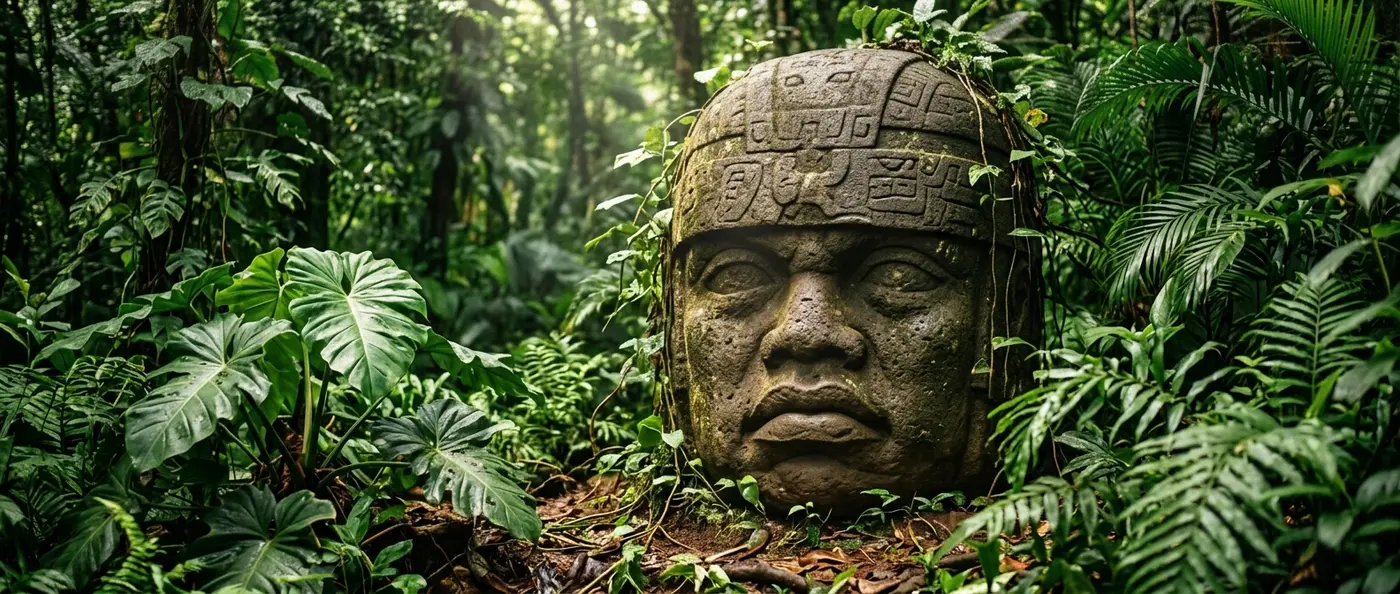
The Olmec colossal heads rank among ancient America's greatest mysteries. Standing up to 9 feet tall and weighing as much as 44 tons, these monuments impress not just with their size but with their artistic perfection. Each head depicts different facial features — broad faces with thick lips and penetrating gazes that seem to stare directly at the viewer.
The most striking element is the head covering that resembles a football helmet. Archaeologists believe these likely represent protective gear used in the ritual rubber ball game known as tlachtli. Clay figurines from San Lorenzo show players in similar headgear, supporting this interpretation.
Building these monuments was itself a technological marvel. The basalt they're carved from comes from Cerro Cintepec, a volcanic region in the Tuxtla Mountains roughly 50 miles away. The Olmecs had to drag these massive stone blocks to the nearest navigable river, then transport them on rafts down the Coatzacoalcos River to the San Lorenzo area.
🏛️ San Lorenzo: Mesoamerica's First Great City
San Lorenzo, dating to around 1150 BC, stands as the earliest known center of Olmec civilization. While the rest of Mesoamerica remained at Neolithic development levels, the Olmecs had already created an extraordinarily complex society with organized administration and monumental architecture.
San Lorenzo's location wasn't random. Built on a compact plateau rising about 160 feet above the surrounding plains, the site offered natural protection and regional control. What makes San Lorenzo even more impressive is that at least the top 25-35 feet of the plateau were human-made. The deep ravines cutting through the plateau, once thought natural, proved artificial, created by constructing long ridges.
The site's surface contains roughly 200 small mounds, each once supporting a wood-and-thatch residence. This arrangement suggests San Lorenzo functioned both as a ceremonial center with political and religious functions and as a small city with permanent population.
🌾 The Ecological Foundation of Olmec Power
The Olmecs' rise wasn't accidental but rested on specific ecological advantages. The southern Gulf of Mexico region, with abundant rainfall and rich alluvial soil along natural river levees, offered exceptional conditions for corn cultivation. The region rivaled Mesopotamia's Fertile Crescent in agricultural potential.
As populations grew, competition for controlling these fertile lands led to a dominant landowner class emerging. From these conflicts arose powerful families who managed to impose control and organize society in ways that enabled massive projects like the colossal heads.
💡 The Olmec Trade Network
Exotic materials found at San Lorenzo reveal that early Olmecs controlled an extensive trade network covering much of Mesoamerica. Interestingly, jade, which later became so important to the Olmecs, doesn't appear at their sites before 900 BC and San Lorenzo's fall.
⚔️ The Mysterious Destruction of 900 BC
Around 900 BC, San Lorenzo met a violent end. Many stone monuments, perhaps most, were deliberately destroyed or otherwise mutilated. They were then buried in long lines within the ridges and elsewhere at the site. Archaeologists believe the destruction may have been caused by invaders, though the exact cause remains unknown.
This early rise and fall shows the Olmecs reached high levels of social complexity much earlier than the rest of Mesoamerica. Their ability to organize massive infrastructure projects and create monumental art suggests powerful social controls and hierarchical organization existed.
🎨 The Art of Master Sculptors
The Olmecs were perhaps ancient Mesoamerica's greatest sculptors. Whether carving microscopic jade figures or giant basalt monuments, they worked with exceptional artistic skill. Their art quality was so high that several archaeologists initially questioned their great antiquity.
Beyond the colossal heads, the Olmecs created other art forms. San Lorenzo's clay figurines depict naked, sexless individuals with were-jaguar characteristics — an Olmec deity portrayed as a hybrid between jaguar and human infant. These figurines reveal aspects of this ancient civilization's religious life and beliefs.
📖 Read more: Ancient Olympia: Temple of Zeus and the Lost Wonder
Carving Techniques
Monuments were carved with great technical precision using only stone tools. The method involved pounding and grinding, a process requiring enormous patience and skill.
Artistic Style
Olmec style features realistic depictions emphasizing individual characteristics. Each colossal head is unique, suggesting they portray specific individuals.
Were-Jaguar
The Olmecs' central deity combined jaguar and infant characteristics. This hybrid being symbolized the connection between human and divine worlds.
🏺 Influence on Later Civilizations
After San Lorenzo's fall, other Olmec centers like La Venta continued flourishing during the Middle Formative Period (900-300 BC). This period shows increased cultural regionalization, with other civilizations like the Zapotec developing their own centers.
The Zapotec at Monte Albán reached high development levels, creating Mesoamerica's first writing system and first written calendar. Nevertheless, Olmec presence can be traced widely both at this site and in the Valley of Mexico.
Olmec legacy deeply influenced all later Mesoamerican civilizations. The Maya, Zapotec, Totonac, and Teotihuacán culture developed distinct variations of their common Olmec heritage. Elements like the ritual ball game, jaguar worship, and monumental sculpture continued as central features of Mesoamerican civilizations for millennia.
🔬 Modern Archaeological Research
San Lorenzo excavations began systematically in the 1960s and continue today. Each excavation reveals more about Olmec society and culture. Modern dating techniques have confirmed the finds' antiquity and helped understand the chronological sequence of events.
The identity of the individuals depicted in the colossal heads puzzles archaeologists. Are they rulers? Gods? Famous athletes from the ritual ball game? The absence of written texts from this early period makes definitive answers difficult.
📊 Comparison with Other Ancient Civilizations
🌟 Significance for World History
The Olmecs mark a turning point in human development. Along with ancient Egypt, Mesopotamia, and China's civilizations, they constitute one of the independent centers where cultural complexity developed. Their case is particularly significant because it shows how similar social structures and cultural expressions can emerge independently in different parts of the world.
The colossal heads remain as witnesses to this ancient glory. Today, scattered across Mexico's museums and archaeological sites, they continue impressing visitors with their size and artistic perfection. They prove that monumental achievement spans all cultures and eras.
Olmec study continues, and each new discovery brings more details about this pioneering civilization to light. From Mexico's tropical jungles to modern laboratories, the quest to understand the Olmecs constitutes a fascinating journey to civilized life's beginnings in America.