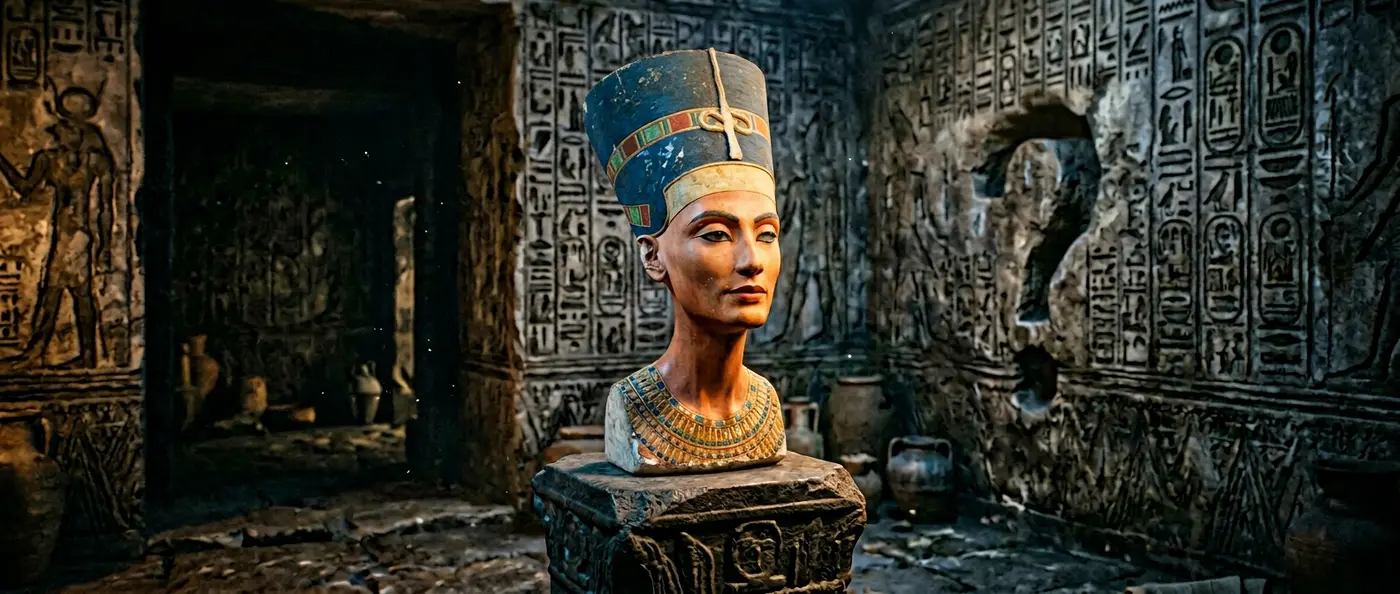
👑 The Enigmatic Queen of the 18th Dynasty
Nefertiti ruled Egypt when the world was young. Her name means "the beautiful one has come," and she lived up to it as chief wife to Pharaoh Akhenaten and stepmother to Tutankhamun. The 14th century BC was chaos — religious revolution, family intrigue, and power struggles that would make Game of Thrones look tame. Yet despite her fame and the pivotal role she played in history, Nefertiti's tomb remains one of Egyptology's greatest unsolved mysteries.
The family tree reads like a soap opera written by someone with a serious Oedipus complex. Genetic testing conducted in 2007 on 16 royal mummies revealed that Tutankhamun was Akhenaten's son by another wife — making Nefertiti his stepmother. But wait, there's more. The boy king married his half-sister Ankhesenamun, who happened to be Nefertiti's daughter with Akhenaten. So Nefertiti wasn't just Tut's stepmother — she was also his mother-in-law.
Royal incest was standard operating procedure during this period, creating a web of relationships that would make a genealogist weep. These twisted family structures reflected the political and religious upheavals of the time. When your divine right to rule depends on bloodline purity, you keep it in the family. Literally.
🔍 The Discovery That Shook Archaeology
July 2015. British archaeologist Nicholas Reeves published findings that challenged accepted views of KV62. Armed with high-resolution laser scans of Tutankhamun's tomb, Reeves spots something everyone else missed: traces of passages and doorway openings that had been plastered over and painted during the boy king's burial preparation.
The Egyptology establishment wasn't having it. Reeves' theory got shot down faster than you could say "pyramid scheme." But here's the thing about good science — it doesn't care about your feelings. Over the next few years, examination after examination supported several of his key ideas. "I haven't found anything that makes me doubt my initial conclusions," Reeves stated. "I think we're now approaching a solution."
November 2015 brought the moment of truth. Egyptian Antiquities Minister Mamdouh Eldamaty invited Reeves and Japanese radar specialist Hirokatsu Watanabe to Luxor. For two nights, the team ran ground-penetrating radar scans on the western and northern walls of Tutankhamun's burial chamber. The radar detected cavities.
📡 What the Radar Revealed
March 2016. Eldamaty stands before reporters in Cairo with news that could rewrite Egyptian history. The radar scans didn't just reveal hidden chambers — they detected unidentified objects sitting inside those spaces. Objects composed of both metal and organic materials. Objects that have been waiting in darkness since the Bronze Age collapsed.
"This could rewrite Egyptian history," Eldamaty declared, though he refused to speculate about what exactly lay beyond the walls. After the initial tests, the minister announced he was "90% positive" that another chamber existed behind the tomb's northern wall. Ninety percent. In archaeology, that's practically a guarantee.
🎯 The Critical Findings
Japanese specialist Watanabe believes there are objects made of metal and organic materials behind the northern wall, and other objects composed of organic materials behind the western wall. The exact nature of these objects remains unknown — but they're definitely there.
External experts examined the radar findings with fresh eyes. Remy Hiramoto, a semiconductor and microelectronics specialist who has served as a consultant to UCLA's Egyptian Coffins Project, reviewed the raw data alongside colleagues including Adrian Tang from NASA's Jet Propulsion Laboratory. When NASA gets involved, you know things are serious.
Hiramoto called the dataset "tight" and confirmed: "It validates the original hypothesis that there is a non-natural chamber or cavity on the other side of that wall. Based on the signatures that exist in the data, there is a void, and there's definitely something inside the void. There's something there."
🏺 Why Nefertiti?
The theory that Nefertiti lies buried behind Tutankhamun's northern wall rests on explosive evidence. One of the most jaw-dropping aspects of Reeves' hypothesis: the famous death mask of Tutankhamun was originally made for Nefertiti. Several prominent Egyptologists agree with this proposal, and there are clear signs that many of Tut's grave goods were originally crafted for someone else.
Kara Cooney, an Egyptologist at UCLA who has done extensive research on the 18th Dynasty, puts it bluntly: "It makes us look at everything again. When I look at statues of Tutankhamun now, I'm not sure if I'm seeing his face or Nefertiti's." The implications extend far beyond Tutankhamun's burial.
Tutankhamun's Mask
Many experts now believe the famous golden mask was originally crafted for Nefertiti and later modified for the young pharaoh. The evidence is in the details.
Recycled Grave Goods
Multiple objects in Tutankhamun's tomb show signs they were originally intended for another person, possibly a royal woman. Ancient hand-me-downs with deadly serious implications.
The Wall Paintings
The burial chamber walls are painted with funerary scenes, but their layout suggests haste and improvisation. Someone was in a serious hurry to get this tomb ready.
🗺️ The Valley of the Queens Mystery
The Valley of the Queens sits 2.4 kilometers west of Ramesses III's temple at Medinet Habu. This necropolis housed queens and royal children from the 19th and 20th dynasties (1292-1075 BC). Over 90 known tombs dot the landscape, typically consisting of an entrance corridor, some small chambers, and a sarcophagus room. Standard royal burial architecture.
But here's the problem: Nefertiti belonged to the 18th Dynasty, and her tomb hasn't been found in the Valley of the Queens, the Valley of the Kings, or anywhere else. For a queen of her stature to simply vanish from the archaeological record is unprecedented. Where do you hide the most famous woman in ancient Egypt?
The answer might lie in the turbulent period following Akhenaten's death. The religious revolution he started — introducing monotheistic worship of the Aten — had torn Egypt apart. After his death came violent backlash and a return to traditional religious practices. In that chaos, a stepmother-turned-pharaoh might have been buried hastily, her tomb sealed and forgotten as Egypt tried to erase the Amarna period from history.
🔬 Technology Reveals Ancient Secrets
Jason Herrmann specializes in archaeological geophysics at Eberhard Karls Tübingen University in Germany. He explains that a skilled radar operator can determine specific details about invisible materials. "In my previous experience, I was able to distinguish metal from stone quite easily," he noted, referencing past work using radar to detect metallic objects buried in sand dunes in the United Arab Emirates.
Detecting a metallic object in a stone-carved space should be easier than finding it in sand. "I'm not surprised that he can distinguish something that's a weaker reflector than stone or metal would be," Herrmann said, referring to the possible presence of organic matter. Radar waves can easily distinguish between limestone and other materials.
📊 18th Dynasty Tomb Comparison
💡 New Horizons for Archaeology
If Nefertiti's tomb is confirmed behind the walls of KV62, it will be a discovery that forces experts to reexamine the entire Tutankhamun era. "You look at the coffin, the tomb, the statues," says Cooney. "Everything about this period needs to be reevaluated." The discovery would require scholars to reconsider fundamental assumptions about the period.
2022 marked the beginning of private tours at the new Grand Egyptian Museum in Giza, where all objects from Tutankhamun's tomb will be housed. For the first time since Howard Carter discovered them in the 1920s, all the artifacts will be displayed together. Among them: the mummy, the golden death mask, the inner golden sarcophagus, jewelry, and the throne. A complete collection that might tell only half the story.
But the big question remains: What's hiding behind those walls? Eldamaty refused to reveal the next step in the investigation. "We have to wait," he stated. The waiting continues, but each new piece of evidence brings archaeologists closer to solving a 3,339-year-old mystery.
Whatever emerges from behind those walls will force experts to see the Tutankhamun era with fresh eyes. The possibility of finding Nefertiti's tomb isn't just the discovery of another royal burial. It's the chance to understand one of the most turbulent and fascinating periods in ancient Egyptian history. And if those radar scans are right, we're about to get answers to questions we've been asking for over three millennia.