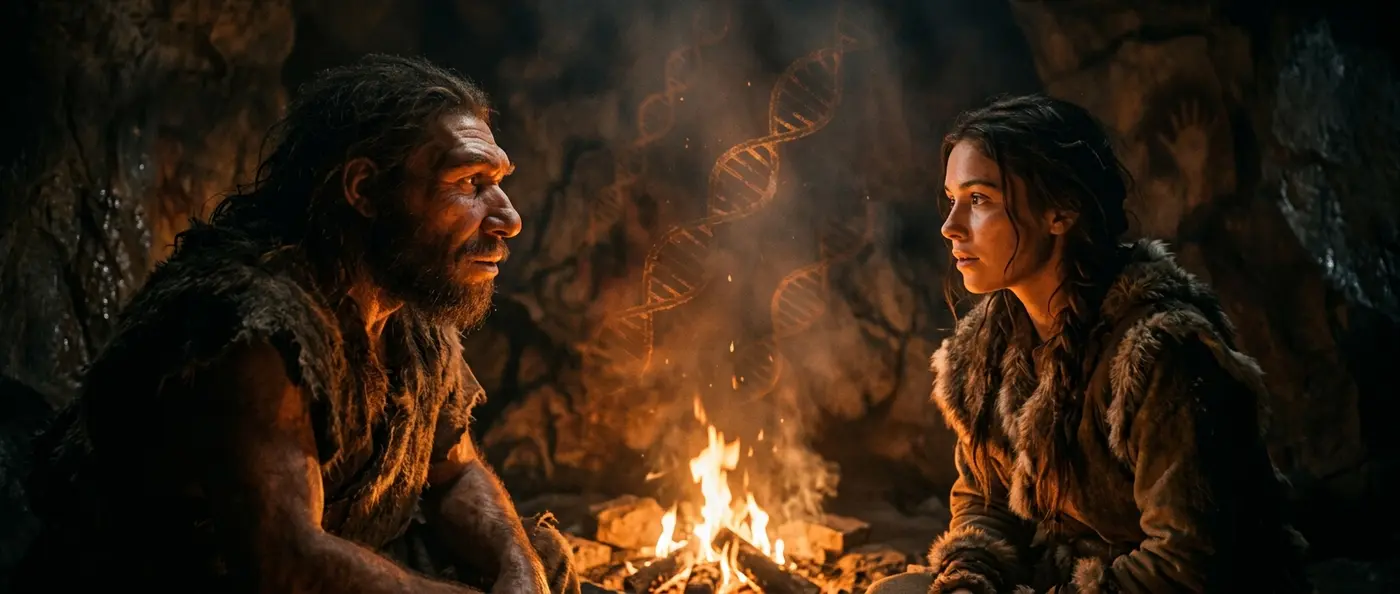
← Back to Ancient Civilizations Neanderthal-Sapiens interbreeding revealed through DNA analysis showing sex-biased mating patterns
📜 Ancient Civilizations: Ancient History

When Neanderthals Met Sapiens: The Sex That Shaped Our DNA

📅 March 5, 2026 ⏱ 7 min read

For over 20 years, geneticists have confronted a puzzle. Modern human genomes carry roughly 2% Neanderthal DNA — except in specific regions called "Neanderthal deserts," particularly on the X chromosome, where zero Neanderthal genes survive in any living person. Why? A February 2026 study in Science provides the answer: ancient human sex was heavily biased by gender. The most common pairing wasn't random hookups between wandering tribes. It was male Neanderthals coupling with female Homo sapiens — a preference so strong it left permanent scars in our genetic code 55,000 years later.

🧬 The Mystery of Missing Neanderthal DNA

Our ancestors and Neanderthals shared a common African ancestor 550,000 to 750,000 years ago — likely Homo heidelbergensis or possibly Homo antecessor. One group migrated to Europe, evolving into Neanderthals and their "cousins," the Denisovans (these two branches split 430,000-473,000 years ago). The group that stayed in Africa became Homo sapiens. Neanderthals were perfectly adapted to cold climates: short and stocky, averaging 5'7" for males and 5'3" for females, with broad chests, large noses, prominent brow ridges, and brain volumes equal to or larger than ours. They inhabited vast territories — from the Iberian Peninsula to Siberia and the Middle East. Around 55,000 years ago, the main wave of modern humans leaving Africa encountered Neanderthals in the Middle East — and that's where the major interbreeding occurred. There had been earlier contacts around 100,000 years ago, but the largest genetic exchange traces to the ~55,000-year event.

The result of this genetic mixing reaches us today: non-African populations carry roughly 2% Neanderthal nuclear DNA on average. These genes influenced real physiological functions — they helped early European Homo sapiens adapt to colder climates, affecting skin and hair color. But this DNA distribution isn't uniform. Certain regions of the human genome — especially the X chromosome — show zero Neanderthal fragments in any living human. These "Neanderthal deserts" have defied explanation for over a decade.

~2% Neanderthal DNA in non-Africans
~55,000 Years ago — major interbreeding
73 African women in the study
2026 Year published in Science

🔬 The Study: Chromosomes Reveal Ancient Preferences

Alexander Platt, a population geneticist at the University of Pennsylvania, and his research team, collaborating with Sarah Tishkoff, analyzed genomes from 73 women from three modern African populations without Neanderthal DNA — the !Xoo, Ju|'hoansi, and Khoisan — and compared them with several Neanderthal genomes. Choosing African populations was crucial: precisely because they carry no Neanderthal DNA, they function as a "clean reference point" for comparison. First, they examined Neanderthal X chromosomes and discovered significantly higher percentages of modern human DNA there compared to other Neanderthal chromosomes. This finding upended previous assumptions: the absence of Neanderthal genes from the human X chromosome wasn't due to biological incompatibility.

"For years, we simply assumed these deserts existed because certain Neanderthal genes were biologically 'toxic' to humans — as tends to happen when species diverge — and natural selection eliminated them because they caused health problems," Platt explained in a University of Pennsylvania public announcement. But the new study, published February 26, 2026, shows the most likely explanation is sexual mate preference — an evolutionary mechanism central to sexual selection, similar to what explains why male peacocks develop colorful tails. The explanation is straightforward: since females carry two X chromosomes while males carry only one, a preference for matings between female H. sapiens and male Neanderthals would mean fewer Neanderthal X chromosomes entered the human gene pool — creating exactly the same pattern researchers see in modern genomes today.

Female mammals have two X chromosomes (XX), while males have one X and one Y (XY). If the majority of crossbreeding occurred between male Neanderthals (XY) and female Sapiens (XX), then for each such pairing, only one Neanderthal X would enter the offspring — and only in female children. Male children would receive the Neanderthal Y, not the X. This asymmetry explains why Neanderthal genes are rare in the human X chromosome — but more common in autosomal chromosomes.

đŸ€ Who Was Choosing Whom?

The question "whose preference was being expressed" remains open. "I have no idea whose preference is being expressed here," Platt told Live Science. We can't know if it was female Sapiens who preferred male Neanderthals — perhaps because their short, muscular build signaled strength and protective ability — or if male Neanderthals preferred female Sapiens, or if social structures — like patrilineal or matrilineal reproduction and kinship systems — determined the pairings. Evolutionary biology knows that mate selection is partly learned behavior, meaning cultural practices may have played a role. Previous research on the Neanderthal Y chromosome shows there were also matings between male Sapiens and female Neanderthals, but the new study reveals these were clearly less frequent. The research team didn't rule out more complex evolutionary scenarios that might combine natural selection, sexual bias, mate preference, and sex-specific migration — but the genomic data shows a clear dominant trend.

Something paleoanthropology already knew is that the two groups were barely at the edge of biological compatibility. Interbreeding led to reduced fertility — particularly male babies who inherited Neanderthal Y chromosomes faced increased risk of miscarriage and reduced reproductive capacity. This means Neanderthal genetic contribution decreased gradually with each generation, even if interbreeding continued. Combined with the massive difference in population sizes — Sapiens vastly outnumbered them, both in group size and overall population density — interbreeding may well have been one of the main reasons for Neanderthal extinction: they were essentially "absorbed" genetically into the much larger Homo sapiens population, gradually losing their genetic identity.

Neanderthals didn't disappear exclusively due to genetic absorption. The archaeological record shows resource competition was fierce — Sapiens arrived in Europe around 45,000 years ago in much larger numbers, overturning the demographic balance. The climate instability of that period — alternating glacial and interglacial cycles — pressured already small Neanderthal populations. Around 40,000 years ago, Neanderthals disappeared from the archaeological record, with last appearances in southern Spain roughly 26,000 years ago. Even after their biological extinction, a piece of them survives in our DNA — a genetic legacy spanning tens of thousands of years.

Sexual Preference

The study proves sexual preference — male Neanderthals with female Sapiens — explains X chromosome "deserts" better than any hypothesis of natural selection or biological incompatibility.

Reduced Fertility

Interbreeding led to reduced reproductive success — male babies with Neanderthal Y chromosomes faced miscarriages — gradually reducing Neanderthal genetic contribution each generation.

European Adaptation

Neanderthal genes helped Sapiens adapt to cold European climates. This genetic legacy influenced skin color, hair, immune system — and still exists today.

Common ancestor 550,000-750,000 years ago in Africa
Major interbreeding ~55,000 years ago in Middle East
Dominant pairing Male Neanderthal + Female Sapiens
Genetic legacy ~2% in DNA of non-African populations
Neanderthal extinction ~40,000-30,000 years ago

The research team plans to study "the evolution of social structures and gender roles within Neanderthals," which "could potentially shed light on the picture," Platt said. "But I think we're still far from knowing that." Mate selection — partly learned, partly cultural behavior — shaped our genetic identity in ways visible 55,000 years later. The Neanderthal genes we inherited actively influence our physiology today, affecting our immune system, fat processing, allergies, and the structure of our skin and hair.

Neanderthals went extinct as a species around 40,000 years ago, but their genetic signature lives within us — in the DNA of every non-African human on the planet. In 2018, researchers announced the discovery in Denisova Cave of a female bone aged 80,000-120,000 years with a Neanderthal mother and Denisovan father — direct biological proof that interbreeding between ancient human species occurred. The interbreeding between Neanderthals and Sapiens wasn't random. It was selective and sex-biased, leaving traces we're still decoding with today's genomic tools.

Neanderthal Sapiens ancient DNA human evolution interbreeding genetic archaeology chromosome analysis ancient civilizations prehistoric humans evolutionary biology

📚 Sources