📖 Read more: Ancient Mesopotamians Gained Power Through Gender Fluidity
🗿 What Are the Nazca Lines
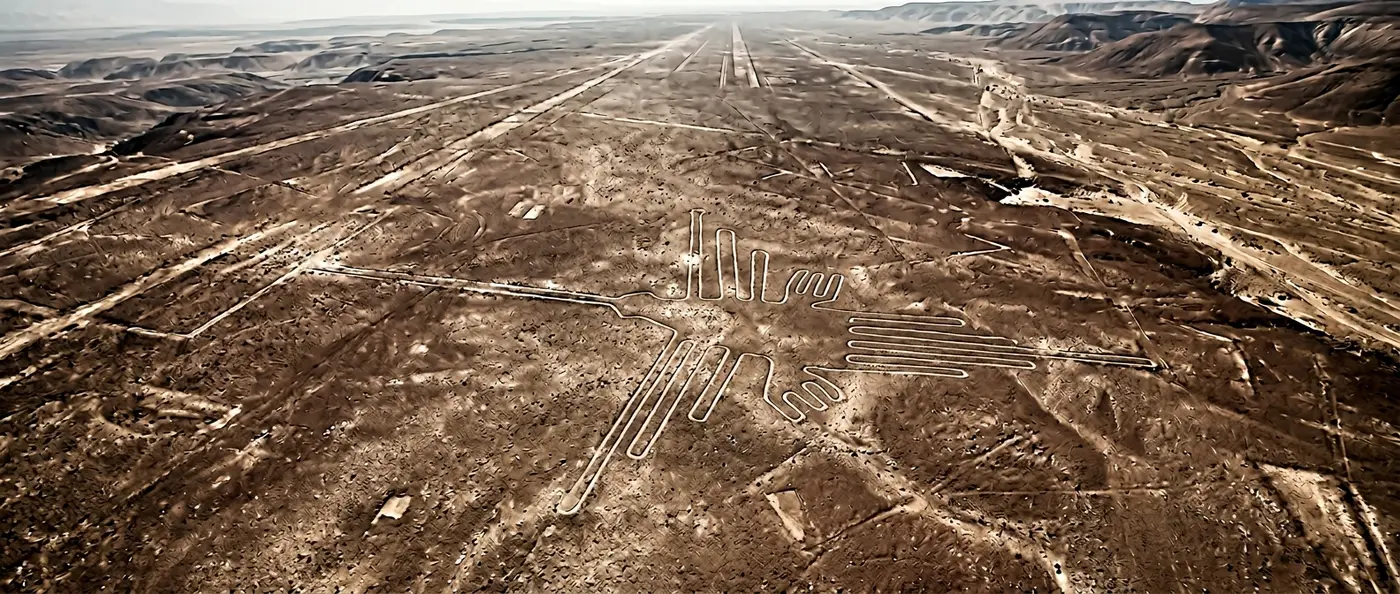
The Nazca Lines have puzzled archaeologists for nearly a century. Picture massive drawings etched into Peru's southern desert floor by the pre-Incan Nazca culture. Their construction method was deceptively simple: ancient artists scraped away the top layer of reddish pebbles, revealing lighter-colored earth beneath.
The designs range from straight lines stretching for kilometers to intricate depictions of animals, humans, and geometric shapes. Some of the most famous include a 93-meter hummingbird, a 46-meter spider, and a monkey with a spiraled tail. Their scale is so massive that their full form becomes clear only from great height.
Discovery happened by accident in the 1920s when airplane passengers flying over the region spotted strange patterns on the ground. Since then, scientists have identified roughly 430 geoglyphs, with most discoveries coming in the past two decades thanks to satellite imagery.
🔬 The AI Revolution
September 2024 changed everything. A team of Japanese scientists published groundbreaking research in PNAS that dramatically expanded our understanding of the Nazca Lines. Using an AI model trained to recognize faint geoglyph outlines in satellite images, they identified 303 new designs in just six months — from September 2022 to February 2023.
The AI identified potential lines 20 times faster than human researchers. It generated a list of candidate locations, including areas where geoglyphs had never been found before. Researchers visited these sites and confirmed the existence of the new lines.
Among the fresh discoveries: abstract humanoid figures, "decapitated heads," domesticated animals, fish, birds, cats, and scenes possibly depicting rituals. The most striking find was a 22-meter geoglyph showing a "killer whale holding a knife" — an image that raises questions about the Nazca's relationship with the sea.
⚔️ Two Types of Geoglyphs
The research showed two distinct types of Nazca Lines serve different purposes. The first type, called "relief-type," includes smaller, more complex designs. The second, "line-type," covers larger areas and uses more straight lines.
The numbers show a clear pattern: 82% of relief-type geoglyphs depict humans or domesticated animals, while 64% of line-type show wild animals like birds and whales. This differentiation suggests different purposes and uses.
Researchers also observed that relief-type geoglyphs sit near historic pathways, indicating they were meant to be seen by passersby. Line-type geoglyphs are distributed uniformly across the desert, suggesting they "were likely constructed and used at a community level for ritual activities."
📖 Read more: Angkor Wat: World's Largest Temple Reveals Ancient Secrets
Relief-Type Geoglyphs
Smaller, intricate designs depicting mainly humans and domesticated animals. Positioned near pathways for travelers to observe.
Line-Type Geoglyphs
Large designs with straight lines depicting wild animals. Uniformly distributed for community ceremonies.
🌟 The Mystery of Purpose
Despite new discoveries, the exact purpose of the Nazca Lines remains unsolved. Why would an ancient civilization dedicate so much time and effort to creating massive designs that can only be fully appreciated from the sky?
Theories vary wildly. Some researchers believe the lines functioned as an astronomical calendar, with specific designs aligning with celestial bodies on important dates. Others argue they were part of rain ceremonies in the dry desert, or that they marked underground water sources.
That different geoglyphs served different purposes deepens the puzzle. The smaller designs near pathways might have served as guideposts or religious symbols for travelers, while the larger ones were probably used in mass ceremonies.
💡 Did You Know?
The Nazca Desert is one of the driest places on Earth, with rainfall less than 25mm annually. This extremely dry climate is what preserved the lines intact for nearly 2,000 years!
🏺 The Nazca Civilization
The line creators, the Nazca culture, flourished in southern Peru's coastal region from roughly 200 BC to 600 AD. They inherited the earlier Paracas culture and developed an exceptionally advanced society despite harsh environmental conditions.
The Nazca were skilled engineers who built an amazing system of underground aqueducts, known as "puquios," to transport water from the mountains to the dry desert. Many of these systems still function today. They also created exceptional polychrome pottery with intricate designs depicting deities, animals, and daily life scenes.
Their society appears to have been theocratic, with powerful priests ruling from ceremonial centers like Cahuachi. This massive ritual city, covering 24 square kilometers, was likely the center where geoglyph construction work was planned and organized.
📖 Read more: Cahokia: North America's Lost Mega-City
🔱 Religious Beliefs and Symbolism
The animals depicted in the lines aren't random. Many, like the condor, spider, and monkey, held sacred meaning in Nazca mythology. The condor connected to mountains and sky, the spider to rain and fertility, while the monkey represented the Amazon jungle.
Interestingly, many depicted animals didn't live in the Nazca Desert. Monkeys, parrots, and other jungle creatures suggest trade or cultural contact with the Amazon. The recent discovery of the "knife-wielding whale" reinforces the hypothesis of close ties with the sea and coastal populations.
The newly discovered humanoid figures, especially those resembling shamans, suggest the lines might have connected to consciousness-altering rituals. The Nazca used psychotropic plants like San Pedro cactus in religious ceremonies, and the lines likely formed part of these spiritual practices.
🗺️ Geoglyphs Around the World
🛰️ The Future of Research
The AI breakthrough suggests hundreds more geoglyphs wait to be found. Researchers estimate they'll discover at least 250 additional geoglyphs in coming years, as AI has already identified hundreds of candidate locations not yet investigated on-site.
Meanwhile, new technologies like LiDAR (Light Detection and Ranging) and drones equipped with multispectral cameras promise to reveal even more secrets. These technologies can "see" beneath the desert surface and spot lines that have nearly vanished from erosion.
However, preserving the lines faces serious challenges. Climate change brings unusual rainfall to the region, which can erode the delicate designs. Additionally, illegal mining, agricultural expansion, and tourism threaten the archaeological site's integrity. In 1994, the Nazca Lines were declared a UNESCO World Heritage Site, but their protection remains an ongoing challenge.
As we continue uncovering new lines and better understanding the culture that created them, the Nazca Lines remind us of ancient peoples' creative genius. In an age without airplanes or satellites, the Nazca managed to create artworks that can only be fully appreciated from the sky — an achievement that continues to inspire and puzzle us.