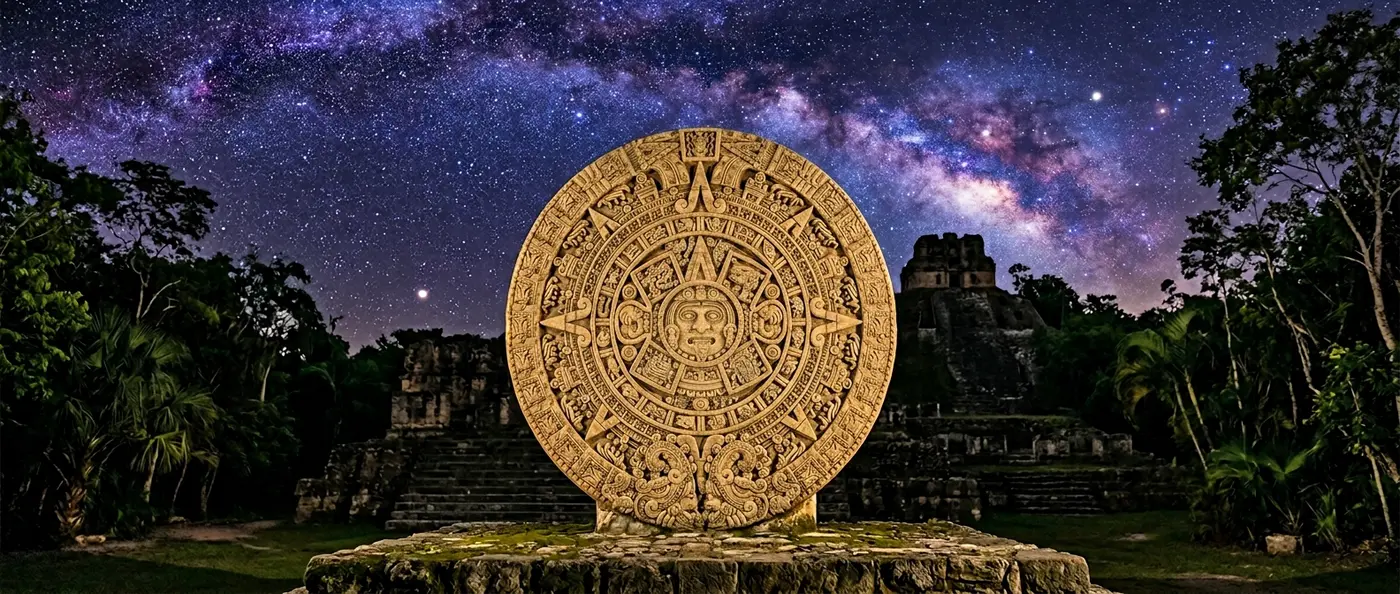
🌟 The Maya's Astronomical Genius
The ancient Maya were hands down one of history's greatest sky-watching societies. They kept systematic records of the sun, planets, and stars. From these observations, they built a complex calendar system to regulate their world — one of the most accurate in the pre-modern era.
Maya astronomers watched the sun closely. They aligned massive structures like pyramids to track solstices and equinoxes. They also used these buildings, plus caves and cenotes, to mark zenith days — the two times each year in the tropics when the sun sits directly overhead and vertical objects cast no shadows.
They could predict solar and lunar eclipses with pinpoint accuracy. The Dresden Codex, one of four surviving ancient Maya texts from the 11th century, contains astronomical tables proving the Maya tracked lunar nodes — the two points where the moon's orbit intersects the ecliptic plane.
📜 The Writing System and Codices
Maya scribes kept detailed records of astronomical observations in codices — hieroglyphic books that folded accordion-style and were made from bark paper. The Maya writing system contained over 800 characters, including hieroglyphic and phonetic signs representing syllables.
Only four Maya codices survive today: the Dresden, Madrid, Paris, and Grolier codices. These precious documents were made from fig bark paper folded like an accordion, with covers of jaguar hide.
Deciphering Maya writing took decades. In the 1950s, linguist Yury Knorozov proved Maya writing was phonetic as well as hieroglyphic. In 1958, Heinrich Berlin showed certain glyphs referred to places or ruling families. Tatiana Proskouriakoff established that Maya inscriptions were primarily historical, focusing on the lives of Maya rulers and their families.
⚔️ Eclipses and Religious Ceremonies
For the Maya, celestial observations weren't just scientific curiosity. Knowledge was power. If you kept records of what happened during certain celestial events, you could prepare and take appropriate action when the cycles repeated.
In Maya belief, sunsets connected to death and decay. Each night, the sun god Kinich Ahau made the dangerous journey through Xibalba, the Maya underworld, to be reborn at sunrise. Solar eclipses were seen as a "broken sun" — a sign of potential catastrophic destruction.
During solar eclipses, Maya nobles, especially the king, performed bloodletting ceremonies. They pierced their bodies and collected drops of blood to burn as offerings to the sun god. This "royal blood" was the highest form of sacrifice, meant to strengthen Kinich Ahau.
🔬 Why Such Precision?
The Maya needed accurate calendars for three main reasons: agriculture (when to plant and harvest), religious ceremonies (tied to astronomical events), and eclipse prediction (to prepare for necessary rituals).
🏛️ The Maya Calendar's Legacy
The Maya calendar system was incredibly complex, featuring multiple interlocking cycles. The most famous is the Long Count, which counted days from a mythical creation date. There was also the Tzolk'in (a 260-day ritual cycle) and the Haab' (a 365-day solar cycle).
The calendars achieved extraordinary precision. While our modern Gregorian calendar has an error of about one day every 3,236 years, the Maya calendar had an error of just one day every 5,000 years or so. They accomplished this without telescopes or modern instruments.
Mathematical Genius
The Maya developed a vigesimal (base-20) number system and were among the first civilizations to use the concept of zero, centuries before it appeared in Europe.
Architectural Precision
Pyramids and temples aligned with astronomical events. El Castillo at Chichén Itzá creates the illusion of a serpent descending the stairs during equinoxes.
Cultural Impact
The Maya system influenced other Mesoamerican civilizations and continued being used into the 17th century, 200 years after Spanish conquest.
🌾 Daily Use of the Calendar
The Maya calendar wasn't just an astronomical tool — it was fundamental to organizing society. It determined agricultural activities, especially corn cultivation that formed their dietary foundation. Farmers knew exactly when to prepare fields, when to plant, and when to expect the rains.
The calendar also determined auspicious days for various activities: marriages, trade deals, military campaigns, even naming children. Each day carried its own energy and significance, and priest-astronomers were responsible for interpreting these influences.
In the Tabasco region, where Maya civilization flourished after the Olmecs, the calendar continued being used for centuries. Monument 6 at Tortuguero, housed in the Carlos Pellicer Cámara Regional Museum of Anthropology in Villahermosa, contains one of the few ancient references to the end of a calendar cycle — the one misinterpreted as predicting the world's end in 2012.
💡 Comparison with Other Ancient Calendars
The Maya calendar's accuracy becomes even more impressive when compared to other ancient systems. While the ancient Egyptians used a 365-day calendar without correction for leap years, the Maya had incorporated complex corrections into their system.
📊 Ancient Calendar Accuracy
The Maya system, while primarily based on lunar cycles for religious purposes, achieved remarkable accuracy in calculating the solar year. This shows their deep understanding of the complex movements of celestial bodies.
🔭 The Maya Scientific Method
The Maya developed a systematic method of recording and analyzing data. For centuries, generations of astronomer-priests recorded every celestial event, creating a massive database of observations. For centuries, generations of astronomer-priests recorded every celestial event, creating a massive database of observations.
These records allowed them to recognize patterns and cycles that repeated. For example, they discovered that eclipses occur in 177-day cycles and that Venus completes its synodic cycle in 584 days. Their ability to predict these events reinforced elite power and the people's faith in the divine order of the universe.
In the end, the Maya calendar wasn't just a timekeeping tool. It was a comprehensive system for understanding the world, combining science, religion, and social organization. Its accuracy stands as proof of humanity's capacity for observation, analysis, and understanding of the universe — even without modern technology.