📖 Read more: Maya Calendar: More Accurate Than Our Modern System
📅 The Mystery of the Long Count
The Maya calendar that triggered worldwide panic wasn't your average wall calendar. This was the "Long Count calendar" — an extraordinarily complex time-tracking system spanning roughly 5,125 years, starting from 3114 BCE.
December 21, 2012, marked the end of the 13th Bak'tun, a period of nearly 400 years in Maya timekeeping. But instead of rolling into the 14th Bak'tun, the calendar would reset to zero — like an old 1960s car odometer flipping back after hitting 99,999.9 miles.
The Maya obsessed over period endings. They considered them monumentally significant. The biggest period endings they experienced were Bak'tun completions. For them, the 13th Bak'tun's end would be "extraordinarily important" — but it never meant world's end.
William Saturno, a Maya archaeology specialist from Boston University, puts it bluntly: the Maya loved their cycle completions like we love New Year's Eve. Big celebration, fresh start, life goes on.
🗿 The Single Ancient Reference
Here's the kicker: only one known Maya text mentions the 13th Bak'tun's end. One. A partially damaged stone slab at Monument 6 in Tortuguero, Tabasco, Mexico.
What this slab actually says remains a puzzle. The hieroglyphs referencing 2012 are partially destroyed. In 1996, Stephen Houston from Brown University and David Stuart from the University of Texas made the first major translation attempt. Their initial interpretation suggested a god would descend at the 13th Bak'tun's end.
New Age websites, discussion forums, and book chapters seized this 1996 analysis as proof the Maya calendar predicted doomsday. But when the two scholars revisited the hieroglyphs, they found something unexpected.
When Houston and Stuart independently reexamined the glyphs recently, they concluded the inscription might contain zero prophetic statements about 2012. Instead, the 13th Bak'tun reference likely serves as a future-looking statement tied to Monument 6's dedication ceremony.
Stuart used a clever analogy to explain this Maya rhetorical device. Imagine a writer commemorating the New York Yankees beating the Philadelphia Phillies in the 1950 World Series. Using Maya methodology, he'd write: "On October 7, 1950, the Yankees defeated the Phillies. This happened 29 years after the Yankees' first victory in 1921. And thus, 50 years before the year 2000, the Yankees won the World Series."
🔍 The Translation Key
Maya text structure confused modern minds. According to Emiliano Gallaga Murrieta from Mexico's National Institute of Anthropology and History, the Maya wrote with poetic sensibility. Even if Monument 6 mentions a god descending at the 13th Bak'tun's end, it's not a world-ending statement.
📖 Read more: 10 Lost Cities That Vanished Without a Trace
🌍 From Archaeological Discovery to Global Mania
How did a partially damaged inscription in remote Mexico trigger worldwide panic? The answer lies in misinterpretation, the internet, and humanity's tendency to seek meaning during uncertain times.
Saturno explains the 2012 frenzy came from disenchanted Westerners looking to ancient peoples for guidance, hoping civilizations like the Maya knew something then that could help us through tough times now.
The irony runs deep. We turned to the Maya for prophecies despite their track record with long-term predictions. As Saturno notes with dry humor: "They didn't see their collapse coming. They didn't see the Spanish conquest coming."
The myth spread like wildfire through internet forums, New Age communities, documentaries, and bestselling books. The misinterpreted 1996 translation became the foundation for countless conspiracy theories and apocalyptic scenarios.
The Myth's Spread
The 2012 end-times idea exploded across the internet through New Age sites, forums, books, and documentaries. The misinterpreted 1996 translation became the basis for countless conspiracy theories and apocalyptic scenarios.
The Real Meaning
For the Maya, the Long Count's end represented an old cycle's completion and a new one's beginning. Like transitioning from the Year of the Rabbit to the Year of the Dragon in the Chinese zodiac.
The Scientific Truth
No Maya text states "Here will be the end of the world and the world will end in fire." This doesn't exist anywhere in ancient texts, according to experts who studied the original inscriptions.
📜 The Maya Calendar System
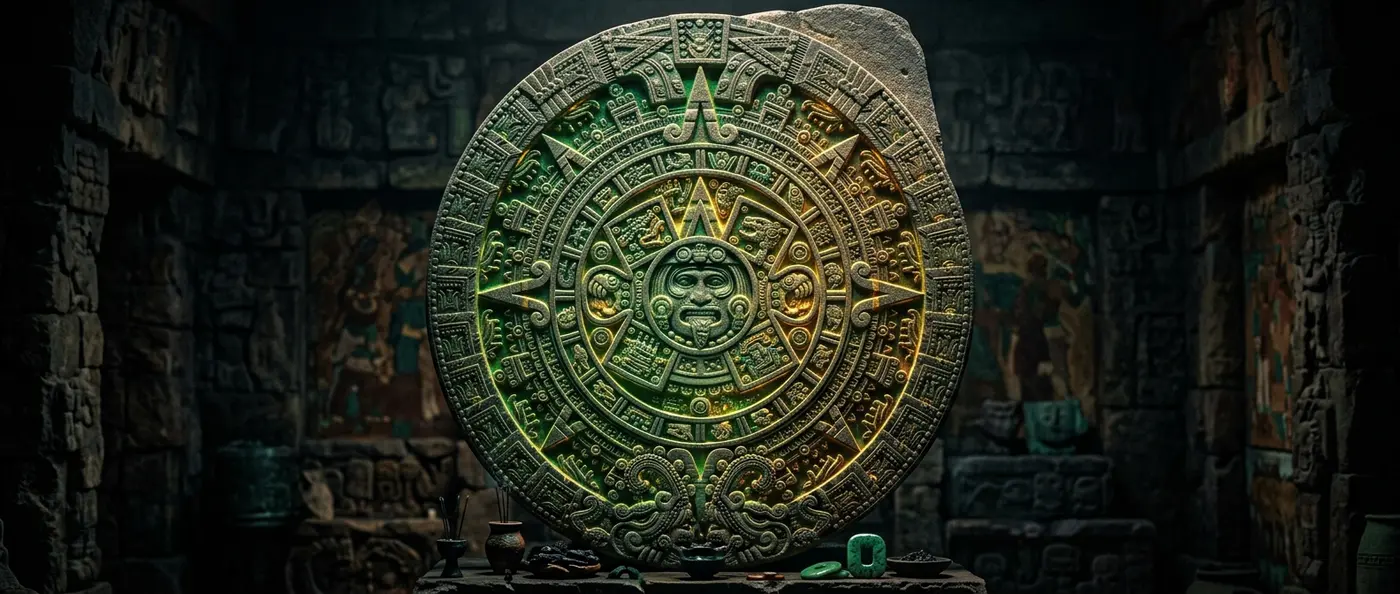
The Maya operated one of the ancient world's most sophisticated timekeeping systems. They didn't use just one calendar, but multiple interlocking systems running simultaneously. The Long Count was merely one component.
📖 Read more: Ancient Egyptian Ostraca: Writing on Pottery Shards
Their system included the Tzolk'in, a sacred 260-day cycle, and the Haab', a solar 365-day cycle. These two calendars combined to create the Calendar Round, a 52-year period. The Long Count tracked longer time spans and historical events.
This system's complexity shows the Maya's deep understanding of astronomy and mathematics. They could predict eclipses, track planetary movements, and create calendars with extraordinary precision.
Though December 21, 2012, passed without apocalyptic events, the phenomenon's impact on popular culture was massive. Movies, books, documentaries, and countless articles explored the topic. The "end times" industry flourished, selling survival products, bunkers, and preparedness seminars.
The 2012 phenomenon revealed something deeper about modern society: our need for meaning and our tendency to project fears and hopes onto ancient prophecies. In an era of rapid change and uncertainty, many people sought answers from a civilization that had vanished centuries ago.
⚖️ Myth vs Reality
🔬 What the Experience Taught Us
The Maya calendar and 2012 story offers valuable lessons about how archaeological knowledge can be misinterpreted and distorted. It underscores the importance of careful scientific research and critical thinking.
For archaeologists and historians, the 2012 phenomenon served as a reminder of their responsibility when communicating findings to the public. A mistaken interpretation or unclear statement can lead to global misunderstanding.
The real Maya legacy has nothing to do with doomsday predictions. For over 2,000 years, they built cities, tracked celestial cycles with mathematical precision, and created art that still adorns museum walls worldwide.
A single damaged stone tablet in rural Mexico somehow convinced millions that the world would end on a specific date. The Maya scribes who carved those hieroglyphs a thousand years ago never could have imagined their calendrical calculations would one day crash computer servers and empty store shelves of emergency supplies.