📖 Read more: CT Scans Reveal Inca Child Sacrifices to Mountain Gods
🏔️ The Discovery That Stunned the World
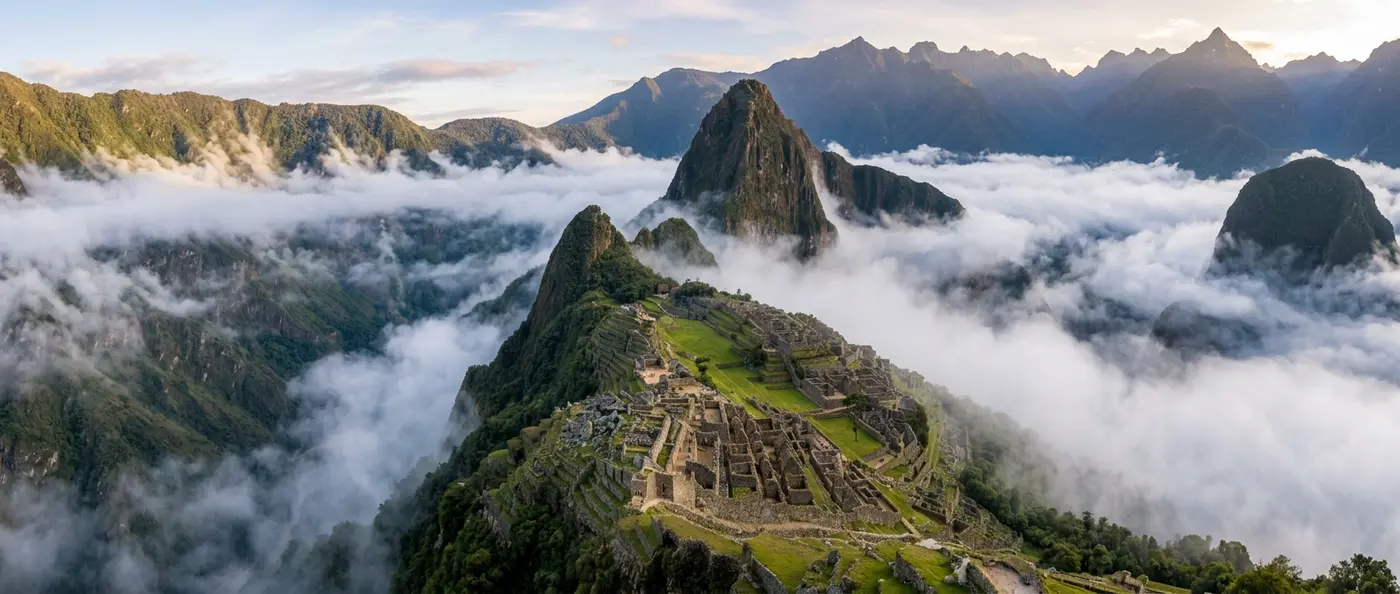
On the morning of July 24, 1911, Hiram Bingham III climbed the steep slopes of the Andes, following a local farmer who had told him about "old buildings" at the summit. What he saw defied belief. Before him stretched an entire city of granite, with temples, houses and terraces that seemed to float among the clouds.
News of the discovery spread rapidly. National Geographic devoted an entire issue in April 1913, with stunning photographs showing the intact Inca architecture. Suddenly, the world knew of this architectural marvel that had survived almost untouched for five centuries.
While Bingham initially believed he had found the lost city of Vilcabamba, the last refuge of the Incas, later research proved something different. Machu Picchu wasn't just a city. It was a sacred center, a royal retreat, a place where earth met sky.
🏛️ Architecture That Defies Gravity
Machu Picchu's construction methods prove as extraordinary as its mountain perch. The Incas used no mortar. Every stone, some weighing over 50 tons, was cut with such precision that not even a knife blade fits between them. This technique, known as "ashlar," allowed the buildings to withstand centuries of seismic activity.
The city divides into two main sectors: urban and agricultural. The urban sector includes about 200 structures, from simple homes to elaborate temples. The Temple of the Sun, with its perfectly carved windows, aligns precisely with the winter solstice. The Intihuatana, a carved rock that functioned as a solar clock, demonstrates the Incas' sophisticated astronomical knowledge.
The agricultural terraces weren't just farmland. They functioned as a support system protecting the city from landslides, while creating microclimates for different crops. Engineers estimate that 60% of the construction lies below ground - foundations and drainage channels that have weathered five centuries of earthquakes and monsoons.
Around 1572, just a century after its construction, the city was abandoned. The Spanish conquistadors never discovered it. There are no traces of battle or destruction. Simply, the inhabitants vanished.
One theory suggests that the smallpox epidemic brought by Europeans decimated the population. Another version connects the abandonment to the death of Pachacuti, the emperor who likely ordered its construction. Without royal support, maintaining such a remote city became impossible.
📖 Read more: Karnak Temple: Egypt's Largest Religious Complex
Recent DNA studies from mummies found in the area reveal a cosmopolitan population. People from across the Inca empire lived here - from the Pacific coast to the Amazon. The evidence points to Machu Picchu as a royal retreat and administrative center, not an ordinary city.
🔬 DNA Reveals
Genetic analyses from 2023 showed that Machu Picchu's inhabitants came from at least 17 different ethnic groups of the Inca empire, proving the city's strategic importance as an administrative center.
🗿 Sacred Space and Astronomical Observatory
Machu Picchu's location wasn't random. It sits between two sacred mountains - Huayna Picchu to the north and Machu Picchu to the south. For the Incas, mountains were "apu" - powerful spirits that protected communities. The city functioned as a bridge between the earthly and celestial worlds.
The Intihuatana, meaning "where the sun is tied," is perhaps the most mysterious monument. This carved granite rock functioned as a precise astronomical instrument. During the winter solstice, the sun stands directly above the pillar, casting no shadow. Priests believed they could "tie" the sun to prevent its departure.
The Temple of the Three Windows represents the three worlds of Inca cosmology: the underworld (Uku Pacha), the earthly world (Kay Pacha) and the celestial world (Hanan Pacha). Each window is oriented toward specific astronomical phenomena. Modern astronomers marvel at these precise celestial calculations.
Temple of the Sun
Semicircular structure with windows that align perfectly with the winter solstice. The Incas observed celestial body movements from here.
Water System
16 fountains fed by a spring 750 meters away. Water flowed continuously through carved channels, serving both ritual and practical purposes.
Sacred Rock
At the city's center, a natural rock was carved to mimic the shape of Huayna Picchu mountain, symbolizing the earth-sky connection.
📖 Read more: Ishtar Gate: Babylon's Cosmic Marvel That Defied Time
🌾 Daily Life in the Clouds
Despite its reputation as a mystical center, Machu Picchu was a living community. Archaeological finds reveal details of daily life: ceramic vessels for chicha (corn beer), bronze and obsidian tools, textiles from alpaca and vicuña.
Residents cultivated over 30 varieties of corn on the terraces, along with potatoes, quinoa and beans. The microclimate allowed coca cultivation, a sacred plant used in ceremonies. They also ate llama and alpaca meat, while exotic products like Pacific fish and Amazon fruits arrived via the Incas' extensive road network.
The city's workshops produced refined objects. Tools for metallurgy, traces of textile dyeing and unfinished sculptures have been found. Machu Picchu's artisans created artwork destined for the empire's elite.
LiDAR technology recently revealed that Machu Picchu was part of a broader complex. Roads, smaller settlements and agricultural installations extend kilometers around the main city. The site wasn't an isolated refuge but the center of a wider region.
In 2022, archaeologists discovered new underground structures using ground-penetrating radar. They appear to be storage areas and possibly ritual spaces not yet excavated. Each excavation reveals more about daily life in this mountain stronghold.
Isotope studies on human bones revealed the diet and origins of inhabitants. Individuals from coastal areas retained "signatures" of seafood in their bones, while others from the Amazon had traces of tropical plants. This diversity confirms Machu Picchu as a crossroads of the empire.
📊 Machu Picchu vs Other Inca Cities
📖 Read more: 3,000 Ancient Ostraca Discovered in Athribis: Major 2026
🌍 World Heritage and Challenges
Since 1983, Machu Picchu has been a UNESCO World Heritage Site. It receives over 1 million visitors annually, a number that creates serious conservation challenges. The footsteps of millions of tourists wear down the ancient stones. Humidity from so many people's breath affects structural stability.
Authorities now enforce strict limits. Only 2,500 people are allowed daily, at specific times. The Inca Trail requires permits months in advance. Despite restrictions, visitors still feel the pull of these ancient stones.
Drones now monitor erosion, sensors measure micro-movements, and digital reconstructions offer virtual tours. The race is on to preserve Machu Picchu not just as a tourist destination but as proof of what humans can achieve.
💭 Eternal Mystery in the Clouds
More than a century after its "discovery" by the Western world, Machu Picchu continues to hold its secrets. Every stone, every step, every perfectly carved window speaks of a civilization that deeply understood the relationship between humans and nature.
Perhaps this is the greatest lesson. In a world where we build against nature, the Incas built with it. Machu Picchu wasn't imposed on the landscape - it became part of it. And perhaps that's why, when humans left, nature embraced it again, protecting it for future generations.
Those fortunate enough to visit describe a sense of awe that transcends architectural beauty. It's the realization that you're standing in a place where time stopped. Where stones remember and mountains whisper stories. Machu Picchu remains, as the Incas named it, the "Old Peak" - eternal witness to humanity's ambition to touch the sky.