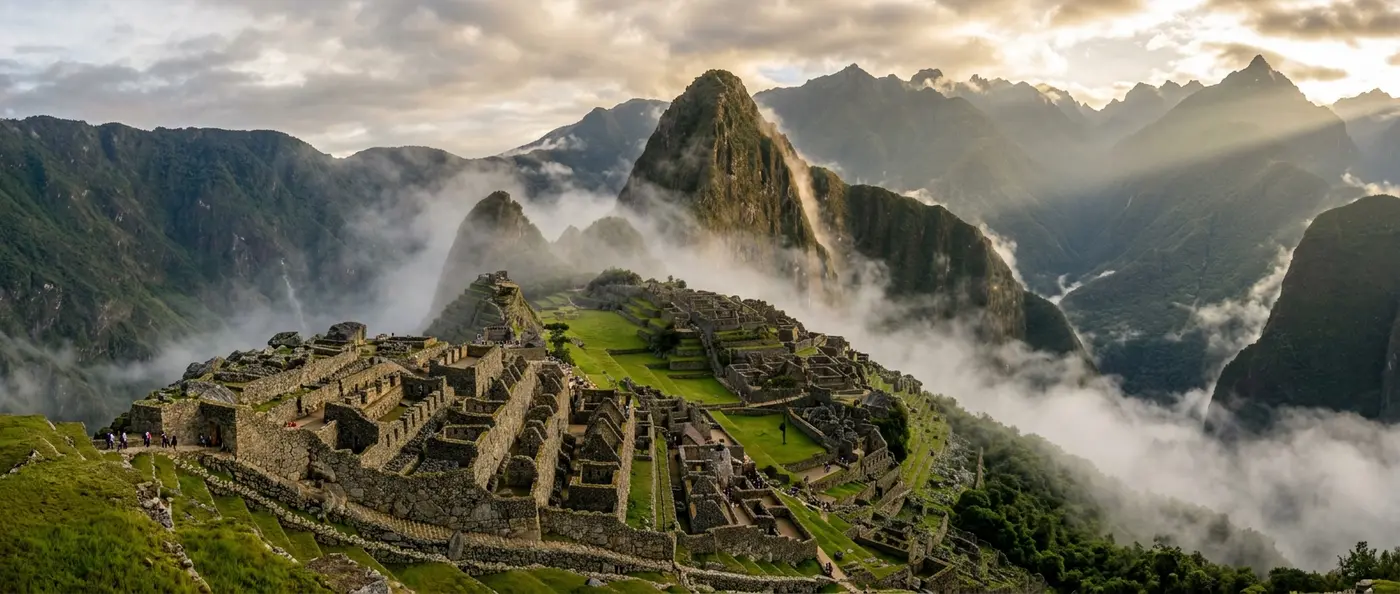
Granite blocks weighing 20 tons. Cut to fit so perfectly that you can't slide a knife blade between them. Hauled up 8,000-foot mountain slopes without wheels, pulleys, or pack animals. Five hundred years later, they're still standing while modern buildings crumble. Welcome to Machu Picchu, where Inca engineers pulled off feats that would challenge today's construction crews.
📖 Read more: Machu Picchu: The Lost City of the Clouds
🏔️ The Discovery That Stunned the World
July 24, 1911. American explorer Hiram Bingham III climbs through cloud forest, following a local farmer who claims he knows something interesting. What Bingham finds defies belief. An entire city, nearly intact, suspended between sky and earth on a knife-edge ridge. Stone temples. Terraced gardens. Houses with their roofs missing but walls standing straight and true.
The Spanish conquistadors never found this place. That's what makes Machu Picchu extraordinary. While other Inca sites got ransacked, rebuilt, or buried under colonial churches, this city remained frozen in time. When the last inhabitants walked away around 1572, they left behind the most complete Inca settlement ever discovered.
But here's the puzzle that still keeps archaeologists awake at night: why build a city here? The location seems insane. Sheer drops on three sides. No major trade routes. Supplies had to be carried up treacherous mountain paths. Yet the Incas chose this spot for something so important they invested decades of labor to create it.
Three theories dominate the debate. Royal estate for Inca emperor Pachacuti. Sacred center dedicated to sun worship. Astronomical observatory for tracking celestial cycles. Maybe all three. The truth probably died with the last residents.
⚒️ Engineering Miracles Without Mortar
Forget everything you know about ancient construction. The Incas didn't use mortar. Didn't have iron tools. No wheels. No draft animals. Yet they moved granite blocks that weigh more than a school bus and fitted them together with tolerances that would impress a Swiss watchmaker.
The technique is called ashlar masonry. Each stone gets shaped to match its neighbors exactly. Not close. Exactly. The joints are so tight that centuries of earthquakes haven't budged them. When the ground shakes, the stones actually dance and settle back into position. It's earthquake-proof construction that modern engineers are still trying to understand.
How did they do it? Bronze tools and stone hammers. Wooden levers and rope made from llama hair. Human muscle power and engineering genius. They'd rough-shape stones at quarries, then fine-tune the fit on site. Some blocks show dozens of test fittings before they found the perfect match.
The water system blows minds even today. Sixteen fountains carved from solid rock. Channels that carry mountain spring water throughout the city. The engineering is so precise that water still flows through the original system after 500 years. During Peru's rainy season, the drainage prevents landslides that would bury lesser constructions.
🌞 Sacred Buildings and Astronomical Mysteries
The Temple of the Sun sits at Machu Picchu's heart. Curved granite walls. Windows positioned to catch the first rays of sunlight during winter solstice. The precision isn't accidental. These builders understood astronomy better than most medieval Europeans.
The Intihuatana stone is even more impressive. "Hitching post of the sun" in Quechua. This carved granite pillar works as a sundial, calendar, and ritual center. During equinoxes, the sun sits directly above the pillar at noon, casting no shadow. The Incas believed this stone held the sun in its path across the sky.
Three windows in the Temple of the Three Windows represent the Inca cosmos: underworld, earthly realm, and heavens. The windows frame sunrise on specific dates throughout the year. Stand in the right spot at the right time, and you see the sun rise perfectly centered in each opening.
Modern archaeoastronomers have mapped dozens of these alignments. Machu Picchu isn't just a city. It's a giant stone calendar that tracks solstices, equinoxes, and the rising of important star clusters. The entire site functions as an astronomical instrument.
Temple of the Sun
Curved granite walls with windows that capture sunlight during winter solstice. The perfect curve mirrors the Qorikancha temple in Cusco, suggesting royal connections.
Intihuatana Stone
Carved granite pillar that functions as astronomical instrument. During equinoxes, it casts no shadow at noon, a phenomenon the Incas considered sacred.
Temple of Three Windows
Trapezoidal windows symbolize the three worlds of Inca cosmology and frame sunrise on sacred dates throughout the year.
🌾 Agricultural Terraces: Engineering Meets Survival
Those terraces aren't just pretty landscaping. They're sophisticated agricultural technology. Each level has multiple layers: large stones at the bottom for drainage, then gravel, sand, and finally fertile soil carried up from the valley floor. The system prevents erosion while creating microclimates for different crops.
The Incas grew over 100 varieties of corn and potatoes. They used the temperature differences between terrace levels to experiment with new cultivars. Machu Picchu was essentially an agricultural research station. Higher terraces for cold-resistant crops. Lower levels for heat-loving plants.
The drainage system still works perfectly. Heavy rains that would trigger landslides elsewhere get absorbed and channeled away safely. Modern engineers study these terraces to understand sustainable mountain agriculture. Five centuries later, they're still the gold standard for steep-slope farming.
Food storage was equally clever. Stone warehouses called qollqas used natural air circulation to preserve corn, potatoes, and quinoa. The buildings stay cool and dry year-round without any artificial climate control. Some still contain traces of ancient crops.
🗿 The Mystery of Abandonment
Around 1572, something happened. The city emptied. Not gradually. Suddenly. People left behind pottery, tools, even personal ornaments. But they took the gold. They took the most sacred objects. They took their mummies. This wasn't panic. This was planned evacuation.
Why? Spanish conquest is the obvious answer, but it's not that simple. The conquistadors never found Machu Picchu. Smallpox epidemics might have killed the population, but the evidence doesn't support mass death. Civil war between Inca factions disrupted supply lines, but the city could have survived independently.
The most intriguing theory: deliberate abandonment to prevent Spanish discovery. The residents destroyed access trails, removed valuable objects, and let the jungle reclaim their city. They chose to preserve Machu Picchu by walking away from it.
Archaeological evidence supports organized departure. No gold artifacts remain. No royal mummies in the cemetery. The most valuable items vanished while everyday objects stayed behind. Someone made careful decisions about what to save and what to leave.
💡 Did You Know?
The city's real name remains unknown. "Machu Picchu" means "Old Mountain" in Quechua and refers to the peak where it sits, not the city itself. The Incas left no written records of what they called their cloud-forest citadel.
🔬 Modern Discoveries and Technology
LiDAR scanning revealed that Machu Picchu was part of a larger network. Roads and trails connect it to other Inca sites throughout the region. Hidden beneath jungle vegetation lie more terraces, buildings, and ceremonial platforms. We've only scratched the surface.
DNA analysis of human remains from the cemetery shows residents came from across the Inca empire. This supports the theory that Machu Picchu was a royal estate where specialized craftsmen and priests gathered from distant provinces.
Geological studies explain why this location was chosen. Natural fractures in the granite provide drainage. The rock formation offers stable foundations for heavy buildings. The Incas didn't just pick a pretty spot. They selected a site with perfect engineering properties.
Ground-penetrating radar has identified possible underground chambers. Magnetic surveys suggest metal objects buried beneath known structures. Each new technology reveals more complexity in what we thought was a thoroughly explored site.
🏺 Daily Life in the Clouds
Pottery fragments, stone tools, and bronze ornaments paint a picture of sophisticated daily life. Residents ate corn, quinoa, potatoes, and llama meat. They wore fine textiles woven from alpaca wool. They used obsidian blades sharper than modern surgical steel.
Houses had stone beds with straw mattresses and small niches in walls for personal belongings. Each residential compound included a courtyard where families cooked and worked. Social hierarchy showed in architecture: elite houses near temples featured precisely cut stones, while workers lived in simpler structures at the city's edges.
The cemetery revealed burial practices. Bodies were placed in fetal positions, wrapped in textiles, and buried with personal items. Some graves contained elaborate pottery and bronze jewelry, suggesting significant wealth differences among residents.
Water was precious and sacred. The sixteen fountains had specific purposes: drinking, cooking, ritual bathing. The highest fountain was reserved for the most important ceremonies. Lower fountains served daily needs. Even water distribution reflected social order.
⚖️ Machu Picchu vs Other Inca Cities
🌍 World Heritage and Modern Challenges
UNESCO declared Machu Picchu a World Heritage Site in 1983. Over 1.5 million visitors arrive annually, creating serious conservation challenges. Foot traffic erodes ancient stones. Air pollution from helicopters damages surfaces. Tourist infrastructure strains the fragile mountain environment.
Peruvian authorities have imposed strict limits. Daily visitor numbers are capped. Drones are banned. Tourists must follow designated paths. But balancing preservation with tourism revenue remains a constant struggle. The site generates hundreds of millions in tourism dollars while facing accelerating degradation.
Climate change adds new threats. Intense rainfall and landslides are becoming more frequent. Scientists continuously monitor soil stability and structural integrity with modern instruments. Some areas now require active intervention to prevent collapse.
The biggest challenge? Machu Picchu's popularity threatens its survival. Every visitor contributes to wear and tear. Every photo opportunity creates foot traffic on fragile structures. The very fame that protects the site through international attention also endangers it through overuse.
🔮 Mysteries Awaiting Answers
One hundred years of study, and Machu Picchu's deepest secrets remain locked in stone. What was its exact purpose? Why was it built in such an isolated location? How did they transport those massive stones? Advanced tools reveal new details, but the fundamental mysteries persist.
Ground-penetrating radar might reveal hidden chambers. Isotope analysis of human teeth could show where residents originated. Advanced dating techniques might pinpoint construction phases. Each new technology reveals fresh details about Inca construction methods.
The most tantalizing possibility? Undiscovered sites in the surrounding mountains. If Machu Picchu was part of a larger complex, other cities might lie hidden beneath jungle canopy. Satellite imagery and LiDAR scanning continue revealing anomalous features that could be buried ruins.
Machu Picchu defies easy explanations. Here, human ingenuity carved beauty from impossible terrain. The more we learn, the more we admire the Incas who built this city in the clouds. They created something so precise that five centuries later, our best engineers still study their techniques.