📖 Read more: Battle of Thermopylae: The Real Story Behind the 300
🗡️ What Was the Krypteia
The Krypteia was a secret institution of Spartan society that functioned as a combination of military training and state security. Young Spartans, typically aged 18-20, were selected to participate in this harsh ordeal that lasted an entire year.
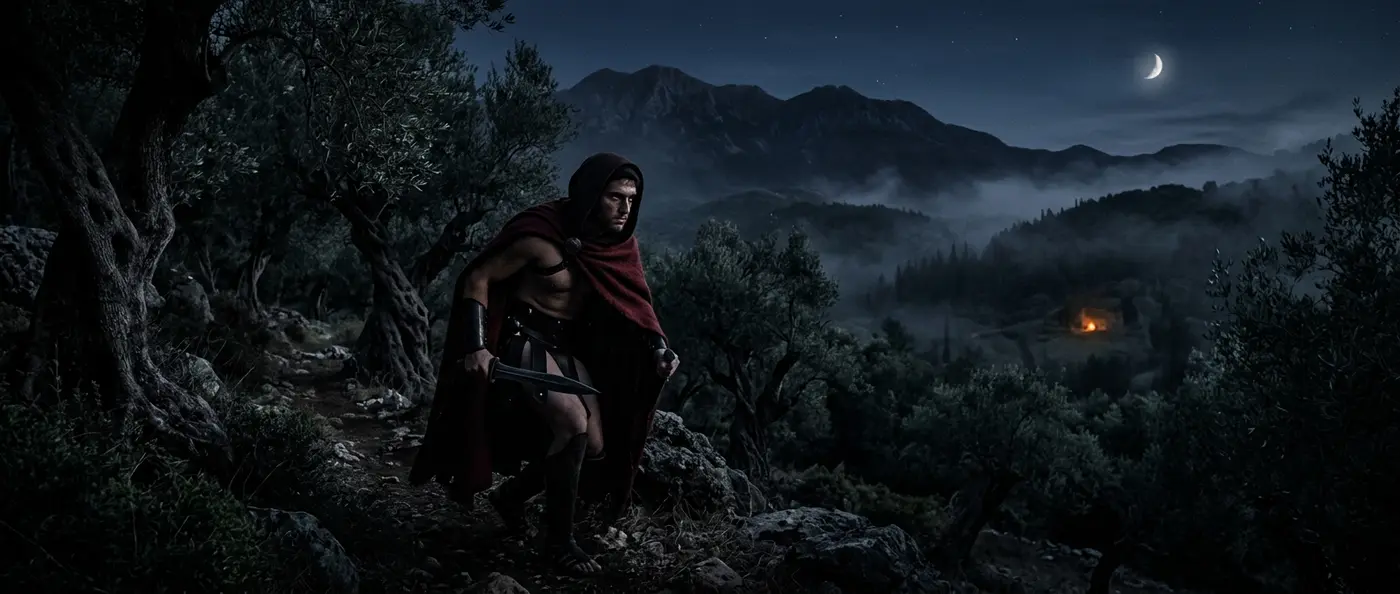
The participants, known as "kryptoi," were sent into the countryside with minimal equipment. They had to survive hidden during the day and move only at night. Their primary objective was surveillance and, when deemed necessary, the elimination of helots considered dangerous to the stability of the Spartan state.
The Krypteia served two brutal purposes: it completed the agoge by testing young warriors' survival skills, while simultaneously terrorizing the helot population that outnumbered Spartans by as much as seven to one.
⚔️ Training and Methods
Preparation for the Krypteia began in childhood through the agoge. Boys who demonstrated exceptional abilities in combat, endurance, and discipline were selected for this elite unit. The selection wasn't random — the authorities sought young men with specific characteristics that would make them effective killers.
During their service, the kryptoi had to develop skills that went beyond conventional military training. They learned to move silently, remain invisible, survive with minimal resources, and observe without being detected. The ability to live for extended periods in the countryside, feeding on what they found or stole, was crucial to their success.
The kryptoi hunted like wolves. They targeted isolated helots or small groups, avoided fair fights, and vanished into the darkness after each killing.
The Krypteia wasn't simply a military institution. It was a fundamental element of the Spartan system of control and order maintenance. In a society where helots outnumbered Spartans in a ratio that some historians estimate as high as 7 to 1, fear and suppression were necessary tools of governance.
The institution operated on multiple levels. First, it created a climate of constant terror among the helot population, who never knew when and from where the kryptoi might strike. Second, it preemptively neutralized potential rebellion leaders, targeting helots who stood out for their strength, intelligence, or leadership ability.
Simultaneously, the Krypteia served educational purposes. Young Spartans who passed through this ordeal gained valuable experience in unconventional warfare tactics, espionage, and survival. These skills proved useful in Sparta's military campaigns, where knowledge of terrain and ability to conduct covert operations could determine the outcome of a battle.
Surveillance
Continuous monitoring of helots to identify potential threats and gather intelligence about conditions in the countryside.
Security
Protection of the Spartan state from internal threats and prevention of helot uprisings through systematic terror.
Training
Final test of the agoge that transformed young men into complete warriors with specialized skills.
💀 Impact and Legacy
The Krypteia left deep marks on both Spartan society and historical memory. For the helots, it represented a constant threat that shaped every aspect of their daily lives. The knowledge that each night could be their last created a climate of perpetual fear that paralyzed any thoughts of resistance.
However, the institution had unexpected consequences. The violence and brutality it cultivated in young Spartans contributed to creating a society that, despite its military superiority, remained culturally stagnant. While other Greek cities flourished in arts and sciences, Sparta remained trapped in a cycle of violence and oppression.
📖 Read more: Ancient Thebes: Athens' Forgotten Rival That Ruled Greece
The long-term impact of the Krypteia on Spartan society was catastrophic. Dependence on violence as a means of control created a fragile system that eventually collapsed. When Sparta's military power began to wane, there were no other institutions or cultural foundations to support the society.
🔍 Historical Controversy
Ancient historians held conflicting views about the Krypteia. Plutarch described it as a necessary evil, while Aristotle condemned it as a barbaric practice that contradicted Greek values. This debate continues today among historians.
📜 Sources and Evidence
Our knowledge of the Krypteia comes mainly from later sources, as the Spartans left no written testimonies. Plutarch, writing in the 1st century AD, provides the most detailed description of the institution in his biography of Lycurgus. He describes how the ephors declared war on the helots each year, thus legitimizing the murders committed by the kryptoi.
Aristotle refers to the Krypteia in his "Politics," criticizing it as an example of excessive brutality. He notes that this institution revealed the fundamental weakness of the Spartan system — its dependence on violence to maintain order. Thucydides, while not explicitly mentioning the Krypteia, describes incidents of mass executions of helots that were likely related to its activities.
Modern historians have attempted to reconstruct the complete picture of the institution by combining these fragmentary sources. The lack of Spartan texts makes it difficult to fully understand the motives and methods of the Krypteia. However, its impact on Spartan society and its reputation as one of the harshest institutions of antiquity remain undisputed.
The Krypteia wasn't unique in the ancient world. Many civilizations developed similar mechanisms of control and suppression. In ancient Rome, the frumentarii functioned as secret police, gathering information and neutralizing threats to the state. In the Persian Empire, the "eyes and ears of the king" performed similar functions.
But the Krypteia was different — it turned mass murder into a graduation ceremony. Every young Spartan elite had to prove himself by killing helots to earn his place in society.
⚖️ Comparison of Secret Services
🏺 Decline and End
The Krypteia began losing its significance as Sparta itself entered a period of decline. After the defeat at Leuctra in 371 BC, Sparta's military supremacy was irreparably shaken. The loss of Messenia and the liberation of thousands of helots drastically reduced the need for such control mechanisms.
During the Hellenistic period, the reformist kings Agis IV and Cleomenes III attempted to revitalize Sparta's traditional institutions. However, the Krypteia wasn't included in their reforms. The social structure had changed so radically that the institution no longer had any reason to exist.
The final blow came with the Roman conquest. The Romans, while admiring certain aspects of Spartan tradition, didn't tolerate such autonomous institutions of violence. Sparta was transformed into a tourist attraction for wealthy Romans who wanted to see the descendants of the legendary warriors, but the Krypteia had vanished forever.
The institution's legacy survived only in the texts of historians and philosophers. For centuries, it was used as an example of the extremes to which a society can go when it relies exclusively on violence and fear. Modern scholars continue to analyze the Krypteia as a case study of state terrorism and social control mechanisms.