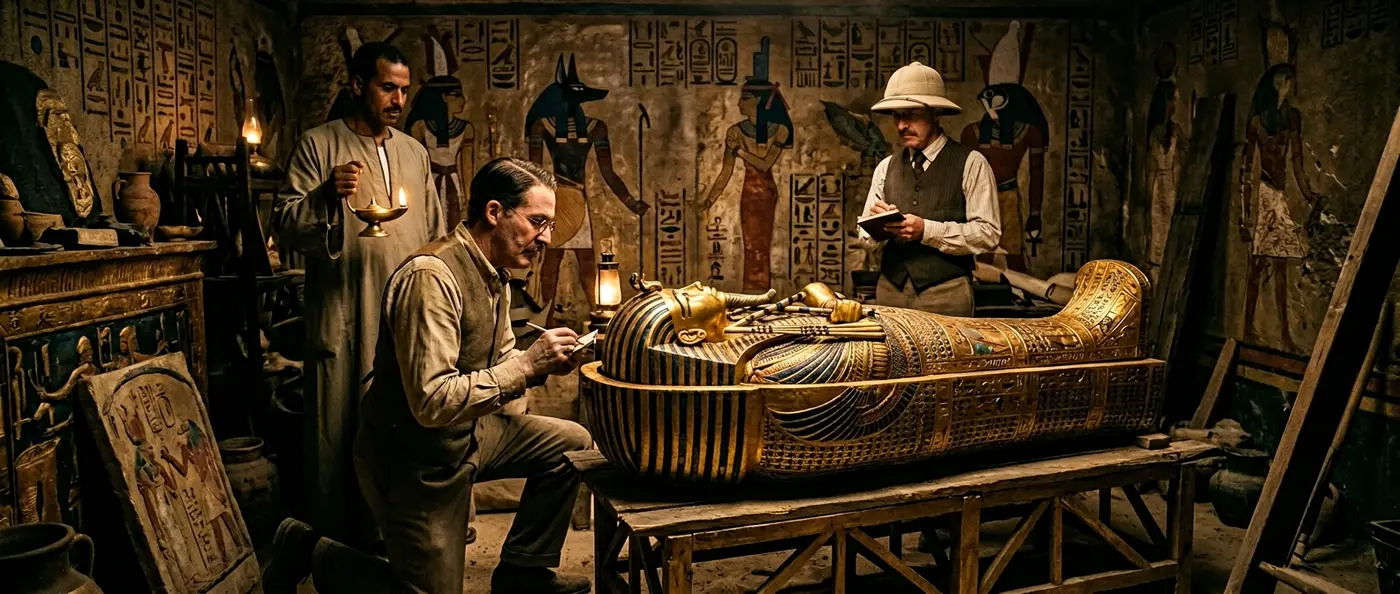
Hot knives sliced through a pharaoh's neck in November 1925. Three years after Howard Carter's team discovered Tutankhamun's tomb in Egypt's Valley of the Kings, they faced a problem: the boy king's mummy was fused to his golden coffin by hardened black resin. So they decapitated him. Then they hacked off his arms at the shoulders, elbows, and wrists. They severed his legs at the hips, knees, and ankles. They split his torso from pelvis to spine. When they finished, they glued the pieces back together and photographed the reconstructed corpse as if nothing had happened. For nearly a century, this brutal dismemberment remained buried in archival photographs while the public celebrated Carter's discovery.
🏺 The Pharaoh Who Died at 19
Tutankhamun — originally Tutankhaten — ascended Egypt's throne as a child, likely the son or close relative of Akhenaten, the heretic pharaoh who had upended Egyptian religion with worship of the sun disk Aten. After Akhenaten's death, the young king restored the traditional gods, renamed himself Tutankhamun (honoring the god Amun), and moved the capital back to Memphis. He married Ankhesenamun, Akhenaten's third daughter. His reign lasted barely a decade. Despite his youth, he restored Amun's temples that had been destroyed during the Amarna revolution. Medical analysis of his mummy in 2010 found traces of malaria parasites in his bones, combined with a degenerative bone disease — likely the causes of his death at 19. He died without an heir and was succeeded by Ay, his elderly advisor.
His tomb was small — probably a hastily converted burial chamber because his intended tomb was claimed by Ay. But precisely because it was small and its location quickly forgotten, it remained virtually untouched for over 3,000 years. Workers building Ramesses VI's tomb (20th Dynasty, c. 1190-1077 BCE) constructed stone shelters directly above its entrance, burying it under tons of rock and rubble. Tomb KV 62 had suffered some ancient robbery — there are traces of broken seals and resealing — but most objects remained in place, making it the best-preserved royal tomb in ancient Egypt. Until November 1922, when Carter's team located it after systematic searching in the Valley of the Kings, funded by Lord Carnarvon.
🔪 The Destruction: Hot Knives and Brute Force
It took years to clear the tomb's antechamber — a decade-long excavation in total. When Carter's team finally opened the innermost sarcophagus, they faced a nightmare: the pharaoh's body was cemented to the coffin by hardened, black, tar-like resin. This resin had been poured in massive quantities over the bandages during the burial ceremony about 3,300 years ago to protect the body from decomposition, but after three and a half millennia it had hardened like concrete. Carter wrote in his notes that the corpse was "firmly stuck" and that "no amount of legitimate force" could remove it.
Carter's team placed the sarcophagus in the desert sun at temperatures exceeding 120°F, hoping the heat would soften the resin. The method failed completely — the resin had undergone such deep chemical transformation that even African heat couldn't melt it. Then the team resorted to more violent methods: they used heated knives to cut through the resin between the head and the burial mask, decapitating the pharaoh in the process. What followed was systematic destruction. According to records at Oxford University's Griffith Institute, Tutankhamun was "decapitated, his arms separated at the shoulders, elbows and hands, his legs at the hips, knees and ankles, and his torso cut from the pelvis to the iliac crest." The pieces were glued back together to simulate an intact body — a macabre reconstruction that concealed the violence of the procedure.
Ancient Egyptian embalmers poured hot resin over mummy bandages as a final protective layer against decomposition. In Tutankhamun's case, so much was used that after 3,000 years, the resin polymerized and transformed into a black, hard mass — essentially a natural cement that fused sarcophagus, mask, and body into an inseparable whole. This chemical process was irreversible, making non-destructive removal practically impossible with 1925 technology.