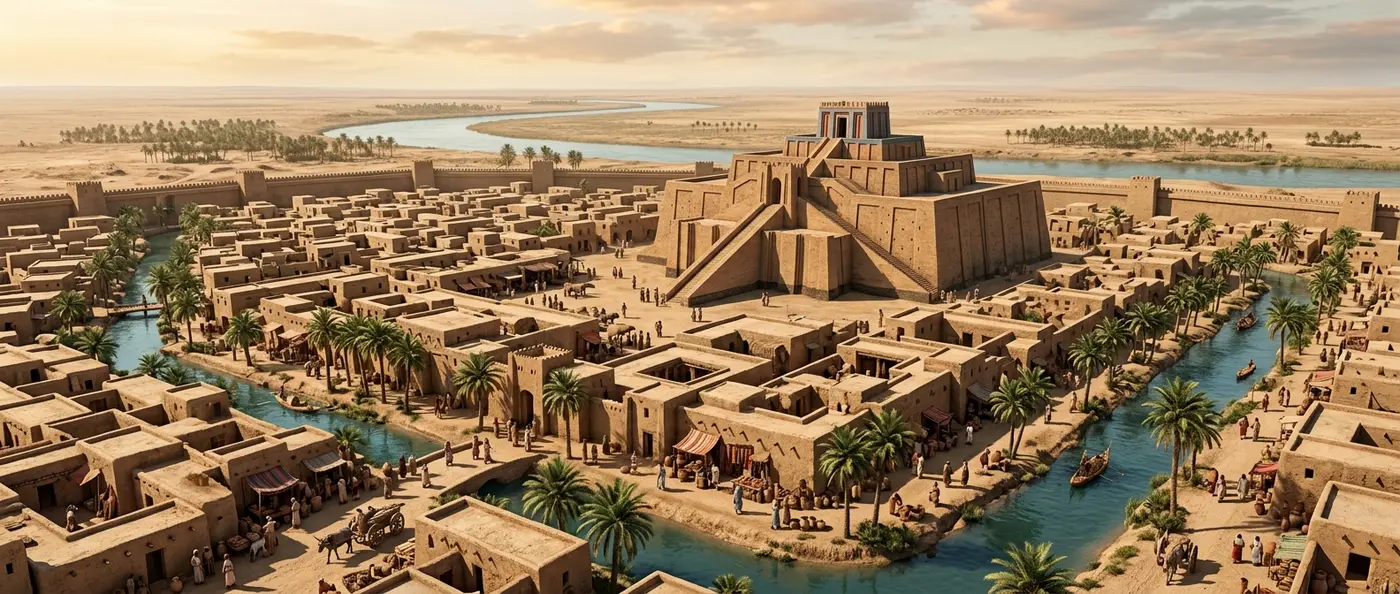
Picture walking down a street 6,000 years ago. Mud-brick buildings tower overhead. Thousands of people bustle through organized neighborhoods. A priest carves symbols into clay tablets. You're witnessing something that had never existed before in human history: the world's first cities. This was Mesopotamia — the place where everything changed.
🏛️ The Neolithic Revolution: Setting the Stage
Cities didn't just appear overnight. The story begins around 10,000 BC, when humans first started settling down. Humans were abandoning their nomadic hunter-gatherer lifestyle, but the transition took thousands of years.
In the valleys and mountains of Iran, Iraq, Anatolia, Syria, and Palestine, people began domesticating animals — sheep, goats, cattle, and pigs. They cultivated wild ancestors of grains and legumes: wheat, barley, lentils, and peas. This shift — the Neolithic Revolution — made cities possible.
Archaeological sites like Zawi Chemi Shanidar and Shanidar in northwestern Iraq show us what this looked like. Dating from the 10th to 9th millennium BC, these pre-pottery sites contained primitive grain-grinding stones, remains of huts about 4 meters in diameter, and cemeteries with burial goods.
The shift to permanent settlements had unexpected consequences. Child mortality dropped dramatically, leading to population growth. As settlements expanded, people began spreading from mountainous dispersal centers toward the plains. There, in the fertile floodplains between the Tigris and Euphrates rivers, the first cities took shape.
🌾 From Farming Villages to Urban Centers
Archaeologist V. Gordon Childe coined the term "urban revolution" to describe this transformation. He identified 10 criteria indicating urban civilization development: increased settlement size, wealth concentration, large-scale public works, writing, representational art, and knowledge of science and engineering.
While Childe's exact criteria weren't universal, certain features appear essential for urban life. The most crucial? The ability to produce storable food surpluses.
This surplus freed some people from food production. They could become craftsmen, priests, administrators, soldiers. Specialization meant interdependence. The potter needed the farmer's grain. The farmer needed the metalworker's tools. The priest needed everyone's offerings. Complex systems of exchange and redistribution emerged.
🏺 The Sumerians: History's First City Dwellers
Around 5000 BC, in southern Mesopotamia — later called Sumer — thousands of people began living together in organized cities. Thousands of people lived together in organized cities for the first time in human history. These weren't just large villages. They were something radically different.
These first cities had distinctive features. They had systems for exchanging and redistributing goods between specialized, interdependent zones. There was differentiated control of productive resources like land and animals. And they needed defense against raids or armed conflict.
The Sumerians created cities like Uruk, Ur, Lagash, and Eridu. Each city was an independent state with its own king, gods, and laws. At each city's center rose a ziggurat — a massive pyramid-shaped temple dedicated to the city's patron deity.
Uruk
Uruk: The era's largest city, with a population reaching 50,000 around 2900 BC. Writing was born here.
Ur
Ur: Famous for its royal tombs and magnificent ziggurat. Birthplace of the biblical Abraham.
Eridu
Eridu: Considered the world's oldest city. According to Sumerian mythology, kingship first descended from heaven here.
📜 Writing and Bureaucracy Are Born
As cities grew larger and more complex, a problem emerged. How do you track transactions, taxes, temple offerings? The answer came around 3200 BC with writing's invention in Uruk.
The first writing wasn't for poetry or stories. It was accounting. Sumerians carved symbols into clay tablets to record sheep deliveries to temples, barley stored in warehouses, workers laboring in fields. From these simple symbols evolved cuneiform script — humanity's first complete writing system.
Writing brought bureaucracy. Cities needed scribes, accountants, administrators. Schools were created to train scribes. For the first time, people existed who didn't produce food but managed and organized.
💡 Did You Know?
The word "bureaucracy" comes from the French "bureau" (office) and Greek "kratia" (rule). But bureaucracy itself was born in Mesopotamia, 5,000 years before these words existed!
⚔️ City-States in Constant Competition
Sumerian cities were never united under central authority. Each city-state was independent and often at war with neighbors. They fought for control of irrigation canals, fertile land, trade routes.
This constant competition drove innovation. Cities raced to build better tools, stronger armies, deeper canals. Kings tried to outdo each other by building larger temples, digging deeper canals, organizing greater campaigns.
One famous leader was Gilgamesh, king of Uruk around 2700 BC. His story, preserved in the Epic of Gilgamesh, gives us a picture of life in these first cities — walls protecting inhabitants, temples reaching skyward, markets where merchants from distant lands met.
🌍 The Urban Model Spreads
The urban revolution didn't stop in Mesopotamia. Like a spreading wave, the city concept traveled to other regions. In Egypt, cities appeared slightly later. In northern China, the Longshan culture people first urbanized around 2500 BC.
In the Indus Valley of South Asia, Mohenjo-daro and Harappa became major urban centers during the 5th millennium BC. In the Americas, the first known urban civilizations include the Olmecs in Mesoamerica (around 1100 BC) and Peru's Chavín (around 900 BC).
Each region developed its own version of urban life, adapted to local conditions and needs. But all shared common features — population concentration, labor specialization, surplus creation, art and technology development.
🗺️ First Cities Worldwide
🏗️ Foundations of the Modern World
You can't overstate this transition's significance from small farming settlements to the first cities. Almost everything we take for granted in modern life — from writing and laws to trade and art — has roots in these first urban communities of Mesopotamia.
The Sumerians gave us not just the first cities but the first schools, libraries, written laws, hospitals. They invented the wheel, the 12-month calendar, the time measurement system of 60 minutes and 60 seconds. Even the beer we drink today has roots in Sumerian breweries.
Walk through any city today — New York, Tokyo, Lagos — and you're experiencing an idea born in Mesopotamia 6,000 years ago. The mud-brick walls of Uruk became the glass towers of Manhattan. The clay tablets of Sumerian scribes became our smartphones. It all started there, on the banks of the Tigris and Euphrates.